326 East 18th Street
Gramercy | built 1853
Open on the map3 entries

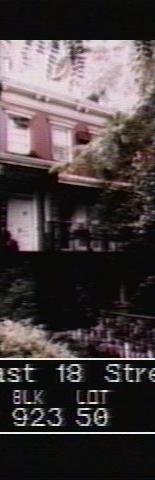
The city photographed every building for its tax records around 1940 and again in the 1980s. NYC Municipal Archives.
Written with AI from the source each entry cites, then fact-checked.
- 1852
Cornelia Ten Broeck leases her family's farmland for a row of houses
In 1852 Cornelia Stuyvesant Ten Broeck leased plots of her family's inherited farmland, once part of Peter Stuyvesant's 120-acre bouwerie, to builders on condition that they put up "good and substantial dwelling houses" of at least three stories in brick or stone. The lease produced a row of three Italianate houses at 326, 328 and 330 East 18th Street, each set back behind an unusually deep, iron-fenced front yard.
Source: Ephemeral New York
- 1853
Stonecutter Henry Wilson builds his own house at 326 East 18th Street
The Italianate house at 326 East 18th Street was finished in 1853 for stonecutter Henry Wilson, one of five developers who had leased the land the year before. Wilson became its first resident and partnered with John Edwards in the stone yard Wilson & Edwards. The house's cast-iron veranda and fence front a front yard that is unusually deep for Manhattan.
Source: Daytonian in Manhattan
- 1905
Detective John J. Cray is living at 326 East 18th Street
By 1905 police detective John J. Cray was living at 326 East 18th Street, and while he lived there he rose to lieutenant, captain, inspector and, in 1920, deputy commissioner. He died in the house in September 1925. A police escort that included 500 mounted officers carried his coffin from the house toward St. Patrick's Cathedral.
Source: Daytonian in Manhattan
Further reading
- The "Unexpected Surprise" at No. 326 East 18th StreetDaytonian in Manhattan
- Lovely houses and lush front yards on 18th StreetEphemeral New York
Nearby
- Beth Israel Petrie Division10 Nathan D Perlman Place | 7 entries
- Hotel 17225 East 17th Street | 3 entries
- St. George's Episcopal Church211 East 16th Street | 8 entries
- Friends Seminary and Meeting House222 East 16th Street | 15 entries
- St. George's Episcopal Church209 East 16th Street | 4 entries
- Town & Village Synagogue334 East 14th Street | 4 entries