Century Building
33 East 17th Street | also 38 East 18th Street | Flatiron | built 1881
Open on the map11 entries

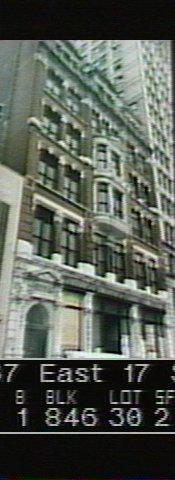
The city photographed every building for its tax records around 1940 and again in the 1980s. NYC Municipal Archives.
Written with AI from the source each entry cites, then fact-checked.
- 1867
Aaron Arnold buys the Union Square houses on the future Century Building site
In 1867 Aaron Arnold, founder of the Arnold Constable dry-goods firm, bought the Union Square houses that stood on the future site. He struck a deal with the neighboring Everett House hotel to keep a light court at the hotel's rear, which shows he meant to build a store there. He soon changed course and bought land at 19th Street and Broadway in April 1868, so the houses stayed standing.
“…an agreement made in 1867 with the owners of the Everett House that ensured the preservation of a light court at the rear of the hotel…”
- 1881
Arnold Constable & Company builds an unusual Queen Anne style office building
Arnold Constable & Company built the Century Building on East 17th Street in 1880-1881 at a cost of nearly $300,000, without lining up an anchor tenant in advance. Architect J. William Schickel designed it in the Queen Anne style, unusual for a commercial building, using red brick trimmed in Wyoming bluestone with fish-scale shingles, terra cotta panels, and a two-story oriel window.
Source: Daytonian in Manhattan
- 1881
The Century Company leases the fifth floor and gives the building its name
The publishing firm Century Company leased the fifth floor beginning in September 1881, calling its new quarters equal to an eight-story building on an ordinary lot and the finest offices on Union Square. From there it published The Century Magazine for adults and St. Nicholas Magazine for children. A rooftop sign erected in November 1882 made the Century name stick to the building.
Source: Wikipedia
- 1885
A single issue of The Century carries Twain, Howells and James
The Century Magazine, published from this building under editor Richard Watson Gilder, ran sections of three major novels in its February 1885 issue: Mark Twain's Huckleberry Finn, William Dean Howells's The Rise of Silas Lapham and Henry James's The Bostonians. A literary historian later called the issue a remarkable bargain for a quarter. The magazine's poetry also featured works by Walt Whitman and Herman Melville.
“…one memorable issue in February 1885 carried sections of Howell's The Rise of Silas Lapham, Twain's Huckleberry Finn and James' The Bostonians…”
- 1888
A glue pot sets the top floor ablaze and burns out the Century offices
On July 7, 1888, a workman went home leaving a gas jet lit beneath a glue pot, and the glue boiled over and set the floor ablaze. By morning the top floor and roof were destroyed, and firefighters had cut through all the ceilings so that the water would not bring them down. The fire gutted the Century Company's editorial and art rooms, and repairs to the building were put at about $195,000.
Source: Daytonian in Manhattan
- 1888
Two firefighters are caught stealing shirts and collars after the fire
After the July 1888 fire was out, John S. Little, an employee of the shirt seller Earl & Wilson, caught two firefighters from Engine Company No. 14, John Murphy and William Connors, stealing shirts and collars. Daytonian in Manhattan notes that the theft added a scandal to the fire. Earl & Wilson put its own damage at about $25,000.
Source: Daytonian in Manhattan
- 1893
The Century Company shows its Chicago World's Fair exhibit of historical manuscripts
In December 1893 the Century Company put on view in this building the display it had taken to the Chicago World's Fair. It included manuscripts by Lincoln, Grant, Oliver Wendell Holmes and Bret Harte, among them Lincoln's 1860 letter accepting his nomination and his corrected copy of the inaugural address. The show also had plaster casts of Lincoln's hands and face and the pencil Robert E. Lee used to correct the Appomattox surrender terms.
Source: Daytonian in Manhattan
- 1895
A runaway Indiana girl is found carrying this building's address on a sign
On August 14, 1895, young Minnie Noe left her home in Jeffersonville, Indiana, with a note saying she had gone to make her fortune. A neighbor, Hamilton Johnson, found her about a mile from home, carrying a satchel and a pasteboard sign reading 33 East Seventeenth Street, New-York. Daytonian in Manhattan cites the episode as a sign of the national prominence the tenants gave the address.
Source: Daytonian in Manhattan
- 1903
An electrical fire wrecks a rug dealer's stock, leading to a record rug auction
On August 9, 1903, a fire began in defective wiring on the floor occupied by the wholesale booksellers Baker & Taylor and spread to the Tavshanjian Rug Company's floor above. Firefighters stopped it before it reached the Century Company's offices. Tavshanjian's rugs, some from the 16th century, were burned or soaked, and within two months the owners auctioned the whole stock, reportedly the largest sale in the rug trade's history.
Source: Daytonian in Manhattan
- 1986
The city designates the Century Building a landmark
New York City designated the Century Building a landmark on October 7, 1986, after the Century Company had vacated in 1915 and decades of garment and toy-industry tenants had passed through. The building was added to the National Register of Historic Places in 1997. Its facade had survived two major fires, in 1888 and 1903, largely intact.
Source: Wikipedia
- 1995
A four-story Barnes & Noble opens after an award-winning restoration
Related Companies restored the Century Building's facade in 1994 and 1995 and converted the interior into a four-story Barnes & Noble bookstore, which opened by late 1995. The restoration work, done by Li/Saltzman Architects, earned a 1996 Preservation Award for Restoration from the Municipal Art Society for its careful treatment of the Queen Anne details.
Source: Wikipedia
Further reading
- Century Building (Union Square, Manhattan)Wikipedia
- The 1881 Century Building -- 33 East 17th StreetDaytonian in Manhattan
Nearby
- Everett Building200 Park Avenue South | 3 entries
- 860 Broadway4 entries
- Old Town Bar45 East 18th Street | 7 entries
- W New York Union Square201 Park Avenue South | 10 entries
- Tammany Hall44 Union Square East | 11 entries
- G. Schirmer Building35 Union Square | 7 entries