Old Town Bar
45 East 18th Street | Flatiron | built 1902
Open on the map7 entries

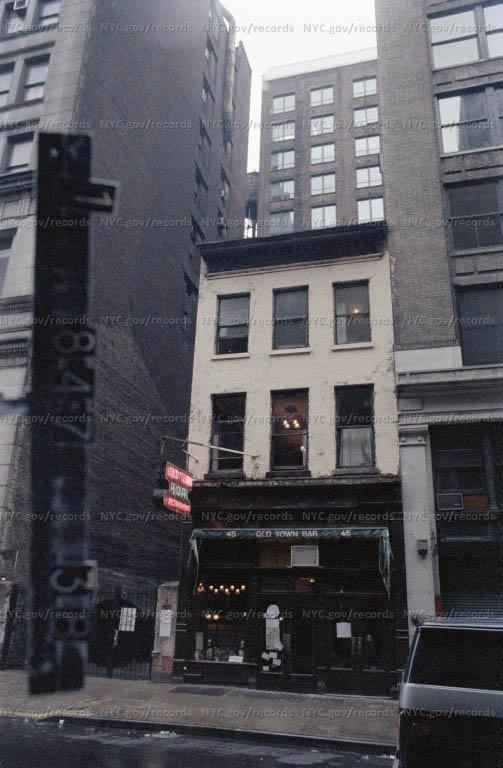
The city photographed every building for its tax records around 1940 and again in the 1980s. NYC Municipal Archives.
Written with AI from the source each entry cites, then fact-checked.
- 1905
A boy selling shoelaces, a patron who keeps a pair and a fake policeman end up arrested at the bar
On the evening of June 10, 1905, 13-year-old Isidor Rosenberg came into the saloon selling shoelaces. A patron, the Brooklyn etcher John Kroll, took a pair and did not give them back, and the boy sat crying outside. A bystander, W. J. Buckly, pretended to be an officer to haul Kroll away, then hid in the cellar until real patrolmen found him. All three were arrested, according to the Times as quoted by Daytonian.
Source: Daytonian in Manhattan
- 1910
Huge porcelain urinals are installed in the men's room
In 1910 the saloon fitted its men's room with large porcelain urinals. Winfield E. Hinsdale had designed and patented the deep fixtures in 1901 to stop splashing. Daytonian notes that the giant urinals were still in place when he wrote about the bar in 2010, part of the unaltered 19th-century character that makes the bar one of Manhattan's best surviving saloons.
Source: Daytonian in Manhattan
- 1920
Prohibition turns the bar into Craig's Restaurant, a regular stop for Al Smith
When Prohibition arrived in 1920, the saloon became Craig's Restaurant and, in Daytonian's words, essentially kept going as usual. Al Smith, whom Daytonian calls the dominant Democratic force in the state, stopped in regularly.
Source: Daytonian in Manhattan
- 1933
The Lohden family buys the bar after Prohibition and renames it the Old Town Bar
After Prohibition ended, the German-American Lohden family bought the bar in 1933 and gave it the name Old Town Bar. A neon sign went up out front in 1937. The place later fell into disrepair after the nearby 18th Street subway station closed on November 8, 1948.
“…the German-American Lohdens, bought the bar, changing the name to the Old Town Bar, and the neon sign was erected, in 1937.”
Source: Wikipedia
- 1952
The bar's pressed-tin ceiling is reportedly repainted for the last time while closed on Election Day
By mid-century the Old Town Bar belonged to Henry Lohden, who hung a neon sign outside but otherwise kept its 19th-century atmosphere. The pressed-tin ceiling, sixteen feet above the 55-foot mahogany bar, reportedly got its last coat of paint in 1952, on a day when the bar was shut for the election. Layers of history have been left to accumulate since.
Source: Daytonian in Manhattan
- 1987
Late Night with David Letterman starts using the bar in its opening montage
The Old Town Bar was part of the opening montage for Late Night with David Letterman between 1987 and 1992. The bar's nineteenth-century interior has also made it a screen favorite, with appearances in films such as The Devil's Own, State of Grace and Bullets over Broadway.
“…in the opening montage of Late Night with David Letterman from 1987 to 1992…”
Source: Wikipedia
- 1992
House of Pain films the video for Jump Around at the Old Town Bar
The rap group House of Pain shot a music video for its 1992 single Jump Around at the Old Town Bar. Madonna later used the bar for her 1993 Bad Girl video, and Whit Stillman used it in his 1998 film The Last Days of Disco.
“House of Pain for a music video for their 1992 single "Jump Around…”
Source: Wikipedia
Further reading
- Old Town Bar and RestaurantWikipedia
- The 1892 Old Town Bar - 45 East 18th StreetDaytonian in Manhattan
Nearby
- Century Building33 East 17th Street | 11 entries
- Everett Building200 Park Avenue South | 3 entries
- 860 Broadway4 entries
- Theodore Roosevelt Birthplace28 East 20th Street | 10 entries
- W New York Union Square201 Park Avenue South | 10 entries
- Parker Building225 Park Avenue South | 4 entries