33 Stuyvesant Street
East Village | built 1861
Open on the map3 entries

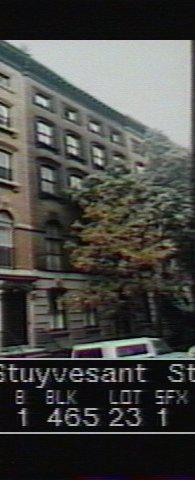
The city photographed every building for its tax records around 1940 and again in the 1980s. NYC Municipal Archives.
Written with AI from the source each entry cites, then fact-checked.
- 1861
An Anglo-Italianate house attributed to James Renwick Jr. is completed at 33 Stuyvesant Street
Developer Matthias Banta builds a row of five-story Anglo-Italianate houses on a triangular lot at Stuyvesant Street, and historians credit the design to James Renwick Jr. The houses stand on rusticated stone bases, with red brick upper floors trimmed in brownstone. Number 33, four bays wide, is among the widest when the row is completed in 1861, and it appears to open as a high-end boarding house, with an 1865 notice offering "elegantly furnished rooms to let."
Source: Daytonian in Manhattan
- 1890
Mary Jenkins dies after her clothing catches fire at a gas stove in the basement
Attorney Joshua B. Jenkins and his wife Mary buy the house in 1867. After he dies in 1872, she takes in roomers and by 1874 runs a full boarding house. On October 23, 1890, the 70-year-old Mary dozes in an armchair beside a gas stove burning high in the basement dining room, and evidence suggests her clothing caught fire, sending her running around the table before she fell in the kitchen and struck her head on the stove.
Source: Daytonian in Manhattan
- 1920
Composer Henry Cowell lives at 33 Stuyvesant Street
Among the residents in the early 1920s is the composer and musician Henry Cowell. Born in 1897, he founds the New Music Society in 1924 and is remembered as one of the country's most influential composers.
Source: Daytonian in Manhattan
Further reading
- The Joshua B. Jenkins House - 33 Stuyvesant StreetDaytonian in Manhattan
- 33 Stuyvesant StreetVillage Preservation: East Village Building Blocks
Nearby
- 31 Stuyvesant Street2 entries
- 35 Stuyvesant Street3 entries
- 122 East 10th Street1 entry
- 124 East 10th Street1 entry
- 29 Stuyvesant Street2 entries
- 126 East 10th Street1 entry