35 Stuyvesant Street
East Village | built 1861
Open on the map3 entries

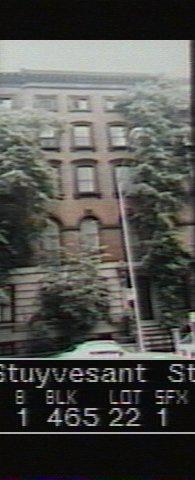
The city photographed every building for its tax records around 1940 and again in the 1980s. NYC Municipal Archives.
Written with AI from the source each entry cites, then fact-checked.
- 1861
James Renwick Jr. completes an Anglo-Italianate house on the triangular Stuyvesant block
After East 10th Street is opened through in 1826, Stuyvesant Street leaves an odd triangular parcel, which Matthias Banta buys for development. Historians attribute the resulting row to James Renwick Jr., architect of Grace Church a few blocks west. The Anglo-Italianate houses, completed in 1861, have rusticated brownstone lower floors under red brick trimmed in brownstone, and they range from 16 to 32 feet wide.
Source: Daytonian in Manhattan
- 1863
Margaret VanDuzer runs the house as an upscale boarding house
Margaret Russell VanDuzer, who most likely leases the house, runs it as an upscale boarding house for a limited number of residents. In 1863 her boarders are the families of the dry-goods merchants John Joseph Clarke and Benjamin Constable. The widow Eliza A. Roe takes over in 1871, and another widow, Clara A. Dunbar, runs the boarding house by 1876.
Source: Daytonian in Manhattan
- 1958
Arts educator Lee B. Anderson buys the house and fills it with Gothic Revival pieces
Lee B. Anderson, an arts education teacher who collects Gothic Revival American furniture, buys the house in 1958 and fills it with Civil War era paintings and furnishings. He carefully tends the wisteria vine that climbs the facade, which earns him a 2003 Village Preservation Award. When he dies in 2010, he leaves the Lee B. Anderson Memorial Foundation to support institutions that advance the appreciation of decorative arts.
Source: Daytonian in Manhattan
Further reading
- The 1861 Lee B. Anderson House - 35 Stuyvesant StreetDaytonian in Manhattan
- 35 Stuyvesant StreetVillage Preservation: East Village Building Blocks
Nearby
- 126 East 10th Street1 entry
- 128 East 10th Street4 entries
- 33 Stuyvesant Street3 entries
- 124 East 10th Street1 entry
- 122 East 10th Street1 entry
- 31 Stuyvesant Street2 entries