Pier 40
343 West Street | West Village | built 1960
Open on the map10 entries

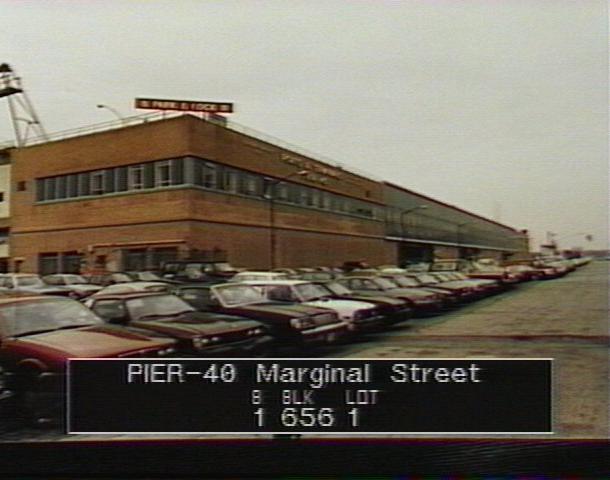
The city photographed every building for its tax records around 1940 and again in the 1980s. NYC Municipal Archives.
Written with AI from the source each entry cites, then fact-checked.
- 1950
Five separate finger piers, numbered 37 to 41, stand where Pier 40 will be built
Before the big terminal, the waterfront here was five city-owned finger piers: Pier 37 at Charlton Street, 38 at King, 39 at West Houston, 40 at Clarkson and 41 at Leroy. Early in the twentieth century they were used by the Southern Pacific, the Delaware, Lackawanna and Western Railroad and the Atlantic Transport Line. By the 1950s the Lackawanna and the Baltimore and Ohio Railroad were the main users. This was an earlier set of buildings on the site.
Source: Wikipedia
- 1958
City dignitaries sail by tugboat to pour the first concrete for the new Pier 40
In 1958 more than 100 businessmen, labor leaders and city officials rode the tugboat Cynthia Moran to the old Pier 38 at King Street for a ceremony marking the first concrete pour. The Department of Marine and Aviation, then the city's own port-development agency, designed and built the project. Instead of a finger jutting into the river, it was a fifteen-acre square, so several large liners and smaller cargo ships could dock at once.
Source: Village Preservation
- 1962
Pier 40 opens as the Holland America Line's New York terminal on a 20-year lease
The new terminal began operating in 1962 under a 20-year lease to the Holland America Line, which agreed to pay more than $1.2 million a year in rent. The shipping company relocated its offices from the Financial District to the pier. It was the first terminal of its kind built by the city itself, and in its first year it served more than 2,000 passengers a day.
Source: Wikipedia
- 1962
A hollow square of three decks lets trucks, taxis and passengers load off the street
The terminal was laid out as a big hollow square with three levels, meant to keep cars and trucks off neighborhood streets. The ground floor handled cargo, with a central courtyard that could hold up to 350 trucks at once. The second floor served passengers, with a furnished waiting room and a curb for taxis, while the roof held parking for more than 700 cars, linked by ramps. The pier reaches 810 feet into the Hudson on over 3,500 steel piles.
“…designed as a "massive hollow square" with three levels to accommodate cars, taxis, and commercial trucks ... roof served as parking for over 700 cars…”
Source: Wikipedia
- 1971
Holland America quits transatlantic passenger service and the pier soon becomes a parking garage
The terminal was built for old-style break-bulk cargo and ocean liners, and it was nearly obsolete on arrival. Container shipping was moving to Elizabeth, New Jersey, and jets were emptying the liners. Holland America ended its transatlantic passenger service in 1971 and sold its cargo division in 1973. The pier then became mostly a place to park vehicles, including for Village residents who couldn't find spaces elsewhere.
Source: Village Preservation
- 1998
The Hudson River Park Act makes Pier 40 part of a park and puts the Trust's offices there
The Hudson River Park Act, passed by the state legislature in 1998, marked out the park and created the Hudson River Park Trust to run it. The Trust set up its own offices inside Pier 40. Over the following years the three-acre central courtyard was converted into two full-size soccer fields that can also serve for baseball.
Source: Village Preservation
- 2008
The Hudson River Park Trust rejects a $700 million entertainment complex proposed for Pier 40
In 2007 the Related Companies proposed an entertainment complex of about 600,000 square feet with 10,000 seats and a cost near $700 million for the pier. Critics nicknamed it Vegas-on-the-Hudson, and the Greenwich Village Society for Historic Preservation worked with the Pier 40 Partnership to voice opposition over traffic and the commercialization of the park. In early 2008 the Hudson River Park Trust rejected the proposal.
Source: Village Preservation
- 2012
Pier 40's ball fields reopen after Hurricane Sandy floods the building under more than 12 feet of water
Hurricane Sandy closed Pier 40 in 2012 after more than 12 feet of water surged over it. On December 19 the fields reopened, after a $50,000 donation paid to repair the damaged turf. Full power did not come back until spring 2013.
“…the pier was closed after being engulfed by more than 12 feet (3.7 m) of water. The fields reopened on December 19 following a $50,000 donation…”
Source: Wikipedia
- 2016
City Council approves the St. John's Terminal rezoning that ties in Pier 40 repair money and air-rights limits
On December 15, 2016, the City Council voted for a rezoning of the site of St. John's Terminal, at West and Houston Streets near the pier. Village Preservation said the deal added limits on transferring Hudson River Park air rights and removed big-box and destination retail from the project. The group also said that, without the deal, there would have been no money for repairs to Pier 40 and its playing fields.
Source: Village Preservation
- 2019
Artist ESPO paints "I Want to Thank You" across Pier 40's south facade for the Global Fund
In the fall of 2019 West Village artist Stephen Powers, known as ESPO, painted a large message on the south side of the terminal. It was part of an international campaign for the Global Fund against AIDS, tuberculosis and malaria, with companion murals in Washington, London, Paris and Berlin. Powers called it a dedication to the Paradise Garage nightclub and to the artist David Wojnarowicz.
Source: Village Preservation
Further reading
- Pier 40Wikipedia
Nearby
- St. John's Terminal550 Washington Street | 10 entries
- Thaddeus Davids Company Building95 Vandam Street | 6 entries
- Urban Glass House330 Spring Street | 5 entries
- James Brown House (Ear Inn)326 Spring Street | 4 entries
- 187 Christopher Street3 entries
- Charles C. Dyer House and Store510 Greenwich Street | 5 entries