James Brown House (Ear Inn)
326 Spring Street | Hudson Square | built 1817
Open on the map4 entries

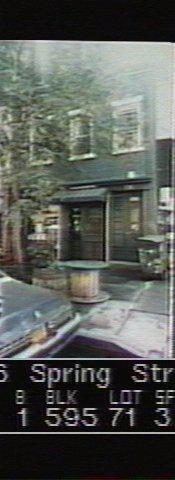
The city photographed every building for its tax records around 1940 and again in the 1980s. NYC Municipal Archives.
Written with AI from the source each entry cites, then fact-checked.
- 1817
James Brown's brick house appears on Spring Street near the Hudson shore
The first city record of this two-and-a-half-story Flemish-bond brick house dates to 1817. Its owner, the African American James Brown, ran a tobacco store on the ground floor. When it was built, the house stood only a few feet from the Hudson River shoreline, which landfill has since pushed away. A tavern occupied the shop from at least 1835, making it one of the oldest taverns in the city.
Source: Wikipedia
- 1919
Tavern owner Thomas Cloke sells the Spring Street building ahead of Prohibition
Irish immigrant Thomas Cloke, who bought the Spring Street building in 1890 to run a tavern serving sailors and dockworkers, sells the property in 1919 just before Prohibition takes effect. The new owners keep serving liquor illegally behind a restaurant front, while the upper floors reportedly double as a boarding house, a smugglers' den, and a brothel.
Source: Daytonian in Manhattan
- 1969
The city designates the James Brown House a landmark
The New York City Landmarks Preservation Commission designates the 1817 James Brown House at 326 Spring Street an individual landmark on November 19, 1969. The Federal-style brick building was built for James Brown, an African American Revolutionary War veteran who ran a tobacco shop on its ground floor, and it stood only a few feet from the Hudson River shoreline at the time. It is added to the National Register of Historic Places in 1983.
Source: Wikipedia
- 1977
Rip Hayman paints over a neon sign and names the Ear Inn
In 1977 the bar's new proprietor, Rip Hayman, painted out part of the letter B in its "Bar" sign so that it read "Ear," a nod to a music magazine published upstairs, and the place has been the Ear Inn ever since. The Landmarks Preservation Commission had designated the house on November 19, 1969.
Source: Wikipedia
Further reading
- James Brown House (Manhattan)Wikipedia
- The 1817 James Brown House - 326 Spring StreetDaytonian in Manhattan
- Ear Inn (in the James Brown House)Place Matters
Nearby
- Urban Glass House330 Spring Street | 5 entries
- Charles C. Dyer House and Store510 Greenwich Street | 5 entries
- 488 Greenwich Street House488 Greenwich Street | 5 entries
- 486 Greenwich Street House486 Greenwich Street | 9 entries
- Dennison and Lydia Wood House310 Spring Street | 5 entries
- 504 Canal Street House504 Canal Street | 9 entries