Charles C. Dyer House and Store
510 Greenwich Street | Hudson Square | built 1899
Open on the map5 entries

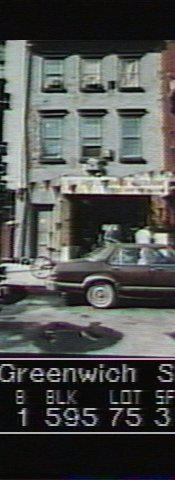
The city photographed every building for its tax records around 1940 and again in the 1980s. NYC Municipal Archives.
Written with AI from the source each entry cites, then fact-checked.
- 1831
A three-story Greek Revival house with a ground-floor shop is first advertised
In 1831 a three-story brick house with a shop on the ground floor is first advertised at 510 Greenwich Street, part of a shopping thoroughfare that grew up as the city pushed north past the newly created Canal Street. Its builder, likely drawing on style books, chose the emerging Greek Revival look, with a flat roof in place of the Federal peaked roof and dormers, but kept a Federal arched entrance with a fanlight for the residence upstairs.
Source: Daytonian in Manhattan
- 1836
Tool dealer Charles C. Dyer buys the building, lives upstairs and sells carpenters' tools below
Charles C. Dyer, born in Maine in 1807, buys the property in 1836, moves his family into the upper floors and runs a tool store below that supplies the building trade. A longtime member of the old Spring Street Church, he studied the Bible and Christian history so closely that he drew four topographical views of Jerusalem by hand, which, the New York Times later wrote, he loved showing to visitors. The Whig and Reform ticket put him up for City Inspector in 1855.
Source: Daytonian in Manhattan
- 1864
Michael Shonborn buys the building and runs a hardware store here until his 1897 retirement auction
Michael Shonborn buys 510 Greenwich Street in 1864 and opens a hardware store in the shop, living upstairs with his family; his son Edward is born in the house in 1877 and later makes deliveries for him. A new storefront goes in during May 1889. After Shonborn retires in 1897, an auction on December 20 sells the store's hardware and tools along with its showcases, counters and shelving.
Source: Daytonian in Manhattan
- 1943
Treasury agents raid the grocery's basement, find a wine press and seize vinegar stock
By 1941 a grocery occupies the ground floor, but it is the activity in the basement that attracts federal attention. On November 16, 1943, Treasury Department agents descend on the store, discover a wine press and take away about 619 and a half gallons of vinegar stock. Two years later the Alcohol Tax Unit announces that, on January 8, 1945, about 175 gallons of what was called wine had been seized at the address.
Source: Daytonian in Manhattan
- 1998
Pintxos, one of just two Basque restaurants in Manhattan, opens in the old shop
The ground-floor shop where Charles Dyer once sold and sharpened saws housed the Sun Lin Chinese restaurant in 1988. In 1998 it becomes Pintxos, billed as a rare Basque restaurant, one of only two in Manhattan. Pintxos survives at least through 2005, after which the building is renovated into a single-family home.
Source: Daytonian in Manhattan
Further reading
- The Charles C. Dyer House and Store - 510 Greenwich StreetDaytonian in Manhattan
Nearby
- James Brown House (Ear Inn)326 Spring Street | 4 entries
- Urban Glass House330 Spring Street | 5 entries
- 488 Greenwich Street House488 Greenwich Street | 5 entries
- Dennison and Lydia Wood House310 Spring Street | 5 entries
- 486 Greenwich Street House486 Greenwich Street | 9 entries
- Former Half Note jazz club289 Hudson Street | 8 entries