354 West 11th Street House
354 West 11th Street | West Village | built 1842
Open on the map7 entries

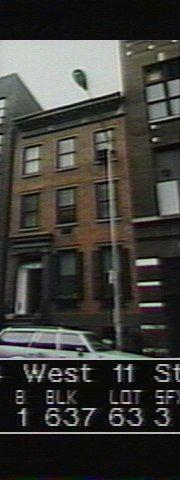
The city photographed every building for its tax records around 1940 and again in the 1980s. NYC Municipal Archives.
Written with AI from the source each entry cites, then fact-checked.
- 1838
A milkman's house of about 1828 stands here until a soap-factory fire hits the block
An earlier house stood on this lot at what was then 144 Hammond Street, built about 1828 by the cartman and milkman Jonathan Lounsberry. It passed to a New Jersey buyer in 1830 and to the lawyer James Agnew in 1832. A fire at a soap factory behind No. 160 in 1838 destroyed about 50 buildings on the block, and the 1841 tax rolls list Agnew's lot with no building.
- 1841
A carver of composition ornament buys the lot, starts the house, and loses it to foreclosure
William B. Fash, who made carved composition ornament at 192 Varick Street, bought the lot in October 1841 for $2,250. The 1842 tax rolls called his house unfinished, and he was living on Greenwich Street. In April 1843 a foreclosure suit ended with the Greek Revival rowhouse sold at auction for $3,325 to the attorney Edwin L.B. Brooks, who never lived in it and leased it to tenants.
- 1854
Susan B. Anthony's uncle Joshua Read buys the house and rents it out
In 1854 the house was bought by Joshua Read, a prosperous farmer and businessman from Palatine Bridge, New York. He was the brother of Lucy Read Anthony and so uncle to the future women's rights leader Susan B. Anthony; he had helped the Anthony family after it was ruined in the Panic of 1837. The Read family never lived here. They rented the house, including to a clerk named David Lockwood in 1856-62.
- 1870
The grocer Friedrich Knubel's family moves in, and his son becomes a national Lutheran leader
Friedrich C. Knubel, a German-born grocer who arrived in 1855, bought the house in 1866 and lived in it from 1870 to 1875, extending it about 11 feet at the rear in 1871. His son Frederick Hermann Knubel was born in 1870, the year the family moved in. He later led the United Lutheran Church in America as its first president, from 1918 to 1945. The family owned the house until 1923.
- 1963
The jazz pianist John Mehegan owns and lives in the house
From 1963 to 1965 the owner and occupant was John F. Mehegan, a jazz pianist, recording artist and author who taught at Juilliard from 1947 to 1964. His four-volume Jazz Improvisation became a widely used text. He had written and played the score for Tennessee Williams's A Streetcar Named Desire, which he performed offstage during its 1947 Broadway run.
“John F. Mehegan (1916-1984), a noted jazz pianist, recording artist, teacher (including Juilliard, 1947-64), and author of numerous books…”
- 1988
The photographer Neil Selkirk, the sole printer of Diane Arbus's work, buys the house
In 1988 the house was sold to Neil and Susan Selkirk. Neil Selkirk is a London-born photographer who works in portraits, advertising and corporate photography and has taught at Parsons School of Design. The 2007 landmark report notes that since Diane Arbus died in 1971, he has been the only person authorized to print her photographs.
“He has been the sole person authorized to print the work of photographer Diane Arbus since her death in 1971.”
- 2007
The Landmarks Commission designates the house as a rare Greek Revival survivor on the far west waterfront
On March 6, 2007, the Landmarks Preservation Commission designated the house, following a November 2006 hearing at which thirteen people spoke in favor and one owner opposed. The report calls it one of the best surviving Greek Revival rowhouses of the 1830s-40s along the Hudson waterfront, noting its three stories, machine-pressed red brick in stretcher bond, wrought-iron stoop railings and brownstone lintels.
“Thirteen people spoke in favor of designation ... One of the owners spoke in opposition to designation.”
Nearby
- Palazzo Chupi360 West 11th Street | 10 entries
- Fleischmann Company building695 Washington Street | 5 entries
- 140 Perry Street4 entries
- Belvedere Stables727 Washington Street | 6 entries
- Garret Forbes House136 Bank Street | 4 entries
- 693 Washington Street1 entry