397 Washington Street
also 28 Hubert Street | Tribeca | built 1896
Open on the map5 entries

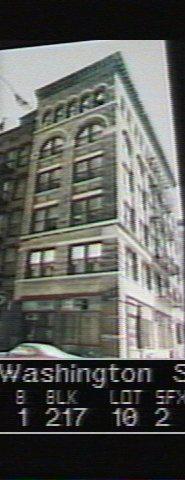
The city photographed every building for its tax records around 1940 and again in the 1980s. NYC Municipal Archives.
Written with AI from the source each entry cites, then fact-checked.
- 1886
A laborer steals an old man's tin box of gold coins from the attic of 28 Hubert Street
In October 1886 laborer John Ellis, who rented a room in the old wooden house at 28 Hubert Street, saw Thomas Sullivan, a man in his seventies who lived in the attic, fingering gold coins from a tin box. The hoard was worth about $52,000 in today's money. Once Sullivan stepped out, Ellis climbed down through the window with the box. The house was later demolished for the present building, so this was an earlier building on the site.
Source: Daytonian in Manhattan
- 1896
George F. Pelham designs a six-story loft building for Gustavus L. Lawrence, who sells it on completion
Produce merchant Gustavus L. Lawrence bought three old buildings in 1895 and hired architect George F. Pelham to replace them with a six-story loft on a 28-by-78-foot site. Pelham combined Renaissance and Romanesque Revival motifs, with beige brick above a red-brick ground floor, three-story arches and a brick chain pattern in the frieze. On April 30, 1896, right after completion, Lawrence sold it to liquor dealer Joseph H. Bearns, who held it as an investment.
Source: Daytonian in Manhattan
- 1901
Sherwin-Williams makes marine paints here and wins contracts from the U.S. Navy
Bearns leased the new building to Sherwin-Williams, a paint and varnish company based in Cleveland, which appears to have used its New York factory mainly for marine paints. In 1896 it advertised vessel paints in Beeson's Marine Directory, and in 1901 it won lucrative contracts with the United States Navy. A Sun reporter who visited on November 6, 1908 found the works busy as business recovered after the Panic of 1907.
Source: Daytonian in Manhattan
- 1914
Importers La Manna, Azema & Farnam can and bottle olive oil, sardines and mushrooms here
Around 1914, when Sherwin-Williams left, the grocery importers La Manna, Azema & Farnam took over the building. They brought in Italian and Spanish goods in bulk, then canned and bottled them on site under their own brand names, such as Francois mushrooms and Mary Elizabeth sardines. Its 1918 newspaper ads sought only women for the bottling department, and the firm remained into the Depression years.
Source: Daytonian in Manhattan
- 1984
The old warehouse becomes a co-op, and the Civitella Ranieri Center later sets up an office
By 1982 the building was being converted to cooperative apartments, with the architect Ekkehart Schwartz serving as president of the co-op board. The conversion was finished in 1984, leaving one residence per floor. By 2005 the Civitella Ranieri Center, which was founded in 1993 as a place where artists, writers and composers from many countries could work, was based in the building.
Source: Daytonian in Manhattan
Further reading
- The Sherwin-Williams Co. Bldg - 397 Washington StreetDaytonian in Manhattan
Nearby
- Max Ams Building399 Washington Street | 4 entries
- 408 Greenwich Street6 entries
- Ragus Tea & Coffee Company warehouse73 Laight Street | 3 entries
- 250 West Street2 entries
- Morrison & Boinest Co. Building413 Greenwich Street | 6 entries
- Sun Warehouse79 Laight Street | 3 entries