Max Ams Building
399 Washington Street | Tribeca | built 1888
Open on the map4 entries

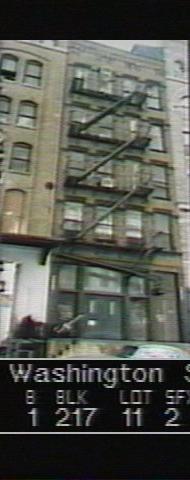
The city photographed every building for its tax records around 1940 and again in the 1980s. NYC Municipal Archives.
Written with AI from the source each entry cites, then fact-checked.
- 1888
Canner Max Ams buys the lot and has William Graul design a five-story building
Max Ams, a German-born canner who came to New York in 1866, bought the 25-by-80-foot lot in 1882 for $7,800. Six years later he put up a five-story building designed by William Graul, with a simple cast-iron base under red-brick neo-Grec upper stories. It seems to have been an investment that failed: on January 4, 1890 Ams bought it back in foreclosure for $21,000.
Source: Daytonian in Manhattan
- 1888
The Landmarks Commission describes the building as a stable with stalls below and lofts above
The Landmarks Preservation Commission's report on the Tribeca North Historic District classifies 399 Washington Street as a stable. Originally the basement held stalls, the first floor was used as a wagon room, and lofts for storage filled the upper floors. The commission thinks Max Ams probably used it as a support facility for his food businesses, and his heirs owned it until 1935.
“Originally, stalls were located in the basement, the first story was used as a wagon room, and the upper floors were storage lofts.”
- 1893
A Chicago judge rules the "Jam Trust" co-founded by building owner Max Ams unconstitutional
In 1888 Max Ams joined six other jam makers to found the American Fruit Preserving Association. Within a decade it controlled 80 percent of the business and was nicknamed the Jam Trust. After a March 1892 petition from investors, one of them very young, who said they had bought stock without full knowledge of the concern, a Chicago judge ruled it unconstitutional. The Evening World reported on June 15, 1893 that a small boy had won a great victory.
Source: Daytonian in Manhattan
- 1933
Steinhardt & Kelly, a fruit firm that began with a pushcart partnership, becomes the long-term tenant
In March 1933 the fruit wholesaler Steinhardt & Kelly moved into 399 Washington Street. Founder Joseph H. Steinhardt, born in Germany in 1854, crossed the ocean at 13 and began by selling apples door to door. He later bought a pushcart and ended a daily feud with an Irish vendor named Kelly by proposing a partnership. He died on December 10, 1926, when the firm did more than $15 million of business a year, and the company stayed in the building through the 1970s.
Source: Daytonian in Manhattan
Further reading
- The Max Ams Building - 399 Washington StreetDaytonian in Manhattan
Nearby
- 397 Washington Street5 entries
- Ragus Tea & Coffee Company warehouse73 Laight Street | 3 entries
- 408 Greenwich Street6 entries
- 250 West Street2 entries
- 74 Laight Street3 entries
- Sun Warehouse79 Laight Street | 3 entries