Mount Vernon Hotel Museum
421 East 61st Street | also 419 East 61st Street | Lenox Hill | built 1799
Open on the map12 entries

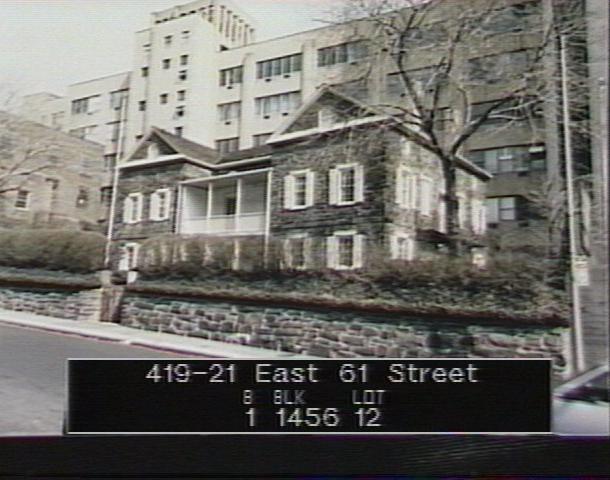
The city photographed every building for its tax records around 1940 and again in the 1980s. NYC Municipal Archives.
Written with AI from the source each entry cites, then fact-checked.
- 1799
A stone carriage house goes up on land first planned as an estate for Abigail Adams Smith
The estate on this land was originally planned in 1795 for Colonel William S. Smith and his wife, Abigail. The building that survives was put up instead in 1799 as the carriage house and stable for the nearby estate of William T. Robinson.
Source: Wikipedia
- 1826
Joseph Coleman Hart turns the carriage house into the Mount Vernon Hotel
In 1826 Joseph Coleman Hart bought the building and converted it into a day hotel, the Mount Vernon Hotel. It operated until 1833, when Jeremiah Towle bought the property and turned it into a private residence.
Source: Wikipedia
- 1826
A fire destroys the estate's mansion, which is never rebuilt, leaving the stable standing
Fire destroyed the mansion of the 23-acre estate on which this stable stands, a farm that Colonel William S. Smith had called Mount Vernon on the East River and that was nicknamed Smith's folly. The mansion was never rebuilt. The stone stable survived and later became the headquarters of the Colonial Dames of America.
“…the mansion burned down in 1826 and was never rebuilt…”
- 1829
Scottish traveler James Stuart stays at the Mount Vernon Hotel
James Stuart, a Scottish diarist, stayed at the Mount Vernon Hotel in 1829 while Joseph Coleman Hart ran it, and described the visit in Three Years in North America, published in 1833. The hotel was one of more than 50 day hotels in or near the city, drawing middle-class guests with boating trips, unusual exhibitions and social events.
“Stuart recorded his 1829 stay at the Mount Vernon Hotel in his Three Years in North America (1833).”
Source: Wikipedia
- 1833
Jeremiah Towle buys the former hotel as a private residence
Jeremiah Towle buys the former day hotel and converts it into a private home. His family keeps the house as their residence for the next 70 years, while the once-rural neighborhood around it grows increasingly industrial.
Source: Wikipedia
- 1905
Standard Gas Light Company buys the property and builds gas tanks nearby
Towle's daughters sell the property to Standard Gas Light Company, which puts up gas storage tanks nearby as the once-rural block industrializes. The stone building itself survives; antiquarian Jane Teller restores it as an antiques shop in 1919 before the Colonial Dames of America buy it in 1924.
Source: Daytonian in Manhattan
- 1919
Antiquarian Jane Teller leases the house and shows early American furniture in it
In 1919 Jane Teller, who headed the Society of American Antiquarians, leased the old stone house as her headquarters and restored its interior. She showed early American furniture there and held workshops in colonial crafts. Her tenancy came five years before the Colonial Dames bought the house.
Source: mvhm.org
- 1924
The Colonial Dames of America buy the house as their headquarters, saving it from destruction
In 1924 the Colonial Dames of America bought the building for their headquarters. The Landmarks Preservation Commission later credited the society with saving it from destruction, praising the result as a Federal-style stone stable converted into a headquarters, with rock-faced masonry on the lower floor and brickwork around its round windows.
- 1939
The Colonial Dames open the house as the Abigail Adams Smith Museum
The Colonial Dames of America bought the building in 1924 as their headquarters and opened it to the public in 1939 as the Abigail Adams Smith Museum. It is now the Mount Vernon Hotel Museum and has been a city landmark since January 24, 1967.
Source: Wikipedia
- 1967
The city designates the Mount Vernon Hotel a landmark
The Landmarks Preservation Commission designates the building, by then known as the Abigail Adams Smith Museum, a New York City landmark. The site is added to the National Register of Historic Places in 1973 and the New York State Register in 1980, cementing its place among the city's oldest surviving structures.
Source: Wikipedia
- 1974
Landscape architect Alice Recknagel Ireys is hired to remake the grounds as a 19th-century garden
In 1974, a year after the house joined the National Register of Historic Places, landscape architect Alice Recknagel Ireys was commissioned to redesign its grounds as a 19th-century garden. The Colonial Dames had bought the adjacent building in 1967, creating a campus of offices, a library, an auditorium and gardens around the old stone house.
Source: mvhm.org
- 2000
The Abigail Adams Smith Museum is renamed the Mount Vernon Hotel Museum & Garden
In January 2000 the Abigail Adams Smith Museum was officially renamed the Mount Vernon Hotel Museum & Garden. The change followed a shift in 1988, when the Colonial Dames refocused the museum on interpreting New York City's last surviving day hotel, with National Endowment for the Humanities grants shaping its development through the 1990s.
Source: mvhm.org
Further reading
- Mount Vernon Hotel MuseumWikipedia
Nearby
- Schwarzman Animal Medical Center510 East 62nd Street | 7 entries
- The Sovereign425 East 58th Street | 1 entry
- Sutton 58426 East 58th Street | 10 entries
- 444 East 58th Street4 entries
- 19 Sutton Place1 entry
- 1 Sutton Place4 entries