Decker Farmhouse
435 Richmond Hill Road | New Springville | built 1931
Open on the map3 entries

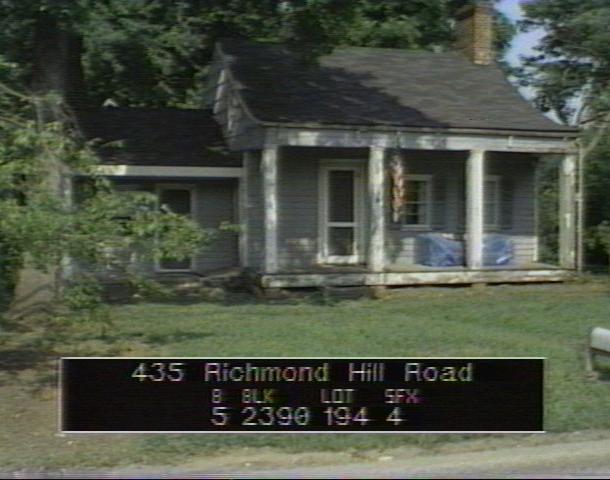
The city photographed every building for its tax records around 1940 and again in the 1980s. NYC Municipal Archives.
Written with AI from the source each entry cites, then fact-checked.
- 1840
Remodeling stretches the farmhouse roof forward into a columned porch
Around 1840 the roof of the Decker farmhouse, first built about 1810, was carried down in a curving sweep past the eave to cover a porch resting on four square columns with plain molded caps. The same remodeling added double-hung sash windows and a narrow porch before the kitchen wing. The Landmarks Preservation Commission later called the one-and-a-half-story clapboard and shingle house a fine survivor of a once common Staten Island farmhouse type.
“About 1840, the roof of the original 1810 house was extended in a graceful sweep from the eave to form a porch supported by four square columns…”
- 1955
Sylvanus Decker wills his farm to the Staten Island Historical Society
Sylvanus Decker, from one of the early families to settle on Staten Island, left this small farm to the Staten Island Historical Society by his will in 1955. The will required the Society to run the eleven-acre property as a farm museum showing nineteenth-century farm life on the island. Besides the farmhouse, the property holds six outbuildings, about three quarters of a mile from Historic Richmondtown.
“This small farm was willed to the Staten Island Historical Society by Sylvanus Decker in 1955.”
- 1967
Landmarks Commission designates the Sylvanus Decker Farm
The Landmarks Preservation Commission designated the Sylvanus Decker Farm at 435 Richmond Hill Road a city landmark on December 13, 1967, after a hearing in September 1966 where one witness spoke in favor and no one opposed it. The owner, the Staten Island Historical Society, backed the designation. Given how fast land was being converted, the Commission expected it would probably become the only nineteenth-century farm left in New York City.
“With the current rate of land conversion it will probably be the only Nineteenth Century farm remaining in New York City.”
Nearby
- Staten Island Mall2655 Richmond Avenue | 4 entries
- Church of St. Andrew5 Arthur Kill Road | 7 entries
- I.S. 72 Rocco Laurie Intermediate School33 Ferndale Avenue | 4 entries
- The Crimson Beech (Cass House)48 Manor Court | 7 entries
- Boehm House43 Arthur Kill Road | 2 entries
- Staten Island Lighthouse418 Edinboro Road | 5 entries