Church of St. Andrew
5 Arthur Kill Road | Lighthouse Hill | built 1872
Open on the map7 entries

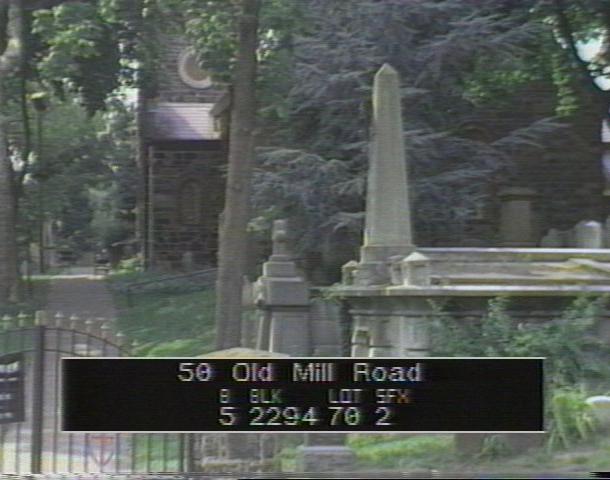
The city photographed every building for its tax records around 1940 and again in the 1980s. NYC Municipal Archives.
Written with AI from the source each entry cites, then fact-checked.
- 1712
Anglican congregation finishes its first small stone church above the Fresh Kill
The Reverend Aeneas MacKenzie organized the Church of St. Andrew in 1705, and for its first seven years the congregation worshipped in the nearby French Church. Its own stone church, with a gambrel roof, went up between 1709 and 1712 in the village then known as Cocclestown, although the interior was completed later. Queen Anne granted the parish its charter in 1713.
“The original small stone Church with gambrel roof was built between the years 1709-1712.”
- 1777
American troops attack British soldiers barricaded inside the church
During the Revolutionary War one of the main British camps was in Richmondtown, with a fort about a thousand yards from St. Andrew's, and several skirmishes were fought near the parish. On August 8, 1777, American forces attacked British troops who had shut themselves up in the church. In the same period the British used the building as a hospital for their wounded.
- 1777
Rector Richard Charlton, grandfather of Saint Elizabeth Ann Seton, is buried in the churchyard
The Rev. Richard Charlton (1705-1777), one of St. Andrew's earliest rectors, is buried in the churchyard. He was the grandfather, on her mother's side, of Elizabeth Ann Seton, the first American-born citizen whom the Roman Catholic Church canonized. Seton's brother and sister lie in the same churchyard.
Source: Wikipedia
- 1801
Richard Bayley, New York City's first chief health officer, is buried at St. Andrew's
Richard Bayley (1745-1801), New York City's first chief health officer and the father of Elizabeth Ann Seton, lies in the St. Andrew's churchyard. The graveyard also holds several members of Congress, among them Henry Crocheron (1772-1819), Jacob Crocheron (1774-1849) and James Guyon Jr. (1778-1846), along with a prominent mausoleum of the Johnston family.
“Richard Bayley (1745-1801), first chief health officer of New York City and father of Elizabeth Ann Seton.”
Source: Wikipedia
- 1822
A high wind knocks down the church's second steeple
A high wind destroyed the steeple of St. Andrew's in 1822. It was the church's second; the first had been raised after the Revolutionary War. By then the colonial church had grown, enlarged in two stages in 1743 and 1770 to 80 by 40 feet, and an east gallery reached through an outside entrance had been added between 1807 and 1810.
“A high wind destroyed the steeple in 1822. This was the second steeple; an earlier one had been erected after the Revolutionary War.”
- 1872
William H. Mersereau rebuilds the burned church within its colonial stone walls
Fires in 1867 and 1872 nearly destroyed St. Andrew's, but each time the original walls survived. Rebuilding after the second fire, architect William H. Mersereau kept those walls and produced the present church, which the Landmarks Preservation Commission compared to an English Norman parish church. Keyed brick frames its round-arched windows and round bull's-eye openings against rough fieldstone, and a square tower carries a louvered belfry and a plain octagonal spire.
“During the last rebuilding in 1872, the architect, William H. Mersereau, using the original stone walls, constructed the present edifice.”
- 1967
City designates St. Andrew's a landmark with no opposition at its hearing
The Landmarks Preservation Commission made the Church of St. Andrew a New York City landmark on November 15, 1967. At the October 1966 hearing three witnesses spoke for designation and nobody opposed it. In a letter, the church's attorney told the commission that the church property had been made part of the Restoration of Richmondtown project.
Further reading
- St. Andrew's Church (Staten Island)Wikipedia
Nearby
- Boehm House43 Arthur Kill Road | 2 entries
- Britton Cottage1001 Richmond Hill Road | 6 entries
- Voorlezer's House59 Arthur Kill Road | 7 entries
- Guyon-Lake-Tysen House3737 Richmond Road | 5 entries
- Third County Courthouse302 Center Street | 4 entries
- Stephens-Prier House3672 Richmond Road | 5 entries