Theodore Roosevelt Birthplace
28 East 20th Street | also 26 East 20th Street | Flatiron | built 1923
Open on the map10 entries

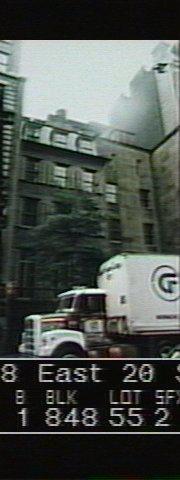
The city photographed every building for its tax records around 1940 and again in the 1980s. NYC Municipal Archives.
Written with AI from the source each entry cites, then fact-checked.
- 1848
Six matching brownstones rise on East 20th Street, including No. 28
Builders erect six identical Gothic Revival rowhouses on East 20th Street in 1848. Lawyer Theodore Roosevelt Sr. buys No. 28, and his brother Robert, a publisher, buys the identical No. 26 next door. Contemporary accounts call the block respectable, though not especially fashionable.
Source: Daytonian in Manhattan
- 1858
Theodore Roosevelt is born in a brownstone on this site
The future president was born on October 27, 1858, in an 1848 brownstone at 28 East 20th Street that his family had bought in 1854. The Roosevelts lived here until 1872, when the neighborhood was turning commercial. The original house was demolished in 1916 to make room for retail space; the house standing here today is a reconstruction.
Source: Wikipedia
- 1873
The Roosevelts move out and the house becomes a rooming house
When young Theodore was fourteen, the family left the original brownstone at 28 East 20th Street, which stood where the museum does now, and it was promptly turned into a rooming house. A 1874 New York Times ad offered two handsomely furnished front rooms on the second floor, and ads for gentlemen's rooms with first-class attendance ran for years afterward. By 1894 a doctor, Elmer P. Arnold, had set up his practice there, probably at basement level.
Source: Daytonian in Manhattan
- 1898
A glass-and-metal storefront and the Wendell Dining Rooms replace the brownstone's ground floor
In 1898 the Roosevelt family, who still owned the original brownstone on this lot, peeled away part of its facade and added a glass-and-metal storefront. The Wendell Dining Rooms opened just before the new year, advertising a French chef and superior appointments, and aiming at women shoppers who wanted lunch. The restaurant lasted only a year or two, and the family sold the house to William R. Kendall in 1899.
Source: Daytonian in Manhattan
- 1904
Republicans meet in the president's birthplace, and Roosevelt wires his congratulations
In autumn 1904 a group of Republicans from the 17th Election District formed the Roosevelt Club and rented the only free room in the birthplace house that then stood on this lot, a six-by-nine-foot back room four flights up. They decorated it with flags and campaign lithographs. Some New Yorkers doubted the altered building was really his birthplace until a telegram from the White House arrived, congratulating the club on meeting in the house where he was born.
Source: Daytonian in Manhattan
- 1916
The original Roosevelt birthplace is demolished for retail space
Long after the Roosevelt family sells the house and moves uptown in 1872, the original brownstone at 28 East 20th Street is torn down in 1916 to make way for commercial development. Theodore Roosevelt, born in the house in 1858, dies three years later in 1919, before any effort to rebuild it begins.
Source: Wikipedia
- 1919
Women's memorial committee buys the altered house and sets a $1 million goal
By March 1919 the Times noted that commercial alterations had left the former four-story brownstone on this lot much smaller. A group of women, the Women's Roosevelt Memorial Committee, bought it along with Robert Roosevelt's adjoining house, with the Douglas Robinson firm acting for them. They aimed to raise $1 million and make it a center for citizenship activities, and by that October a Carnegie Hall address by General Leonard Wood and Scout pledges were building the fund.
Source: Daytonian in Manhattan
- 1923
The Women's Roosevelt Memorial Association rebuilds the birthplace as a memorial
After Roosevelt died in 1919, the Women's Roosevelt Memorial Association bought the lot and hired architect Theodate Pope Riddle to rebuild the house, modeled on its surviving twin next door at number 26, along with an adjoining museum. The house was rededicated in 1923, furnished as it was in 1865. It was donated to the National Park Service in 1963.
Source: Wikipedia
- 1933
Amelia Earhart receives the Roosevelt medal at the memorial's annual reception
For years the Woman's Roosevelt Memorial Association gave a bronze medallion bearing Roosevelt's portrait at an annual reception in the rebuilt house. On January 4, 1933, the honoree was aviator Amelia Earhart. The rebuilt house held five period rooms, two museum galleries and a bookstore, and its roof was laid out as a garden meant for lunches and dinners.
Source: Daytonian in Manhattan
- 1963
The Theodore Roosevelt Association gives the birthplace to the National Park Service
In 1963 the Theodore Roosevelt Association, formed in 1953 when the Women's Roosevelt Memorial Association merged with the Roosevelt Memorial Association, donated the house to the National Park Service. When the National Register of Historic Places was created on October 15, 1966, the site was listed automatically as a national historic site. Today it operates as a museum on the president's life.
“The Theodore Roosevelt Association donated the birthplace to the National Park Service in 1963.”
Source: Wikipedia
Further reading
- Theodore Roosevelt Birthplace National Historic SiteWikipedia
- The Theodore Roosevelt House -- 28 East 20th StreetDaytonian in Manhattan
Nearby
- Gorham Building889 Broadway | 8 entries
- Old Town Bar45 East 18th Street | 7 entries
- 860 Broadway4 entries
- Century Building33 East 17th Street | 11 entries
- Everett Building200 Park Avenue South | 3 entries
- James Harper House4 Gramercy Park West | 3 entries