Olmsted-Beil House
4515 Hylan Boulevard | Eltingville | built 1720
Open on the map7 entries

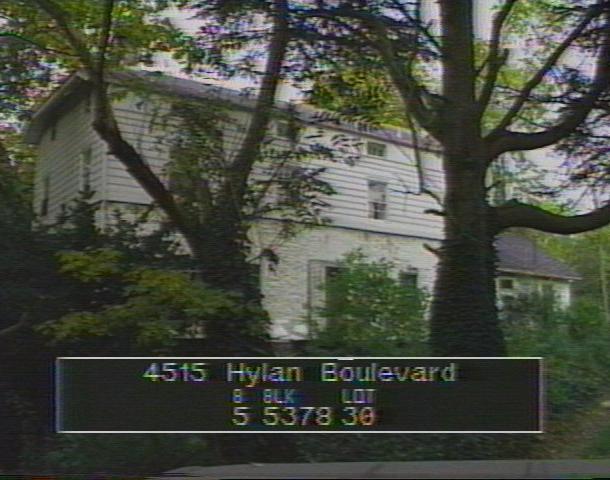
The city photographed every building for its tax records around 1940 and again in the 1980s. NYC Municipal Archives.
Written with AI from the source each entry cites, then fact-checked.
- 1685
Dominic Petrus Teaschenmaker receives a patent for the land from Governor Thomas Dongan
The first recorded owner of this property was Dominic Petrus Teaschenmaker, who obtained his patent from Governor Thomas Dongan on November 3, 1685. The Landmarks Preservation Commission conjectured that his one-room stone shelter survives as half of the present basement.
- 1696
Jacques Poillon acquires the property and turns the stone basement into a Flemish-style farmhouse
In 1696 the land passed to Jacques Poillon, a road commissioner under Governor Slaughter, who built up the old stone basement into a farmhouse in the Flemish manner. Three generations of Poillons had lived here by 1723, and during the Revolutionary War John Poillon, of Richmond County's Committee of Safety, helped arrange the ill-fated peace conference held at the Billopp House.
“In 1696, Jacques Poillon, Road Commissionex under Governor Slaughter, acquired the property and enlarged the basement into a Flemish Style f arm house.”
- 1837
Dr. Samuel Akerley enlarges the small stone farmhouse into a thirteen-room house
The first of two major remodelings came in 1837, when Dr. Samuel Akerley expanded the simple stone building until it held thirteen rooms. The Landmarks Preservation Commission noted that the 1720 one-and-a-half-story farmhouse can still be made out behind these nineteenth-century additions, including heavy stone arches over the basement and first-floor windows.
“…first in 1837, when Dr. Samuel Akerley enlarged this simple stone building to make it a thirteen room house…”
- 1848
Frederick Law Olmsted takes over the farm, renames it Tosomock and plants a tree nursery
Frederick Law Olmsted's father bought the farm and gave it to his son in 1848 to raise crops, plant trees and clear pasture for livestock. Olmsted called the house Tosomock in honor of its first owner, Teaschenmaker, and ran the land as a tree nursery stocked with many unusual kinds of trees. The farm originally took in land across today's Hylan Boulevard, between that road and the beach.
“The house was purchased by Frederick Law Olmsted's father and given to Olmsted in 1848 to grow crops, plant trees and clear for pasture…”
Source: Wikipedia
- 1848
Olmsted raises the roof and adds a wood upper story and porches on three sides
Olmsted's 1848 remodeling lifted and extended the old roof line to create a one-and-a-half-story wooden addition, its attic lit by low windows set at floor level. He added porches on three sides, filled the old stone door arches with pairs of windows, and covered the wall above the narrow porch in wide clapboard.
“…by Frederick Law Olmsted, the noted landscape architect, in 1848, who added a one and a half story wood extension by raising and extending the exist ing roof line…”
- 1967
The house is designated a city landmark as the Poillon House, with its owner's support
The Landmarks Preservation Commission designated the house a landmark on February 28, 1967, under the name Poillon House. At the hearing on September 13, 1966, three witnesses spoke in favor, among them the owner, and nobody opposed. The commission cited a building whose growth can be traced back to the early eighteenth century.
- 2006
The Beil family, the last private owners, sell the house to New York City
After Olmsted sold the farm the land became known as the Woods of Arden, and the Beil family were its final private owners, selling the house to the city in 2006. The building has since fallen into disrepair, and the Parks Department's plan to restore it to its appearance in Olmsted's day depends on raising preservation funds.
“The last private owners, the Beil family, sold the house to the city in 2006.”
Source: Wikipedia
Further reading
- Olmsted–Beil HouseWikipedia
Nearby
- Brougham Cottage4746 Amboy Road | 6 entries
- St. Alban's Episcopal Church76 St Albans Place | 8 entries