Brougham Cottage
4746 Amboy Road | Annadale | built 1940
Open on the map6 entries

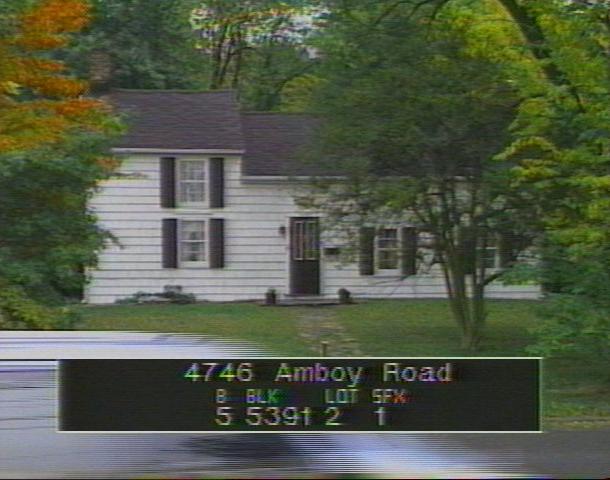
The city photographed every building for its tax records around 1940 and again in the 1980s. NYC Municipal Archives.
Written with AI from the source each entry cites, then fact-checked.
- 1725
A one-room Dutch-American farmhouse rises on Amboy Road, later grown to three sections
The cottage's oldest part, its west wing, was a single H-framed room under a gable roof, with the fieldstone back of its fireplace left exposed outside, a Dutch-American habit. The Landmarks Preservation Commission dates it to roughly 1720-1730 from its low proportions and hewn beams. An early-20th-century owner, William Billard, said he found a Dutch oven and a fire-hardened clay ball holding a 1732 penny in the hearth; the Commission calls the story possibly apocryphal.
“…indicative of the early date, perhaps around 1720 to 1730 ... a clay ball hardened by fire containing a penny dated 1732 buried in the fireplace…”
- 1860
English gardener James Foster opens a plant nursery at the cottage
James A. Foster, born in England in 1821 and trained as a gardener, emigrated in January 1849 and made Staten Island his home. The 1855 state census found him working as a gardener near the John Olmsted farm, presumably in this house, with his family. Around 1860 he started a nursery here, employing his stepson Nelson Gilbey and growing fruit, shade and ornamental trees, shrubs and flowers, and he also laid out gardens for clients.
“Around 1860, perhaps inspired by the Olmsted's precedent, he established a plant nursery, where his stepson, Nelson Gilbey, also was employed.”
- 1887
Stephen Brougham, of the pencil and pen trade, and his wife Ann move into her stepfather's cottage
Stephen M. Brougham, who spent most of his career in the pencil and fountain pen trade, married Foster's stepdaughter Ann Elizabeth on February 14, 1872, and the couple lived in Brooklyn until moving to Staten Island around 1887. James Foster died in February 1897; in 1900 the Broughams lived here with three of their children. Stephen died on December 19, 1910, and Ann sold the house in 1919 to the realtor and lawyer Alrick H. Man. The cottage still carries their name.
“Stephen worked in the pencil and fountain pen business and lived in Brooklyn until the family moved to Staten Island around 1887.”
- 1922
Developer Cornelius Kolff turns the cottage into a lot-sales office and hosts the Historical Society there
Realtor and historian Cornelius J. Kolff leased the cottage from Alrick Man as a branch office for selling lots in his Woods of Arden development, stripping off the old porches. The beamed west room became the sales office and the kitchen a construction office. In June 1922 Kolff, who was leading the borough's Chamber of Commerce at the time, showed the cottage off at a reception, and on July 15 the Staten Island Historical Society met here to vote on merging with the Antiquarian Society.
“On July 15, 1922, Mr. Kolff hosted a meeting of the Staten Island Historical Society in the cottage to vote on the merger…”
- 1923
The Billard family buys the cottage and runs an antiques shop and tea room in it
Alrick Man sold the house in November 1923 to Frances Way Billard, the wife of William Billard. The Billards remodeled it and clad it in shingles, then lived there with their four children while using it as an antiques shop and a tea room. Frances Billard lost the property to foreclosure in 1939.
“They used it as a residence, antiques shop, and tea room, occupying the house with their four children. Frances Billard lost the house to foreclosure in 1939.”
- 1946
Walter and Ethel Mallien begin 54 years in the cottage, filling it with colonial art
Walter Mallien, a retired shipping-lines supervisor, and his wife Ethel made the cottage their home in 1946 and stayed 54 years, decorating it with the 17th- and 18th-century British and American artworks and objects they collected. Walter saw to it that the city Parks Department would preserve the house. Council Member Stephen Fiala allocated city capital funds to buy the house, which became part of the 226-acre Blue Heron Park, and it was designated a city landmark in 2016.
Nearby
- St. Alban's Episcopal Church76 St Albans Place | 8 entries
- Olmsted-Beil House4515 Hylan Boulevard | 7 entries