St. Alban's Episcopal Church
76 St Albans Place | also 78 St Albans Place | Eltingville | built 1931
Open on the map8 entries

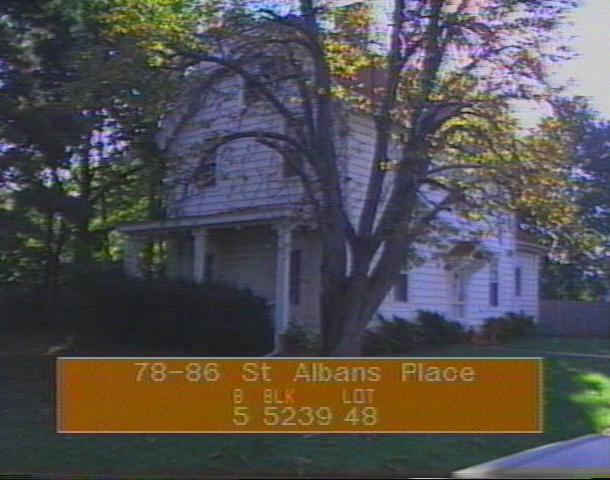
The city photographed every building for its tax records around 1940 and again in the 1980s. NYC Municipal Archives.
Written with AI from the source each entry cites, then fact-checked.
- 1865
The Church of the Holy Comforter opens for worship on land given by Albert Journeay
This church began as the Church of the Holy Comforter, organized by residents of farming Southfields, as Eltingville was then called, under the lead of Albert Journeay. A small church was put up on land he donated, and it held its first service on October 8, 1865, two weeks before the parish was formally incorporated.
“A small church was built in 1865 on land donated by Journeay. It opened for worship on October 8, 1865, two weeks before the church was officially incorporated.”
- 1865
Richard Mitchell Upjohn, son of Richard Upjohn, designs the board-and-batten church
The church was designed by Richard Mitchell Upjohn (1828-1903), the English-born son of the Gothic Revival church architect Richard Upjohn. He spent most of his life in Brooklyn, joined his father's firm in 1846, became a partner in 1851, and is best known for the Connecticut State Capitol at Hartford, begun in 1872.
“Architect Richard Mitchell Upjohn (1828-1903) was the son of the noted church architect and Gothic Revivalist Richard Upjohn (1802-1878).”
- 1870
Blocked from buying Albert Journeay's land, the vestry looks into moving the church
The church soon proved too small, and in September 1869 the vestry formed a committee to get plans for transepts and a bell tower. Enlarging it meant buying more land, but talks with Albert Journeay, who owned the neighboring property, went nowhere. In December 1870 the vestry set up a committee to study moving the whole building instead.
“Talks with Albert Journeay, who owned the adjacent property, were unsuccessful and in December, 1870, the vestry es tablish ed a committee to investigate moving the…”
- 1872
The church is moved 272 yards to its present site on St. Alban's Place
Land nearby had been secured by January 1871, but money troubles delayed the work until 1872. The last services at the old location took place on May 5, 1872; the small wooden church was then moved 272 yards to this site and reopened for worship on May 26. It closed again on August 4 so enlargement could begin.
- 1873
The enlarged church reopens with transepts and a new corner bell tower
The enlargement split the chancel from the nave and inserted north and south transepts between them, and the bell cote on the roof gave way to a square bell tower at the northwest corner. The board-and-batten walls carry zig-zag bands, and the gables of the transepts and west front hold hexagonal windows whose tracery bars widen into a star. The church reopened on February 16, 1873.
“Work then proceeded on the enlargement of the building which was reopened on February 16, 1873.”
- 1951
Holy Comforter merges with St. Anne's of Great Kills and takes the name St. Alban's
In 1951 the Church of the Holy Comforter absorbed the members of St. Anne's Episcopal Church in Great Kills, a parish it had itself spun off in 1929, and adopted the St. Alban's name. The merged parish remains active in the Episcopal Diocese of New York.
“In 1951, Holy Comforter absorbed the congregation of nearby St. Anne's Episcopal Church, Great Kills, and changed its name to St. Alban's.”
Source: Wikipedia
- 1980
St. Alban's is designated a city landmark as a rare surviving wooden country church
The Landmarks Preservation Commission designated St. Alban's on September 9, 1980, after a December 1979 hearing at which one witness spoke in favor and none against; the vestry also wrote in support. The commission's report ranked it among the finest wooden rural churches of the mid-19th century left in New York City.
- 1984
The parish acquires an 1883 Hook & Hastings pipe organ
In 1984 St. Alban's acquired a pipe organ built by Hook & Hastings in 1883. It is believed to be the oldest pipe organ surviving in any Staten Island church.
Source: Wikipedia
Further reading
Nearby
- Brougham Cottage4746 Amboy Road | 6 entries
- Olmsted-Beil House4515 Hylan Boulevard | 7 entries