Spaulding Estate Coachman's House
4970 Independence Avenue | Riverdale | built 1899
Open on the map6 entries

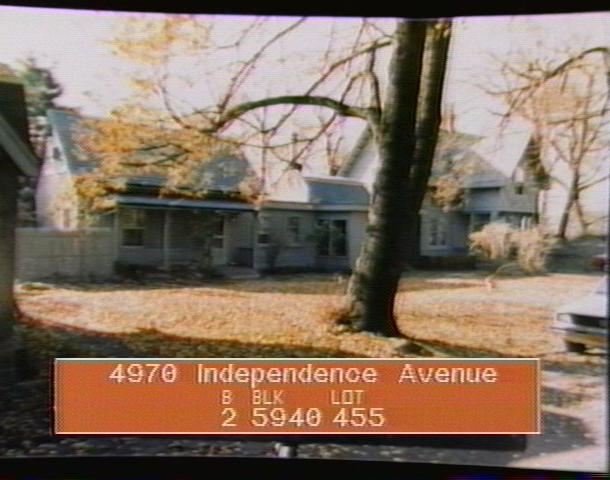
The city photographed every building for its tax records around 1940 and again in the 1980s. NYC Municipal Archives.
Written with AI from the source each entry cites, then fact-checked.
- 1879
Merchant Henry F. Spaulding has Charles W. Clinton design a house for his coachman
Henry Foster Spaulding headed the woolens firm Spaulding, Vail & Fuller and sat on Tilden's committee to bring down the Tweed ring. In 1879, about fifteen years after his villa Parkside was completed, he had Charles W. Clinton design this cottage as his coachman's residence. Clinton had trained in Richard Upjohn's office and in 1894 formed the firm Clinton & Russell.
“Spaulding's coachman's house was designed by Charles W. Clinton in 1879, some fifteen years after the main house was completed.”
- 1880
The coachman's cottage goes up in the Stick Style, with board-and-batten walls and a polychrome roof
The two-and-a-half-story house has board-and-batten siding on the first story and crossed exterior sticks above, a Stick Style way of showing the wooden frame inside. Dormers with jigsaw ornament, chimneys, a polychromed slate roof with bracketed eaves, and a bracketed entrance porch under an overhanging gable complete the cottage look. Clinton kept the design simple to suit a servant's home.
“Intended as a servant's dwelling, it is appropriately simple and unpretentious design, yet handsomely detailed and soundly constructed.”
- 1893
After Spaulding's death, his estate passes to Percy Pyne Jr. and then into Wave Hill
When Spaulding died in 1893, his house came into the possession of Percy Pyne Jr. Around 1900 the property was purchased and became the center section of George Walbridge Perkins's large estate, Wave Hill. In the 1930s Mrs. Perkins gave the main house, Parkside, to Riverdale Country School, but the eastern part of the property, with the coachman's house, stayed with Wave Hill.
“After Spaulding's death in 1893, his house came into possession of Percy Pyne, Jr.”
- 1909
The coachman's house is moved across Independence Avenue to its present site
The cottage first stood on the Wave Hill grounds near today's rose garden. In 1909 it was moved across the street to its current lot, and in 1914 it was remodeled.
“The coachman's house, originally situated near the present rose garden, was moved across the street in 1909 and remodeled in 1914.”
- 1968
A connecting addition joins the house to a second cottage moved from Wave Hill
In 1968 a connecting addition attached the coachman's house to a smaller, simpler cottage that had also been moved off Wave Hill proper in 1909. The commission later found that despite the move and these alterations, the house kept much of its original character.
“A smaller, simpler cottage, which also had been moved from Wave Hill proper in 1909, was attached to the coachman's house by a connecting addition in 1968.”
- 1981
The Landmarks Preservation Commission designates the coachman's house a landmark
At a July 12, 1979 hearing, two witnesses spoke in favor and nobody opposed. Designating the house on July 28, 1981, the commission called it one of only a few picturesque cottages known in New York City, a type meant for rural settings, built when Riverdale was a private enclave of country estates.
“…is one of only a few of the type known to exist in New York City.”
Further reading
- Henry F. Spaulding Coachman's HouseWikipedia
Nearby
- Spaulding coachman's house, east wing4970REAR Independence Avenue | 2 entries
- Anthony Campagna Estate640 West 249th Street | 5 entries
- 5225 Independence Avenue1 entry
- Wave Hill House665 West 252nd Street | 5 entries
- Thomas A. Buckner Jr. House5200 Sycamore Avenue | 3 entries
- Duff House4767 Henry Hudson Parkway West | 2 entries