John Y. Smith House
502 Canal Street | Tribeca | built 1819
Open on the map10 entries

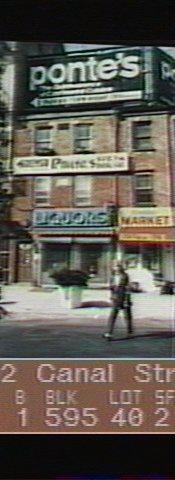
The city photographed every building for its tax records around 1940 and again in the 1980s. NYC Municipal Archives.
Written with AI from the source each entry cites, then fact-checked.
- 1818
John Y. Smith, a starch and hair powder maker, builds a double shop-and-house at Canal and Greenwich
In 1818, as the city began covering the Canal Street drainage ditch, Smith received an oddly shaped corner lot from Alexander L. Stewart and started a double building with a shop on each street front and living rooms above. The two sections meet at a rounded corner. Smith made starch and hair powder, working on the ground floor and raising his family upstairs until 1829.
“Smith, a manufacturer of starch and hair powder, operated his business from and lived in the building with his family until 1829.”
- 1819
A rounded corner bay joins two Federal-style facades of Flemish-bond brick
The three-story brick building stands on an irregular corner lot, with a 30-foot front on Greenwich Street and a 24-foot front on Canal Street. A two-bay rounded corner links the two facades, which are laid in Flemish bond and have brownstone lintels and sills. The original peaked roof was later removed, and large billboard frames went up on the flat roof that replaced it.
- 1827
Hatters take over the corner: Edward Pew opens a shop in 1827 and a Bowery hat dealer receives the building in 1829
The building got its first street number in the 1827 tax assessment, the year the hatter Edward Pew opened a shop in it. In 1829 the building passed from Smith to Alonzo Alvord, who owned a hat store on the Bowery. The empty lot beside it, which later became 504 Canal Street, went with it and was still being used as a side yard.
“…transferred to Alonzo Alvord, owner of a hat store on the Bowery…”
- 1872
Dr. George A. Hayunga turns the corner saloon into a pharmacy
A saloon had taken over the Canal Street corner storefront by the 1850s. By 1872 Dr. George A. Hayunga, a Canadian-born Union Navy surgeon whose office and home were on Broome Street, had turned it into a pharmacy. In 1882 he chaired the West Side Protective Association in its fight against the New York Central Railroad for blocking streets and running cars on Sundays. His son, also a doctor, was running the drugstore by 1897.
Source: Daytonian in Manhattan
- 1874
The corner liquor store at 502 Canal Street goes to a Christmas Eve mortgage auction
In June 1873 the owner of the liquor store at the corner of Canal and Greenwich advertised its lease, fixtures and stock for sale, citing his bad health. Apparently nobody bought, and the contents went to a mortgage auction at noon on Christmas Eve 1874: an English pump, glassware, bars, silverware and a stock of imported liquors. The advertisements call it the well known liquor store at 502 Canal Street.
Source: Daytonian in Manhattan
- 1906
The Health Department orders tenants out of 502 Canal Street as unfit for human habitation
After a notice of violation for defective plumbing and drainage, a Health Department report of August 1, 1906 judged the building dangerous to life and unfit to live in. Blue-collar tenants upstairs had been falling ill, and they were given six days to leave. Repairs were finished by October, and one tenant, a city deckhand, stayed on for at least two more years.
Source: Daytonian in Manhattan
- 1914
The Lutheran Hospital of Manhattan is listed at 502 Canal Street, in a building with a drugstore
Dr. George Hayunga, who ran the drugstore in the building, urged the need for a Lutheran hospital at a January 1909 meeting, and a society for it was formed in 1911. By 1914 the New York Charities Directory had a Lutheran Hospital of Manhattan entry giving 502 Canal Street as its address. The hospital bought uptown land in 1915 and opened a new facility in October 1916.
Source: Daytonian in Manhattan
- 1956
Dr. George Hayunga, who ran the corner drugstore and a free clinic for decades, dies in his Canal Street home
George E. Hayunga ran the drugstore at the corner and a free clinic for the poor while living next door at 504 Canal Street for decades. A local resident said in 1954 that he had delivered at least 70 percent of the babies in the neighborhood. He retired at 90, though some patients kept consulting him, and died in his Canal Street home on March 20, 1956. His grandson and namesake, George E. Hayunga III, practiced medicine too and sold the property in 1966.
Source: Daytonian in Manhattan
- 1998
The Landmarks Preservation Commission designates the building after a hearing with no opposition
The Landmarks Preservation Commission held its hearing on April 21, 1998, and designated the 480 Greenwich Street/502 Canal Street House, also called the John Y. Smith House, a landmark that June 30. Eight people, including a Community Board 1 representative, spoke in favor and none opposed. The commission valued it as part of a rare cluster of early nineteenth-century buildings on a partly landfilled block near the Hudson waterfront.
- 2012
Hurricane Sandy hits the scaffolded building, and a wall collapses two months later
Scaffolding went up around the decrepit building on October 29, 2012, the night Hurricane Sandy arrived. The storm left it marked unsafe by the Department of Buildings, and in January 2013 a wall collapsed, which George Calderaro of the Historic Districts Council called demolition by neglect. The owners planned to dismantle the facade on Canal Street by hand and rebuild it using the original bricks, and SRA Architecture converted the interior into a single-family house.
Source: Daytonian in Manhattan
Nearby
- 504 Canal Street House504 Canal Street | 9 entries
- 506 Canal Street House (John G. Rohr House)506 Canal Street | 7 entries
- 508 Canal Street House508 Canal Street | 8 entries
- 486 Greenwich Street House486 Greenwich Street | 9 entries
- 131 Watts Street2 entries
- 488 Greenwich Street House488 Greenwich Street | 5 entries