504 Canal Street House
504 Canal Street | Tribeca | built 1841
Open on the map9 entries

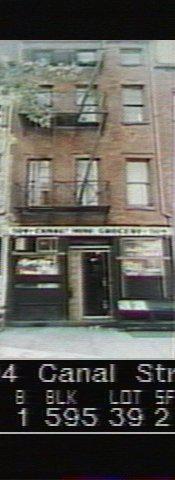
The city photographed every building for its tax records around 1940 and again in the 1980s. NYC Municipal Archives.
Written with AI from the source each entry cites, then fact-checked.
- 1841
Robert Stewart builds a four-story brick house-and-store with a granite storefront on a vacant side lot
Around 1841 Alexander Stewart's heir, Robert Stewart, developed the empty parcel that had served as a side yard for the corner building at 502 Canal. The four-story brick building has a heavy post-and-lintel granite storefront at street level and living space above, and a gently pitched roof. It first appears in the 1842 tax assessment as 237 Canal Street and took the number 504 in 1860.
- 1850
The 1850 census finds a collar maker, a clerk's large family and a boilermaker living in the building
The first census after the building was completed shows the Irish-born collar maker William Kelly, aged 26, and his wife Margaret running a collar business in the ground-floor store, with two teenage apprentices living with them. Upstairs, 50-year-old clerk William Hoffmire shared another unit with his wife Maria, two adult sons (a machinist and a silversmith) and six younger children. A third household was headed by a 30-year-old boilermaker, James O'Neil.
- 1863
A former saloon at 504 Canal Street becomes a Union Army recruiting office offering to furnish substitutes
After the ground-floor saloon was put up for sale in July 1861, three months into the Civil War, the space became a Union Army recruiting office. Once the 1863 Enrollment Act let draftees buy an exemption for $300 or pay a replacement, a newspaper ad from the office promised $500 to $1,000 to volunteers and substitutes, and said it would supply substitutes quickly. It would also take a few boys of 18.
Source: Daytonian in Manhattan
- 1865
A tenant who retrieves one stolen deed for a $2 fee is hauled before a judge
Miles Gragin, in town from Pennsylvania to sell property, fell asleep on a Canal Street stoop and woke to find four deeds, which he valued at $15,000, gone. Daniel Hogan, an engineer lodging at 504, offered to get them back for a price, took $2 and returned from inside the building with one deed. Gragin found a policeman, and on July 12, 1865 Hogan, who said he had chased a boy who took the package, was held for trial.
Source: Daytonian in Manhattan
- 1872
Louis Picus takes over the building, and a lodger dies after being taken to a New Jersey hospital
Louis Picus took over the saloon and upper floors in 1872, beginning the building's notorious years as a boarding house. In May, John Keller, who had lodged there six months, was carried to a Hoboken hospital with obvious wounds and died the same day. Picus's wife Bertha testified that he kept falling out of bed, so they tied him down. No one in the house would give the coroner information, and the case was dropped for lack of evidence.
Source: Daytonian in Manhattan
- 1883
A swindler who sent a Syrian family to Picus's hotel is arrested at the pier as he pushes them aboard a ship
A young family from Lebanon who had arrived in November 1882 were told by James Rosedale that they faced prison for begging unless they paid him. He took them to the hotel at 504 Canal Street, where their expenses mounted, and eventually collected $560 from them, including $112 for steerage tickets. On April 18 a bystander saw him pushing the family aboard the City of Richmond, which was bound for Liverpool, and police stepped in and arrested him.
Source: Daytonian in Manhattan
- 1883
A Picus runner sells a Swiss traveler a draft on a bank that does not exist
In September 1883 Frederick Rufenacht, heading to Europe, was met at the landing by a runner for Louis Picus and steered to the Canal Street boarding house. With his last $100 he bought a sight draft for 500 francs on a Basel bank. In Switzerland he found there was no such bank, sailed back and went to the mayor's office. Picus admitted the runner worked for him but denied knowing about the draft, and the case was left unsettled.
Source: Daytonian in Manhattan
- 1892
A cotton-machine salesman lured into a counterfeit-money scheme escapes Picus's hotel and loses his satchel
R. J. Gordon, in New York on business for a cotton-picking machine company, was offered $3,000 in counterfeit "green goods" by a stranger and taken by cab to Picus's hotel, where he registered under a false name. After a second man locked the door and pocketed the key, Gordon asked for water, slipped out and ran to the 5th Precinct, but Bertha Picus grabbed his bag and umbrella. The captain then told Gordon to pay her the day's rent before he could have them back.
Source: Daytonian in Manhattan
- 1997
The rear wall collapses after a repair permit from 1994 goes unused
On April 1, 1997 the rear wall at 504 Canal Street, 18 feet by 20, came down. Newsday reported that a 1994 city permit to fix the non-bearing wall had gone unused. The owners, the Ponte family's carting business, had pleaded guilty to racketeering that January. The damage was repaired and the building survived.
Source: Daytonian in Manhattan
Further reading
- The Notorious Picus Hotel - 504 Canal StreetDaytonian in Manhattan
Nearby
- John Y. Smith House502 Canal Street | 10 entries
- 506 Canal Street House (John G. Rohr House)506 Canal Street | 7 entries
- 508 Canal Street House508 Canal Street | 8 entries
- 486 Greenwich Street House486 Greenwich Street | 9 entries
- 488 Greenwich Street House488 Greenwich Street | 5 entries
- 131 Watts Street2 entries