486 Greenwich Street House
486 Greenwich Street | Hudson Square | built 1823
Open on the map9 entries

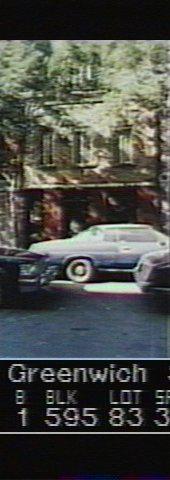
The city photographed every building for its tax records around 1940 and again in the 1980s. NYC Municipal Archives.
Written with AI from the source each entry cites, then fact-checked.
- 1823
Mason John Rohr probably builds the house, then numbered 488 Greenwich Street, and leases it to tenants
Starting around 1820, the Rohr family built rowhouses on the west side of Greenwich Street on land owned by Alexander and Sarah Lispenard Stewart, and the mason John Rohr probably built this one. Tax records show new houses on this lot and the one beside it in 1824. John and his wife, Martha, never lived here but leased the house until 1836; the first known tenant, from 1824 to 1826, was the merchant Isaac Moses. It carried the number 488 until about 1855 to 1859.
- 1831
Baker Charles Hummel lives and apparently bakes here from 1831, then buys the house in 1836
Charles Hummel, a baker, had settled in the house by 1831 and apparently ran his business there too. He bought it from the Rohrs in 1836 and stayed on until about 1850. By 1851 the building was a rooming house, and the street directory listed five working-class male boarders, among them a porter, a baker, a weaver and a foundryman.
“…sold the house in 1836 to Charles Hummel, a baker who had been a resident (and apparently also had his business here) since 1831…”
- 1906
The house turns industrial as a bearing-metals maker, a junk shop and iron works rent it in turn
In 1902 the owner, Robert I. Brown, advertised the property as suitable for light business or stables. A. Allan & Son, a bearing-metals manufacturer founded by Andrew Allan, leased it from 1906 to 1917, and later tenants included a junk shop around 1928 and a chemical firm in the late 1930s. After James Johnston Sr. bought the house in 1953, A. Johnston & Son Iron Works occupied it until at least 1975.
- 1976
Fluxus artist Geoffrey Hendricks moves into the gutted house, and painter Brian Buczak joins him in 1977
Artist Jon Hendricks bought this house and its neighbor in 1975, and by 1976 his brother, the painter and Fluxus performer Geoffrey Hendricks, was living upstairs in the gutted rowhouse. Brian Buczak, an artist from Detroit, moved in with him in 1977, and the two restored the house over time, sleeping in a tent amid the construction one winter. Jon transferred the house to Geoffrey in 1983.
Source: NYC LGBT Historic Sites Project
- 1977
Hendricks and Buczak set up Money for Food Press in the attic and a ground-floor alcove
In 1977 the two artists started Money for Food Press, an imprint they ran from the attic and an alcove on the ground floor. It issued zines, postcards, books documenting their performances and a scrapbook given to them by the mail artist Ray Johnson, with whom Buczak had traded correspondence art since high school. Hendricks later remembered the house's parties and meals as modified Fluxus banquets.
Source: NYC LGBT Historic Sites Project
- 1984
Conceptual artist Lawrence Weiner adds a line about water above the ground floor
In 1984 the conceptual artist Lawrence Weiner added the words WATER SPILLED FROM SOURCE TO USE above the ground story of the house. The owner, Geoffrey Hendricks, had received the house from his brother Jon the year before; he was an artist associated with Fluxus since the 1960s and had taught art at Rutgers University since 1956.
- 1987
Brian Buczak dies of AIDS-related illness, and Geoffrey Hendricks commissions a Philip Glass quartet in his memory
Brian Buczak was hospitalized and diagnosed with AIDS in 1986, and in his last year he painted prolifically, with work centered on confronting AIDS and death. He died in 1987. To commemorate him, Geoffrey Hendricks curated A Memorial Exhibition and commissioned the composer Philip Glass to write String Quartet No. 4.
Source: NYC LGBT Historic Sites Project
- 2007
The city designates the house a landmark as one of the rare modest Federal rowhouses with a shop floor
On July 24, 2007, the Landmarks Preservation Commission designated the house a landmark, after a public hearing on April 10. It called the two-and-a-half-story rowhouse, with Flemish bond brick on its second story, a peaked roof and a pedimented dormer, one of the very rare surviving modest Federal buildings in Manhattan with a commercial ground story. The commission noted that this house and its neighbor at no. 488 survived in a neighborhood largely rebuilt with industrial and loft buildings.
“…is among the very rare surviving and significantly intact modest Manhattan buildings of the Federal style…”
- 2018
After Geoffrey Hendricks dies, the house is kept as an archive with a Fluxus library on the second floor
Geoffrey Hendricks lived in the house from 1976 until his death in 2018. In his later years his partner since 1995, the writer, archivist and curator Sur Rodney (Sur), split his time between his East Village apartment and the house and cared for him as he battled cancer. Afterward the house was kept as a processing and storage archive for the artists' work, with a Fluxus library on the second floor.
Source: NYC LGBT Historic Sites Project
Nearby
- 488 Greenwich Street House488 Greenwich Street | 5 entries
- Charles C. Dyer House and Store510 Greenwich Street | 5 entries
- Urban Glass House330 Spring Street | 5 entries
- 504 Canal Street House504 Canal Street | 9 entries
- John Y. Smith House502 Canal Street | 10 entries
- 506 Canal Street House (John G. Rohr House)506 Canal Street | 7 entries