Church of St. Luke and St. Matthew
520 Clinton Avenue | also 519 Vanderbilt Avenue | Clinton Hill | built 1891
Open on the map9 entries

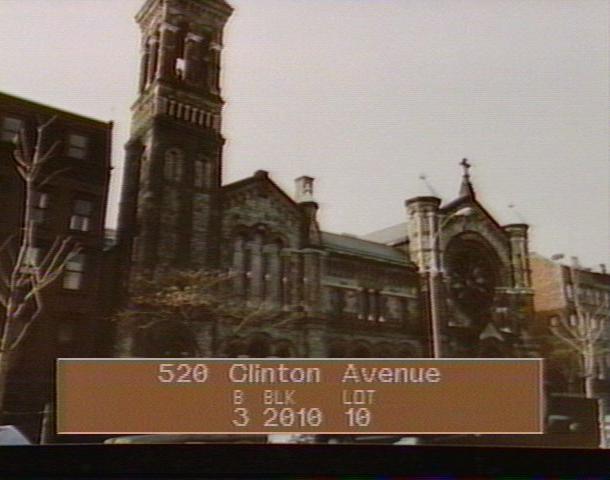
The city photographed every building for its tax records around 1940 and again in the 1980s. NYC Municipal Archives.
Written with AI from the source each entry cites, then fact-checked.
- 1842
St. Luke's, a new Episcopal parish, buys the failed Trinity Church property on Clinton Avenue
Trinity Episcopal Church built a stone church on the west side of Clinton Avenue in 1835, in a sparsely settled farming area, but the neighborhood was too small to support it and the congregation disbanded. A new parish, St. Luke's, organized on December 14, 1841, and on February 1, 1842 its vestry voted to buy the Trinity property. The purchase paid off as wealthy families moved to Clinton Hill in the 1850s.
- 1846
A builder's widow charges that St. Luke's bought the Trinity church cheaply and erased its debt to her husband
In 1846 the widow of Elias Combs, who had built the 1835 church, charged that her husband was never paid. She said the building was bought cheaply after Trinity went bankrupt, wiping out the debt. Other Brooklyn Episcopal churches and a local judge backed her account. St. Luke's blamed Trinity's mismanagement and said it had offered her a choice pew and the deed to the vault holding her husband's remains.
Source: Wikipedia
- 1869
St. Luke's becomes a free church with no rented pews
By 1864 St. Luke's had paid off debts of over $12,000 that came with buying its building. In 1869 it became a free church: no pews were rented and anyone could attend without charge. A writer of the time held the arrangement up as an especially remarkable demonstration that the free church system worked.
Source: Wikipedia
- 1888
Colonel Henry P. Martin offers $40,000 for a Sunday school in memory of his daughter
After a fire on November 27, 1887 destroyed or badly damaged the church, parishioner Colonel Henry P. Martin offered to build a Sunday school on condition that a new church be erected on the old site. He handed the vestry a $40,000 check on January 19, 1888, as a memorial to a daughter who had died not long before. The cornerstone is carved with her initials, EMM, and her portrait is carved on the capitals of the entrance porch.
- 1888
John Welch's grand plan for the new church is cut back to fit the congregation's budget
The vestry picked John Welch's Italian Romanesque design for the Sunday school in February 1888. His first church plans, with a marble-columned sanctuary and a tall corner tower, proved too costly. By November 1888 the vestry wanted a smaller church costing no more than $40,000, so Welch left out the tower for the time being and used yellow pine columns painted to look like marble.
“Building project should be revived on basis of a smaller church, less expensive exterior, omission of tower for the present and a cost not exceeding $40,000.”
- 1896
Tiffany windows fill the nave as the church finishes paying for its building
The church seated 1,500 when it was finished in 1891, and its construction left a mortgage that stood at $33,000 in 1892. Fundraising by members cleared it by 1896. Most of the nave windows were installed in 1896 and made by Tiffany. The rose window had come earlier, a gift from the children of the Sunday school in 1890.
“Most of the windows in the nave were also installed in 1896, and were crafted by Tiffany.”
Source: Wikipedia
- 1914
A fire guts the church interior, and the building is rebuilt for 1915
A fire in March 1914 destroyed the interior and brought down sections of the roof, though the outer walls stood. Damage was estimated at $300,000. The church was rebuilt within those walls, largely to the original design, with a larger Sunday school and redesigned parish hall. It reopened on September 19, 1915, with a rebuilt organ planned as the city's largest, with four manuals and sixty stops.
“A major fire in 1914 destroyed the interior of this building and caused sections of the roof to collapse, but the outer walls remained intact.”
Source: Wikipedia
- 1943
St. Luke's merges with St. Matthew's, a parish whose former rector had drawn criticism over remarks on race
A New York court ordered St. Luke's merged with St. Matthew's Episcopal Church in 1943, and the combined parish kept worshipping in the Clinton Avenue building. The merger is credited to falling attendance and a shifting neighborhood population. St. Matthew's had also been caught in controversy after its former rector, William S. Blackshear, said in the press that the church wanted to remain white, and he was criticized by the diocese's bishop, by William Pickens and by James Weldon Johnson of the NAACP.
“…the church wanted to remain white and was not interested in attracting any people of color from the neighborhood's changing population…”
Source: Wikipedia
- 2018
The church begins work to sell its air rights to pay for facade repairs
A fire on December 23, 2012 damaged the foyer, entry doors and facade. Beginning in 2018 the church worked toward selling its air rights so that a residential tower could rise nearby, with the proceeds meant to pay for facade reconstruction and other repairs in keeping with its landmark status. Rezoning for the project was approved in 2019.
“In 2018, the church began work to sell air rights for construction of a nearby residential high rise…”
Source: Wikipedia
Further reading
Nearby
- Royal Castle Apartments20 Gates Avenue | 5 entries
- Co-Cathedral of St. Joseph856 Pacific Street | 4 entries
- Unnameable Books615 Vanderbilt Avenue | 2 entries
- Paul Robeson Theatre (former St. Casimir's Church)40 Greene Avenue | 8 entries
- Joseph Steele House200 Lafayette Avenue | 5 entries
- James W. and Lucy S. Elwell House70 Lefferts Place | 6 entries