Tiffany & Co. Silver Factory (Hawley & Hoops Building)
55 Prince Street | also 53 Prince Street | Nolita | built 1900
Open on the map4 entries

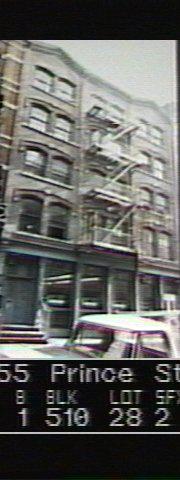
The city photographed every building for its tax records around 1940 and again in the 1980s. NYC Municipal Archives.
Written with AI from the source each entry cites, then fact-checked.
- 1864
Edward C. Moore builds a silver factory and design school on Prince Street for Tiffany & Co.
Silversmith Edward C. Moore replaced an older double-width store at 53-55 Prince Street with a four-story factory of brown brick on a cast-iron base. His family firm had made silverware exclusively for Tiffany & Co. since an 1851 agreement, and he also ran a training school here for artisans in decorative arts. Tiffany bought his operation when it incorporated in 1868, but Moore kept the building and leased it to the company for $6,000 a year.
Source: Daytonian in Manhattan
- 1887
Silversmiths walk out of the Prince Street Tiffany plant in a Knights of Labor strike
On April 21, 1887, the Knights of Labor ordered a citywide walkout of silversmiths. About 300 silver workers were employed at the Prince Street plant, but the Tribune reported barely 100 were at their benches when work began that morning. Edward C. Moore told a reporter the union had pulled out every man who made the goods sold over Tiffany's counters, and said he would take back only those who quit the organization.
Source: Daytonian in Manhattan
- 1904
Candy makers Hawley & Hoops buy the old Tiffany factory
Tiffany announced in December 1897 that a new plant in Newark, New Jersey, would take over its Prince Street production. In November 1904 the building was sold to confectioners Hawley & Hoops, who hired architect Charles E. Reid for a five-story side extension and other changes. The firm employed up to 800 people and sold candy under the "A No. 1" brand, including chocolates pressed into shapes by machines John Hawley designed. Forrest Mars bought the business in 1952 and merged it with Mars.
Source: Daytonian in Manhattan
- 1985
Upper floors become artists' live-work space as SoHo changes
As SoHo turned into a district of artists' studios and galleries, the factory's upper floors were converted starting in 1982 into combined live-work space for artists, while an art studio and store took over the ground floor; the conversion finished in 1985. The building later became home to E. R. Butler & Co., a maker of architectural hardware, which restored the facade.
Source: Daytonian in Manhattan
Further reading
- The Tiffany & Co. Factory -- No. 53-55 Prince StreetDaytonian in Manhattan
Nearby
- James Hart House261 Mulberry Street | 4 entries
- 47 Prince Street3 entries
- Old St. Patrick's Rectory263 Mulberry Street | 4 entries
- Hawley & Hoops Chocolate Factory (Mulberry Street Library)285 Lafayette Street | 3 entries
- 65 Prince Street2 entries
- St. Patrick's Old Cathedral256 Mulberry Street | 11 entries