58 Joralemon Street subway ventilator
58 Joralemon Street | Brooklyn Heights | built 1847
Open on the map4 entries

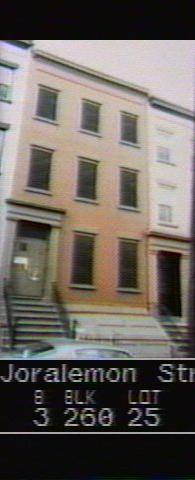
The city photographed every building for its tax records around 1940 and again in the 1980s. NYC Municipal Archives.
Written with AI from the source each entry cites, then fact-checked.
- 1847
A Greek Revival row house goes up at 58 Joralemon Street in Willowtown
The house at 58 Joralemon Street was built in 1847 as a private residence in the Greek Revival style, one of the rows of brick and brownstone houses that filled this end of the street in the 1840s. Brownstoner suggests it may have been built for a merchant. The builder is unknown.
Source: brownstoner.com
- 1897
By 1897 the house holds several households, including a gardener, a glassworker and a weigher
In 1897 the former single-family home was a multi-family dwelling, and that year it housed a gardener, a glassworker and a "weigher." Brownstoner reads this as a sign that Willowtown had become working class rather than gentry.
Source: brownstoner.com
- 1907
The IRT buys the house, guts it and turns it into a subway ventilator
The Interborough Rapid Transit Company took over the property in 1907, gutted the interior and converted it into a subway ventilator, which the source describes as the only Greek Revival one in the world. It also serves as an emergency exit at the eastern end of the Joralemon Street Tunnel, which carries the Lexington Avenue line. The city's Board of Transportation took it over in 1940 and the Transit Authority in 1953.
“The Interborough Rapid Transit Company acquired the property in 1907, gutted the interior, and converted the structure to "the world's only Greek Revival subway ventilator".”
Source: Wikipedia
- 1999
Louvered windows give way to sealed, mullioned panes that make the vent pass as a house
For years the windows held louvers that opened and shut, and neighbors told of clouds of smoke pouring from the house. In 1999 the MTA replaced the 1950s generators and fans, and the louvers were removed. Working with the Landmarks Preservation Commission, it installed permanently shut Lexan windows mullioned to look like the original house windows, repainted the house and fitted a more period front door.
Source: brownstoner.com
Further reading
- 58 Joralemon StreetWikipedia
Nearby
- Grace Church46 Grace Court | 5 entries
- Hotel Bossert98 Montague Street | 7 entries
- Our Lady of Lebanon Maronite Cathedral113 Remsen Street | 8 entries
- Herman Behr Mansion82 Pierrepont Street | 6 entries
- St. Ann & the Holy Trinity Church68 Clinton Street | 6 entries
- Brooklyn Historical Society (Center for Brooklyn History)128 Pierrepont Street | 6 entries