John J. J. Gourgas House
64 Bedford Street | West Village | built 1821
Open on the map5 entries

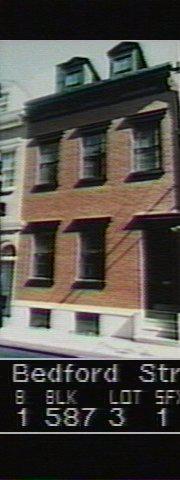
The city photographed every building for its tax records around 1940 and again in the 1980s. NYC Municipal Archives.
Written with AI from the source each entry cites, then fact-checked.
- 1821
Masons James Vandenbergh and Isaac Freeman build three Federal houses at 64 to 68 Bedford on Isaac Jaques's land
Isaac Jaques, a merchant, bought land here in 1819 and sold lots to the masons James Vandenbergh and Isaac Freeman, who built a row of three frame houses with Flemish-bond brick fronts in 1821. They financed it with mortgages from the physician Dr. Valentine Mott. No. 64 was taxed to Jaques and built to rent, and it still has its original two-and-a-half-story proportions and pedimented dormers.
“Nos. 64 and 66 were taxed to Jaques and Freeman respectively and were built for rental purposes…”
- 1857
Scottish Rite founder John J. J. Gourgas buys the house in retirement
John James Joseph Gourgas, born in 1777 at Lake Geneva, Switzerland, came to America in 1803 and ran a Broadway shop selling fancy goods and perfumery. Already retired, he bought 64 Bedford Street in 1857 and lived here with two of his children. He helped found the Scottish Rite's Northern Supreme Council and served as its first Secretary General, and the rite created its top award, the Gourgas Medal, in his honor in 1945. He moved to West 10th Street in 1864 and died there in 1865.
Source: Daytonian in Manhattan
- 1915
A sandwich-board man finds a stolen jewel parcel in the gutter and is arrested for it
Robert Decker, who lived in the rear of the first floor and earned a dollar a day carrying advertising boards through the theater district, stumbled over a snowy parcel on December 14, 1915. It held jewelry from an $8,000 robbery at a Pelham Manor home. His wife pawned a diamond ring for $2, and when she returned days later with a watch, a detective in the pawnshop followed her home. Decker was arrested for grand larceny, but a judge freed him once convinced he had simply found the jewels, and the owner withheld her $500 reward because only part of the haul came back.
Source: Daytonian in Manhattan
- 1920
The Rubino family buys the house; son Michael V. boxes as Porky Young and teaches Gene Tunney
The New-York Tribune reported in September 1920 that Michael Rubino, born in Italy in 1867, had bought the house. He and his wife Maria had 13 children, and several stayed on for decades. Their son Michael V. Rubino fought as a lightweight under the name Porky Young, then gave up the ring to train boxers; Gene Tunney, later the heavyweight champion, was one of his first pupils at the Greenwich Village Settlement House. He also founded the Greenwich Village Sporting Club, a fundraising group for children in need.
Source: Daytonian in Manhattan
- 2011
Investor Barry Schwartz buys No. 64 and links it to No. 66 next door
In 2011 the house was bought by the investor Barry Schwartz, who already owned 66 Bedford Street next door. According to Curbed, as cited by Daytonian in Manhattan, the family bought it as space for guests. The two houses were joined inside by a rear door on the parlor floor. At some point the sheet-metal window cornices were also replaced with paneled lintels suited to the Federal style.
Source: Daytonian in Manhattan
Further reading
- The 1821 John J. J. Gourgas House - 64 Bedford StreetDaytonian in Manhattan
- Then & Now photos: 64 Bedford StreetVillage Preservation: Greenwich Village Then & Now
Nearby
- Deborah Coley House66 Bedford Street | 5 entries
- 60 Bedford Street1 entry
- James M. Vandenbergh House68 Bedford Street | 5 entries
- John P. Roome House70 Bedford Street | 5 entries
- Former Pure Oil station48 7th Avenue South | 1 entry
- Diana Traphagen House67 Bedford Street | 5 entries