Deborah Coley House
66 Bedford Street | West Village | built 1821
Open on the map5 entries

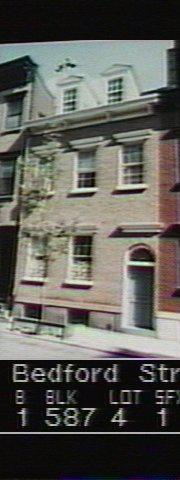
The city photographed every building for its tax records around 1940 and again in the 1980s. NYC Municipal Archives.
Written with AI from the source each entry cites, then fact-checked.
- 1821
Mason Isaac Freeman keeps No. 66 as an investment and rents it to middle-class families
Bedford Street was laid out in 1799, and in 1821 the masons Isaac Freeman and James Vandenberg built identical Federal houses on lots bought from the merchant Isaac Jaques. Vandenberg moved into No. 68, while Freeman kept No. 66 as an investment. In 1836 it was shared by two middle-class families, a carter named David Vanpelt and a grocer named Abraham Tompkins.
Source: Daytonian in Manhattan
- 1837
A druggist styled Reverend sells Vegetable Antibilious Family Pills from the house
In 1837 a resident who gave his profession as druggist rather than clergyman, Rev. B. Hibbard, marketed Vegetable Antibilious Family Pills from No. 66. His advertisement in The Evening Post on August 25 listed liver and digestive complaints, rheumatism, scurvy, fever and ague, worms in children and even the early symptoms of cholera among the ailments they relieved.
Source: Daytonian in Manhattan
- 1855
Widow Deborah Coley starts a small boarding house that her daughter runs after her death
In 1855 Deborah Coley, widow of William Coley, moved in with her daughter Rachel and took in boarders, a common way for widows to earn a living. She never kept more than two at a time, such as the clerks Samuel Barber and John C. Westervelt in 1856. In 1863 she advertised the second floor for $12 a month. After her death in 1874 Rachel took over, with boarders such as a plumbing-supplies dealer and a clerk.
Source: Daytonian in Manhattan
- 1920
Albertson Von Zo Post converts the old house to studio apartments and lowers the door
The New-York Tribune reported on September 24, 1920 that Albertson Von Zo Post had bought the old-fashioned house, and he turned it into studio apartments. He removed the three-step stoop and lowered the doorway to street level, giving it a Georgian-style fanlight, and filled the gap above with brick. A 1921 advertisement in The New York Times offered a three-room studio with kitchen and bath.
Source: Daytonian in Manhattan
- 1922
A gas station goes up on a Seventh Avenue leftover triangle behind the house
When Seventh Avenue was extended south to Varick Street in 1914, it left small triangular lots that were too small for houses, and several became gas stations. One was built in 1922 directly behind 66 Bedford Street and closed in 1970. In 1982 Robert and Sandra Wagenfeld bought the house and the station, returning the house to a single-family home and turning the station into a guest house.
Source: Daytonian in Manhattan
Further reading
- The 1821 Deborah Coley House - 66 Bedford StreetDaytonian in Manhattan
- Then & Now photos: 66 Bedford StreetVillage Preservation: Greenwich Village Then & Now
Nearby
- John J. J. Gourgas House64 Bedford Street | 5 entries
- James M. Vandenbergh House68 Bedford Street | 5 entries
- John P. Roome House70 Bedford Street | 5 entries
- 60 Bedford Street1 entry
- Former Pure Oil station48 7th Avenue South | 1 entry
- 72 Bedford Street1 entry