John P. Roome House
70 Bedford Street | West Village | built 1807
Open on the map5 entries

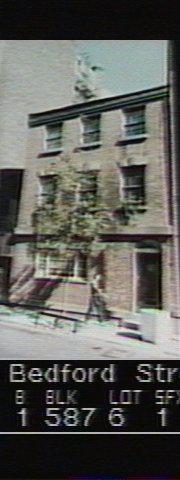
The city photographed every building for its tax records around 1940 and again in the 1980s. NYC Municipal Archives.
Written with AI from the source each entry cites, then fact-checked.
- 1807
John P. Roome builds a Federal frame house with a brick front at 70 Bedford
The city's landmark report dates the house to 1806-07 and names John P. Roome, a sailmaker, as its first owner. It is a frame house fronted in Flemish-bond brick, begun at two and a half stories and raised to a third before 1858. A chair factory put up in 1869 and enlarged two years later stood behind it, and the house has been altered several times since 1900.
- 1820
John P. Roome, a court officer who lived at 70 Bedford, helps burst in on a pair of counterfeiters
Roome served the city's courts as a crier, a post the source likens to a constable. On August 31, 1820, he joined Jacob Hays and other officers at a Pump Street shop, knocked, then forced the door and found two men alone, one with ink on his hands. They seized copper plates for engraving two-dollar bills, and the writer says the pair were sent to prison for life, citing the New-York City-Hall Reporter for the story.
Source: Daytonian in Manhattan
- 1892
Jacob Dieter buys 70 Bedford and runs a 35-man furniture shop that outfits the Hotel Savoy
In spring 1892 Philip Frietag, who had turned the old house into a water softener works, sold the property to Jacob Dieter for $18,750. Dieter's firm, Jacob Dieter & Sons Co., made high-end reproductions of period furniture and employed 35 men in 1893. Its work included the Empire Parlor furnishings and the private dining room chairs for the Hotel Savoy, which opened in 1892.
Source: Daytonian in Manhattan
- 1899
Factory inspectors find Dieter & Sons working craftsmen ten-hour days and Sundays on a courthouse contract
In 1899 Jacob Dieter & Sons took on the job of furnishing the new Supreme Court building on Madison Avenue, and its craftsmen were put on a punishing schedule. On October 27 the New York Times reported the inspectors' findings: the firm had the men work ten hours a day and on Sundays, and, it was claimed, paid them $10 and $12 a week when the rate due was $18 and $24.
Source: Daytonian in Manhattan
- 1962
Noel Paul Stookey of Peter, Paul and Mary buys the derelict factory at 70 Bedford for $38,000
After the building sat empty for about three decades from the start of the Depression, the 25-year-old singer-songwriter had bought it by 1962 for $38,000. He took his fiancee, Betty Bannard, to see it, and she said someone should tear it down, unaware he already owned it. As the conversion back to a house went on in 1963, architect Herbert Lippmann removed the second floor for a 19-foot living room and added a two-story stained glass window at the rear.
Source: Daytonian in Manhattan
Further reading
- The 1806 John P. Roome House - 70 Bedford StreetDaytonian in Manhattan
- Then & Now photos: 70 Bedford StreetVillage Preservation: Greenwich Village Then & Now
Nearby
- James M. Vandenbergh House68 Bedford Street | 5 entries
- 72 Bedford Street1 entry
- Deborah Coley House66 Bedford Street | 5 entries
- 28 Commerce Street1 entry
- John J. J. Gourgas House64 Bedford Street | 5 entries
- 26 Commerce Street1 entry