Lincoln Club
65 Putnam Avenue | Clinton Hill | built 1889
Open on the map6 entries

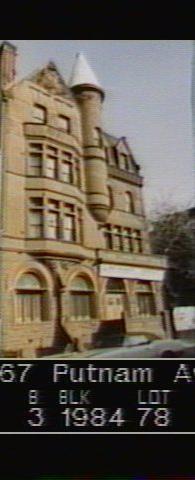
The city photographed every building for its tax records around 1940 and again in the 1980s. NYC Municipal Archives.
Written with AI from the source each entry cites, then fact-checked.
- 1878
Clinton Hill men found the Lincoln Club to socialize and back the Republican Party
A small group of men from Clinton Hill founded the Lincoln Club in January 1878, for social purposes and to further Republican Party interests. The club was officially incorporated in 1879, and at that point it dropped its political activities.
“…founded in January 1878 by a small group of men from Clinton Hill who sought to band together for social purpose and to further the interests of the Republican Party…”
- 1883
The Lincoln Club turns two frame houses on Putnam Avenue into a clubhouse
In 1883 the Lincoln Club bought a pair of wooden houses on Putnam Avenue's north side, in the block between Irving Place and Classon Avenue, and turned them into a clubhouse. A masonry extension went up behind them in 1886 but proved too small for the club's needs. The 1889 clubhouse was planned to incorporate that rear extension.
“In 1883 the club purchased two frame houses on the north side of Putnam Avenue between Irving Place and Classon Avenue and converted them into a clubhouse.”
- 1889
Architect Rudolph Daus, born in Mexico and trained in Paris, designs the new clubhouse
In 1889 the club hired Rudolph L. Daus to plan a new building that would incorporate the recent rear extension, and the clubhouse was ready that fall. Daus was born in Mexico, studied in Berlin and Paris, and opened a Brooklyn office in 1885. He later served as surveyor of buildings for Brooklyn in 1899-1900. The commission called this his finest surviving Brooklyn work.
- 1889
The Queen Anne clubhouse has a basement with bowling alleys and allegorical stained glass
The clubhouse is built of Roman brick and rock-faced brownstone with terra-cotta ornament. The basement originally held a kitchen, a bar and bowling alleys. The window transoms once held stained glass representing Prosperity, Friendship and Concord. By 1981 only the Concord window remained, and the other two had recently been stolen.
“The basement originally had a kitchen, a bar, and a set of bowling alleys.”
- 1900
Lincoln Club limits itself to 400 men chosen by ballot
New members of the Lincoln Club were carefully screened. Membership was capped at 400 men, each candidate needed two active members to vouch for him, and two negative ballots rejected an application. In 1900 the admission fee was $50 and annual dues were $40. Members risked censure, suspension or expulsion for ungentlemanly conduct or boisterous language.
“Membership was limited to 400 men. Prospective members had to be vouched for by two active members and two negative ballots would reject…”
- 1931
The Lincoln Club dissolves and the clubhouse later passes to the Independent Order of Mechanics
The Lincoln Club was dissolved in March 1931, as most of Brooklyn's private clubs disbanded when elite families moved elsewhere. The Independent Order of Mechanics of the Western Hemisphere bought the clubhouse in the 1940s. By 1981 the lodge had mounted an extensive campaign to restore the building, which the commission designated a landmark that year.
Further reading
- Lincoln ClubWikipedia
Nearby
- Brooklyn Waldorf School11 Jefferson Avenue | 1 entry
- James W. and Lucy S. Elwell House70 Lefferts Place | 6 entries
- Co-Cathedral of St. Joseph856 Pacific Street | 4 entries
- Church of St. Luke and St. Matthew520 Clinton Avenue | 9 entries
- Royal Castle Apartments20 Gates Avenue | 5 entries
- 23rd Regiment Armory1162 Atlantic Avenue | 7 entries