House of the Redeemer
7 East 95th Street | Carnegie Hill | built 1917
Open on the map11 entries

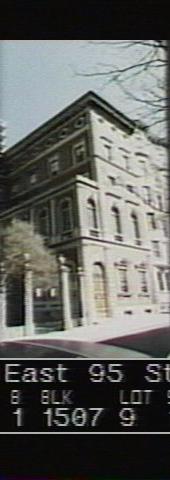
The city photographed every building for its tax records around 1940 and again in the 1980s. NYC Municipal Archives.
Written with AI from the source each entry cites, then fact-checked.
- 1916
Grosvenor Atterbury completes the Fabbri mansion on East 95th Street
Ernesto Fabbri, an Italian-born banker, buys a 100-foot plot on East 95th Street in 1912 and hires architect Grosvenor Atterbury the next year to design a five-story brick and marble residence for himself and his wife, Edith Shepard Fabbri, a great-granddaughter of Commodore Cornelius Vanderbilt. Ernesto's brother Egisto Fabbri, an interior designer, shapes the interiors around the couple's collection of architectural fragments. Construction finishes in 1916.
Source: Daytonian in Manhattan
- 1917
The Fabbris host a lavish debut for daughter Teresa
On January 6, 1917, Ernesto and Edith Fabbri throw a dinner dance at their new East 95th Street mansion to introduce their daughter Teresa to society, drawing some 300 guests. Later that year, on November 21, the family announces Teresa's engagement to James Cameron Clark.
Source: Daytonian in Manhattan
- 1918
Teresa Fabbri Clark gives birth at her parents' mansion while her husband serves in the Air Service
In November 1918 the New-York Tribune noted that a baby had arrived at the Clark home. Teresa Fabbri Clark's husband, Lieutenant James Clark, was serving in the Army Air Service, and the child was born inside the East 95th Street mansion. Wealthy women of the time were attended by doctors at home, not in hospitals.
Source: Daytonian in Manhattan
- 1920
Former ambassador James W. Gerard tells about 100 women in the mansion that they will decide the next election
On January 15, 1920, James W. Gerard, the former ambassador to Germany, spoke at the Fabbri mansion to roughly a hundred women. He told them that women voters would settle the coming presidential election, and said that if women sat in the Senate, the League of Nations treaty would be resolved within a week. The house was often used for political causes and war relief.
Source: Daytonian in Manhattan
- 1921
The Duchesse de Richelieu sings a benefit recital in the mansion for a voice teacher's widow
The Duchesse de Richelieu sang at a recital in the Fabbri house on the afternoon of May 24, 1921. The proceeds went to Madame Clemente Bologna, whose husband, a voice teacher, had recently died. The New York Herald noted that through recitals during the war the duchess had raised several hundred thousand dollars for French soldiers with tuberculosis.
Source: Daytonian in Manhattan
- 1922
Alessandro Fabbri, a pioneer of scientific filmmaking, dies in the mansion after a three-day illness
Alessandro Fabbri, Ernesto's unmarried brother, lived in the East 95th Street house and died there on February 6, 1922, aged 45. The New York Herald had called him a pioneer in using motion pictures for scientific research; he developed a microscopic film process, which he showed off by filming how life grows inside an egg. During the war he paid for a large wireless plant in Maine himself, and the government bought it and hired him to head it.
Source: Daytonian in Manhattan
- 1923
Edith Fabbri keeps the mansion in her 1923 Paris divorce
Edith Shepard Fabbri obtained a divorce from Ernesto Fabbri in Paris in February 1923, and he married Mary Valentine Darrah three months later. Edith received the East 95th Street mansion in the divorce settlement, and she went back to the lavish entertaining the house had hosted before.
Source: Daytonian in Manhattan
- 1924
A Russian prince arrives to stay with Ernesto Fabbri at the mansion
Prince Sergio Romanovsky, Duke of Leuchtenberg, landed in New York aboard the Italian steamship Duilio on Christmas Day 1924. The New York Times reported that he planned a two-month visit with Ernesto Fabbri at 7 East 95th Street, where Ernesto was still living although Edith had gained the house in their divorce.
Source: Daytonian in Manhattan
- 1937
Edith Fabbri turns her library into a ballroom for her granddaughter's debut
For a debutante party on December 18, 1937, Edith Fabbri honored her granddaughter Edith Fabbri Clark with what The New York Times called one of the season's largest such parties. Dancing took place in the library, which was cleared as a ballroom and hung with garlands of real fruit in the Della Robbia manner. Four days later she gave another ball for her grandniece Anne Louise Schieffelin.
Source: Daytonian in Manhattan
- 1949
Edith Fabbri donates her mansion to the Episcopal Church
After her divorce from Ernesto, who remarries in 1923, Edith Shepard Fabbri keeps the East 95th Street house. In 1949, at age 77, she deeds the mansion to the Episcopal Church of New York to promote spiritual retreats, and by December 18 it is known as the House of the Redeemer.
Source: Daytonian in Manhattan
- 1974
The city designates the Fabbri mansion a landmark
New York City's Landmarks Preservation Commission designates 7 East 95th Street, by then serving as the House of the Redeemer retreat house, an individual landmark on July 23, 1974.
Source: Wikipedia
Further reading
- Edith Fabbri HouseWikipedia
- The Ernesto and Edith Fabbri Mansion -- No. 7 East 95th StreetDaytonian in Manhattan
Nearby
- Willard D. Straight House1130 5th Avenue | 9 entries
- Ogden Codman House7 East 96th Street | 2 entries
- Dahlgren-Cartier House15 East 96th Street | 4 entries
- St. Nicholas Russian Orthodox Cathedral15 East 97th Street | 10 entries
- St. Bernard's School4 East 98th Street | 6 entries
- Squadron A Armory71 East 94th Street | 10 entries