Willard D. Straight House
1130 5th Avenue | Carnegie Hill | built 1915
Open on the map9 entries

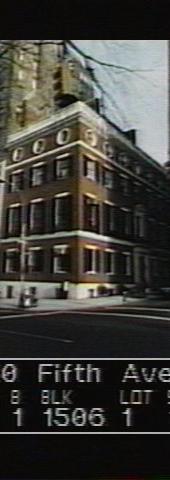
The city photographed every building for its tax records around 1940 and again in the 1980s. NYC Municipal Archives.
Written with AI from the source each entry cites, then fact-checked.
- 1913
Willard Straight buys the corner lot at 94th Street and has already bought the other corner
On November 12, 1913, the financier and diplomat Willard D. Straight bought the lot at the southeast corner of Fifth Avenue and 94th Street for $300,000. He already owned the northeast corner. Daytonian in Manhattan says he meant to build his own house on one corner and sell the other to a congenial neighbor, a way of controlling who lived beside him.
Source: Daytonian in Manhattan
- 1915
Delano & Aldrich design the Willard Straight House
Financier and diplomat Willard D. Straight bought the lot at the southeast corner of Fifth Avenue and 94th Street for $300,000 in November 1913. He hired Delano & Aldrich, who took inspiration from Christopher Wren's wing at Hampton Court for a neo-Georgian house in red brick with white marble trim. The house was finished in 1915.
Source: Daytonian in Manhattan
- 1918
Willard Straight dies of influenza while serving with the American Expeditionary Forces
Willard Straight died of influenza in 1918 while serving with the American Expeditionary Forces, three years after the house was finished. His widow, Dorothy Whitney Straight, stayed on at 1130 Fifth Avenue for years. She helped found the Junior League of New York and hosted teas and fundraisers there for social causes.
Source: Daytonian in Manhattan
- 1927
U.S. Steel chairman Elbert Gary dies in the mansion at 81
After Dorothy Straight's years in the house, Judge Elbert H. Gary, chairman of the board of the United States Steel Corporation, owned it briefly. Gary died there on August 26, 1927, at 81, leaving an estimated estate of $25 million. The house then passed to the utilities investor Harrison Williams, whose fortune was reputed at one time to reach $680 million.
Source: Daytonian in Manhattan
- 1952
The National Audubon Society moves its headquarters into the mansion
The Audubon Society bought the Straight mansion in 1952 for its headquarters. Earlier owners included U.S. Steel chairman Elbert H. Gary, who died in the house in 1927, and utilities investor Harrison Williams. The society left in the early 1970s.
Source: Wikipedia
- 1968
The Landmarks Preservation Commission designates the National Audubon Society building, the former Straight house
The Landmarks Preservation Commission's report is dated May 15, 1968 and names the building the National Audubon Society, formerly the Willard Straight House. Hearings began in November 1966 and were continued twice at the Society's request. The report describes a six-story brick house with marble trim and notes a second-floor reference library of over 18,000 books, pamphlets and periodicals that the Society kept open to members and the public on weekdays.
“On the second floor at Audubon House, the Society maintains a library of over 18,000 books, pamphlets and periodicals.”
- 1974
The International Center of Photography takes over the mansion
In 1974 the house was sold to the International Center of Photography, which opened a museum there devoted exclusively to photography, with Cornell Capa as executive director. The center sold the building in 2000 to hedge fund founder Bruce Kovner, who returned it to residential use.
Source: Wikipedia
- 2001
Hedge-fund founder Bruce Kovner buys the mansion for $17 million
In 2001 the notoriously private hedge-fund billionaire Bruce Kovner bought the house for $17 million. According to Daytonian in Manhattan he spent another $10 million restoring it and converting it back to a residence.
Source: Daytonian in Manhattan
- 2005
Kovner's renovation adds a book vault, a lead-lined study and eighteen water closets
New York magazine reported in July 2005 that Kovner had spent more than $10 million over five years remaking the house into one residence, with a two-story bedroom, a media room and a basement vault for his rare illustrated books. Revised plans filed the year after 9/11 showed the big fourth-floor study sheathed in lead-lined plywood and labeled a "CBR Room," which the writer took to be a safe room against a dirty bomb. A neighbor's rumor that a whole floor was for his dogs may have come from the owning company's name, Three Dogs.
Source: nymag.com
Further reading
- Willard D. Straight HouseWikipedia
- The 1915 Willard D. Straight House - No. 1130 Fifth AvenueDaytonian in Manhattan
Nearby
- House of the Redeemer7 East 95th Street | 11 entries
- The Jewish Museum (Warburg Mansion)1109 5th Avenue | 11 entries
- Ogden Codman House7 East 96th Street | 2 entries
- Dahlgren-Cartier House15 East 96th Street | 4 entries
- William Goadby Loew House56 East 93rd Street | 4 entries
- Nightingale-Bamford School20 East 92nd Street | 5 entries