Squadron A Armory
71 East 94th Street | also 1339 Madison Avenue | Carnegie Hill | built 1972
Open on the map10 entries

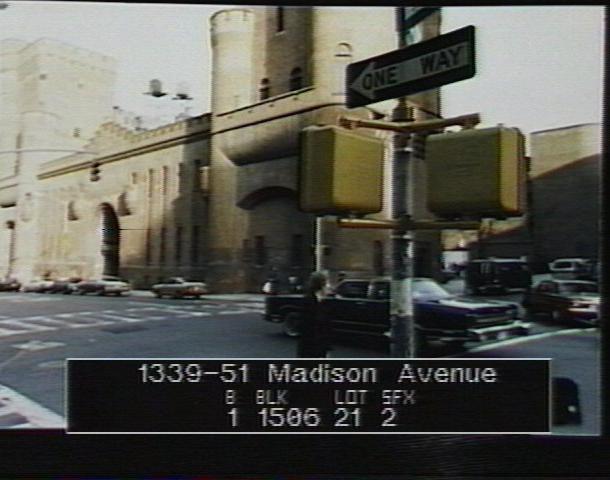
The city photographed every building for its tax records around 1940 and again in the 1980s. NYC Municipal Archives.
Written with AI from the source each entry cites, then fact-checked.
- 1888
John R. Thomas builds the Eighth Regiment Armory on the Park Avenue half of the block
Architect John Rochester Thomas designed the Eighth Regiment Armory, built in 1888-1890 on the Park Avenue half of this block between 94th and 95th Streets. His Squadron A Armory later went up directly beside it, facing Madison Avenue. The Eighth Regiment building was demolished in 1966, and the Hunter school building now stands on its site.
Source: friends-ues.org
- 1895
The cavalry unit Squadron A moves into its new Madison Avenue armory
Designed by John R. Thomas, the armory was built in 1895 for Squadron A, a cavalry unit, and had about 100 stalls for the squadron's horses. A stone plaque still carries the unit's battle cry, "Boutez en avant!"
Source: Wikipedia
- 1896
The Squadron A Armory that stood on this block holds its formal opening with a reception and a ball
The cavalry unit's Madison Avenue armory, which stood on this block, held its formal opening on January 31, 1896, with a reception and ball. Squadron A had begun in 1884 as a private group of gentleman riders called the First New York Hussars. By 1895 it had grown big enough to be divided into two troops under the Squadron name.
“…on January 31, 1896, the formal opening of the Armory took place with a reception and ball…”
- 1917
Squadron A enters federal service and is reorganized as the 105th Machine Gun Battalion
Squadron A, the National Guard cavalry unit based at the Madison Avenue armory on this block, was called into federal service for World War I. On October 13, 1917, it was reorganized as the 105th Machine Gun Battalion. The unit had become Troop A of the state guard in 1889 with 53 men and had served in the Spanish-American War.
- 1920
Squadron A joins two armories into one huge riding ring and becomes known for Saturday polo
In 1920 the squadron took over the neighboring Eighth Regiment Armory and joined the two buildings, making an especially large riding ring. With the added room it grew its social facilities, and it became known for Saturday polo matches, each followed by a black-tie dance. Like the Seventh Regiment, it drew members from the upper ranks of New York society, among them the architect C. P. H. Gilbert.
Source: friends-ues.org
- 1962
Sixty polo horses are still stabled in the old cavalry armory
Sixty polo horses were still being stabled in the armory as late as 1962, according to the New York Times. The building had been designed as a cavalry home, with a riding ring and about 100 horse stalls. By the mid-1960s, neighbors in Yorkville and East Harlem were demonstrating for schools and middle-income housing here, and the state handed the armory to the Board of Education for a new school.
Source: friends-ues.org
- 1966
An emergency landmark vote saves the armory's Madison Avenue facade
Most of the armory was torn down in the 1960s, but the Landmarks Preservation Commission stepped in with an emergency action that stopped the demolition of the Madison Avenue facade and designated it a landmark on October 19, 1966. Hunter College High School and Elementary School now use the rest of the site as their main campus.
Source: Wikipedia
- 1969
Morris Ketchum Jr.'s fortress-style school building for I.S. 29 is completed beside the old facade
After the Park Avenue side of the armory came down, the Department of Education hired Morris Ketchum Jr., a former president of the Architectural League, the Municipal Art Society and the AIA, to design the new school. His modern red-brick fortress, finished in 1969, takes its inspiration from the surviving armory facade that neighborhood advocates had won landmark status for.
Source: friends-ues.org
- 1972
The armory's Madison Avenue facade joins the National Register
On March 24, 1972, the surviving Madison Avenue facade of the former Squadron A Armory was added to the National Register of Historic Places, six years after an emergency landmark vote had saved it from demolition. The armory behind the facade had been built in 1895 by contractor John F. Johnson, with massive brick walls, towers, and about 100 stalls for Squadron A's cavalry horses. Its eastern and central portions were later rebuilt in a style echoing the original armory to house Hunter College's high school and elementary school.
Source: Wikipedia
- 1977
Hunter College High School moves into the school building on the old armory block
After years on the college's East 68th Street campus and then on two floors of an office building at 466 Lexington Avenue, Hunter College High School has occupied the block since 1977. Its building faces Park Avenue and was made to resemble the armory, whose Madison Avenue facade and two empty towers were left standing. With many classrooms lacking windows, the school is called the Brick Prison.
Source: Wikipedia
Further reading
- Squadron A ArmoryWikipedia
Nearby
- Virginia Fair Vanderbilt House60 East 93rd Street | 3 entries
- William Goadby Loew House56 East 93rd Street | 4 entries
- St. Francis de Sales Church135 East 96th Street | 3 entries
- House of the Redeemer7 East 95th Street | 11 entries
- Dahlgren-Cartier House15 East 96th Street | 4 entries
- Willard D. Straight House1130 5th Avenue | 9 entries