Grace Church
802 Broadway | also 94 4th Avenue, 96 4th Avenue, 92 4th Avenue | Greenwich Village | built 1900
Open on the map13 entries

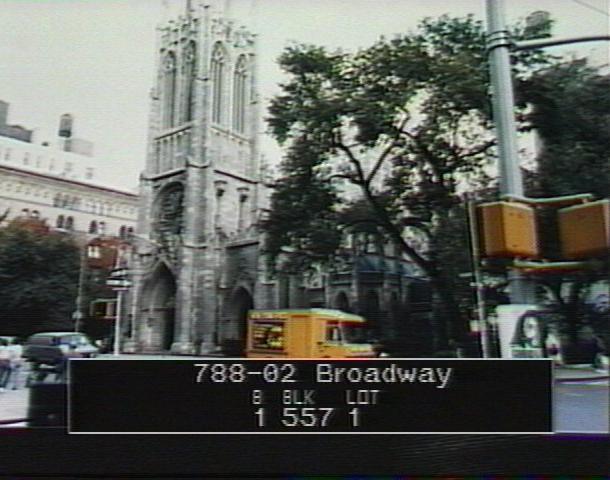
The city photographed every building for its tax records around 1940 and again in the 1980s. NYC Municipal Archives.
Written with AI from the source each entry cites, then fact-checked.
- 1815
Broadway is bent to spare the land that becomes Grace Church
When the city plans to extend Broadway straight north in 1815, landowner Henry Brevoort blocks the route to protect the orchards on his farm, forcing the street into a diagonal jog at what is now 10th Street. The Brevoort family later sells part of that same farmland to Grace Church's builders, letting the church rise on the land its owner once fought to save from the street grid.
Source: Ephemeral New York
- 1846
Grace Church consecrates its new Gothic Revival sanctuary
Architect James Renwick Jr., only in his twenties, completes a white marble Gothic Revival church on land bought from the Brevoort family's old farm. The building quickly becomes known as one of the most fashionable churches in New York, drawing the city's wealthiest families to Broadway and 10th Street for a generation.
Source: Wikipedia
- 1862
Edith Wharton is baptized at Grace Church on Easter Sunday
Edith Newbold Jones was born on January 24, 1862, in a brownstone at 14 West 23rd Street, the third child of George Frederic Jones and Lucretia Rhinelander. Her baptism took place at Grace Church on Easter Sunday, April 20, 1862. Friends and family called the baby "Pussy Jones"; she grew up to be the novelist Edith Wharton.
Source: Wikipedia
- 1863
Circus performers Tom Thumb and Lavinia Warren marry at Grace Church
P.T. Barnum's stars General Tom Thumb and Lavinia Warren, both little people who toured with his sideshow, wed at Grace Church in a ceremony the press dubs the "fairy wedding." Thousands of onlookers crowd Broadway outside, Vanderbilts and Astors attend, and photographer Mathew Brady documents the day before Barnum charges admission to the couple's reception.
Source: Ephemeral New York
- 1876
Consuelo Yznaga marries Viscount Mandeville at Grace Church
Consuelo Yznaga, the godmother of Consuelo Vanderbilt, was married at Grace Church to George Montagu, then known as Viscount Mandeville, on May 22, 1876. Weddings here were prized in the period: the writer Matthew Hale Smith observed in 1869 that a wedding or a burial inside its walls had long been seen as the peak of happiness for fashionable New Yorkers.
“Consuelo Yznaga (godmother of Consuelo Vanderbilt) married George Montagu, the then Viscount Mandeville, on May 22, 1876.”
Source: Wikipedia
- 1881
A marble spire designed by Renwick replaces Grace Church's wooden one
The church was first topped with a wooden spire. In 1881, during the tenure of rector Henry Codman Potter, that spire was taken down and a marble one, again drawn by James Renwick Jr., went up in its place. Three years earlier, the English firm Clayton and Bell had completed the large east window above the high altar, a "Te Deum" window about praise.
“The church originally had a wooden spire, but under the leadership of the rector at the time, Henry Codman Potter, it was replaced in 1881 with a marble spire designed by Renwick.”
Source: Wikipedia
- 1883
Grace Memorial House opens on Fourth Avenue as a day nursery given by Levi P. Morton
Levi P. Morton, a Vice-President of the United States under Benjamin Harrison, gave Grace Church a building at 94-96 Fourth Avenue in memory of his wife. James Renwick Jr. wrapped two earlier houses in a Gothic Revival front, and the result, finished in 1883, was known as the Day Nursery. The Landmarks Commission recorded that it was reputedly the city's first day-care center.
“Given to Grace Church by the Hon. Levi P. Morton, Vice-President of the United States under Benjamin Harrison, in memory of his wife…”
- 1893
Cornelia Martin marries the Earl of Craven at Grace Church
Heiress Cornelia Martin marries William Craven, 4th Earl of Craven, at Grace Church, joining a short list of Grace Church brides of the era who married into the British aristocracy. The wedding reinforces the church's reputation as a favored venue for Gilded Age high society weddings.
Source: Wikipedia
- 1894
Grace Church starts a choir school and a choir of men and boys
In 1894 Grace Church organized the school that is now Grace Church School, created as the first place where choir boys could get formal training for their duties. The Choir of Men and Boys was established the same year. Samuel Prowse Warren, who had been organist since 1868 apart from a two-year gap in the 1870s, served until 1894. A full day school followed in 1934.
“Grace Church School ... was organized in 1894, and was the first place where choir boys could receive formal training for their duties.”
Source: Wikipedia
- 1912
Grace Church memorializes a Titanic victim's sacrifice
After young socialite Edith Corse Evans dies in the Titanic sinking, having reportedly given up her seat in a lifeboat to a mother with children, her memorial service is held at Grace Church. A plaque inscribed "Love is strong as death" is installed beneath a stained glass window inside the church to commemorate her.
Source: Ephemeral New York
- 1974
A lawsuit halts demolition of Grace Church's Gothic houses on Fourth Avenue
On January 22, 1974, the vestry voted to build a school gymnasium that meant tearing down Nos. 92, 94-96 and 98 Fourth Avenue. Students from Columbia and Cooper Union picketed the site in February, and a Joint Emergency Committee formed on February 28. A suit filed in State Supreme Court on March 4 won a temporary restraining order, and an injunction followed in April.
“On March 4, 1974, a suit was brought in the Supreme Court of the State of New York to prevent demolition of the buildings…”
- 1975
A $100,000 grant tied to Eli Lilly turns the fight to save Grace Church's Fourth Avenue houses
After the injunction, the vestry agreed in April 1974 to keep the buildings if the money could be raised, and the Kaplan Fund promised $25,000. The turning point was a $100,000 grant that Thaddeus Seymour, president of Wabash College, obtained from Wabash trustee Eli Lilly and the Lilly Endowment. By June 1975 the New York Times reported the houses saved; about $425,000 was collected.
“Probably the turning point in the fund raising effort came when Thaddeus Seymour, President of Wabash College ... obtained a grant of $100,000…”
- 1977
The Landmarks Commission designates Grace Memorial House after a split hearing
The Landmarks Preservation Commission designated Grace Memorial House (Huntington House) at 94-96 Fourth Avenue as a landmark in a report dated February 22, 1977. At the March 22, 1974 hearing thirty witnesses had spoken for designation and twenty-five against. The report called the Gothic building one of the finest in the city and an essential terminal point of the vista along 11th Street toward Fourth Avenue.
Further reading
- Grace Church (Manhattan)Wikipedia
- Model tenements named for a forgotten bishopEphemeral New York
- Broadway’s delightful bend at East 10th StreetEphemeral New York
- A young socialite goes down with the TitanicEphemeral New York
- A postcard view of Wanamaker’s on BroadwayEphemeral New York
- A 10th Street bakery coins the “breadline”Ephemeral New York
- Broadway and East 10th Street: 1911 vs. 2011Ephemeral New York
- Rhinelander Gardens: then and nowEphemeral New York
Nearby
- Grace Church Rectory804 Broadway | 6 entries
- Cooper Station Post Office93 4th Avenue | 5 entries
- Greenwich Arms85 4th Avenue | 2 entries
- St. Ann's School117 East 11th Street | 4 entries
- 120 East 12th Street4 entries
- 43 East 10th Street5 entries