Grace Church Rectory
804 Broadway | Greenwich Village | built 1847
Open on the map6 entries

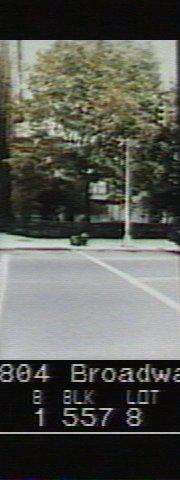
The city photographed every building for its tax records around 1940 and again in the 1980s. NYC Municipal Archives.
Written with AI from the source each entry cites, then fact-checked.
- 1846
James Renwick Jr. finishes a Gothic Revival rectory to match his Grace Church
James Renwick Jr. completed the rectory in 1846 as a companion to Grace Church. Pinnacled corner buttresses, gables with crockets and finials, pointed-arch windows and flamboyant tracery carry the church's Gothic character into a house, and the differing bay windows make it look less symmetrical and more romantic. The Landmarks Commission judged it probably one of the finest Gothic Revival residences in Manhattan.
- 1875
Rector Henry Codman Potter's wife advertises for places for the rectory's servants before a European trip
Henry Codman Potter was rector of Grace Church in 1875 when his wife, Eliza, planned a long trip abroad. On September 30 she ran a notice in the New York Herald hoping to place a cook, a seamstress, a lady's maid and a waitress she would not need while away, and it gave the rectory at 804 Broadway as the address. Rectors of wealthy churches lived much like their millionaire parishioners.
Source: Daytonian in Manhattan
- 1885
Rev. William Reed Huntington's family hosts a debutante tea in the rectory parlors
Once Henry C. Potter became assistant bishop of New York, by election in September 1883, Rev. William Reed Huntington, his wife Theresa and their three children took over the rectory. On December 29, 1885, the house held a tea and reception for the Huntingtons' second daughter, also named Theresa, who had just turned eighteen. The parlors were hung with evergreens and flowers, and guests included the Depews, Tiffanys, Dixes and Reids.
Source: Daytonian in Manhattan
- 1893
A teenage con man from Denmark milks the rectory's assistant ministers until one swears out a warrant
George Stabell had arrived alone from Denmark at 14, and in 1893 he told the assistant ministers Hubert Wells and George Bottome that he wanted to reform. Wells paid a week's rent at a boarding house and handed over $10 more than once, including after Stabell said his brother had turned up and needed a ticket to Baltimore. When Stabell failed to bring back $3 as promised, Wells obtained an arrest warrant at Jefferson Market Court. The other clergymen he had fooled ignored his notes from jail.
Source: Daytonian in Manhattan
- 1899
Rector Huntington installs a Roman jar from Nero's day in the rectory garden
In 1899 the rector, William Reed Huntington, added an ancient Roman jar to the rectory garden. Workers digging for the rectory of St. Paul's church in Rome had found six or seven terra-cotta jars from Nero's reign about 30 or 40 feet down. Huntington had seen two of them in 1884 and persuaded the rector there, Dr. Nevin, to give Grace Church one. It received a bronze mounting after reaching New York and was placed in the garden.
Source: Daytonian in Manhattan
- 1901
Burglars flee the rectory and leave silverware on the dining room floor and a chisel behind
On the morning of April 30, 1901, a maid found silverware strewn across the dining room carpet. Burglars had come in through a basement door, apparently after observing where the maid kept the key to the silver safe, but they fled and left a candle, matches and a chisel behind. They still carried off small pieces, including long-held family heirlooms of the rector, Dr. Huntington. A man with burglar tools had been caught in the basement a year earlier, and the police captain scolded his men for allowing a burglary in so prominent a place.
Source: Daytonian in Manhattan
Nearby
- Grace Church802 Broadway | 13 entries
- Cooper Station Post Office93 4th Avenue | 5 entries
- Strand Bookstore826 Broadway | 14 entries
- Greenwich Arms85 4th Avenue | 2 entries
- 817 Broadway Building817 Broadway | 6 entries
- 830 Broadway Building830 Broadway | 7 entries