43 East 10th Street
Greenwich Village | built 1900
Open on the map5 entries

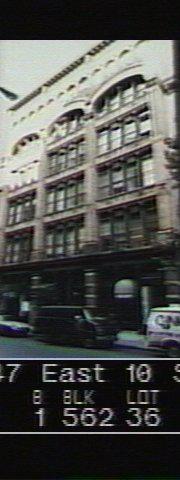
The city photographed every building for its tax records around 1940 and again in the 1980s. NYC Municipal Archives.
Written with AI from the source each entry cites, then fact-checked.
- 1891
Fur dealers Louis and Samuel Sachs hire Richard Berger to build a six-story loft on East 10th Street
The Real Estate Record reported on January 31, 1891 that L. Sachs & Brother, fur manufacturers turned developers, would redevelop Nos. 43, 45 and 47 East 10th Street, with Richard Berger drawing the plans. The result, finished within a year at about $100,000, was a single Romanesque Revival loft with two stores below and five factory floors above. Cast-iron framing allowed large windows, and the facade carried terra cotta panels with portrait busts, putti and garlands.
Source: Daytonian in Manhattan
- 1892
Lovell, Coryell & Company, a newly founded publisher, takes two floors and issues J. M. Barrie titles
The new loft quickly filled with publishers. In March 1892 Lovell, Coryell & Company, a firm recently founded by John Wurtele Lovell and Vincent M. Coryell, signed a three-year lease on the third and fifth floors. That July it released J. M. Barrie's Auld Licht Idylls, sold as a cloth-bound book for about a dollar. Textbook house University Publishing Company and the medical publisher William Wood & Company, founded in 1804, also rented space in the building.
Source: Daytonian in Manhattan
- 1894
A bookseller is sued for binding fire-damaged sheets salvaged from the building's tenant Maynard, Merrill & Co.
Maynard, Merrill & Co., a textbook publisher in the building, had sent pages and covers of an English-language textbook to a bindery on West 18th Street, which burned on June 21, 1893. The ruined stock was handed to junk dealers, but bookseller William Beverly Harison picked out the best sheets, bound them and sold them. The publishers sued him in January 1894 for violating their copyright, a case the Times called novel.
Source: Daytonian in Manhattan
- 1898
A back-draught blast in the boys'-clothing shop blows out windows before dawn and rattles the Lancaster next door
Shortly before dawn on June 16, 1898, an explosion shook the neighborhood around Grace Church and flames burst through the arched windows of Northrop & Curry, makers of boys' clothing, on the top floor. Fire investigators thought gases from a fire in the sealed space had built up until the pressure blew the glass out. Tenants of the neighboring Lancaster woke and begged to be let out, thinking their own house was burning. Damage was estimated at $8,000 to $10,000.
Source: Daytonian in Manhattan
- 1973
The last industrial tenant leaves and the loft is converted to apartments
Apparel firms occupied the building into the 1930s, and when the K. W. Improvement Company bought it in June 1939 it promised extensive alterations, though Berger's facade survived unchanged. The last industrial tenant left in 1973, when the building was turned over to residential use.
Source: Daytonian in Manhattan
Further reading
- Richard Berger's No. 43-47 East 10th StreetDaytonian in Manhattan
Nearby
- The Lancaster39 East 10th Street | 6 entries
- Walcutt & Leeds Building53 East 11th Street | 5 entries
- Albert Apartments23 East 10th Street | 3 entries
- 817 Broadway Building817 Broadway | 6 entries
- Police Athletic League Building (Grammar School 47)34 1/2 East 12th Street | 7 entries
- Grace Church Rectory804 Broadway | 6 entries