The Arsenal
830 5th Avenue | also 1000 5th Avenue | Central Park | built 1851
Open on the map12 entries

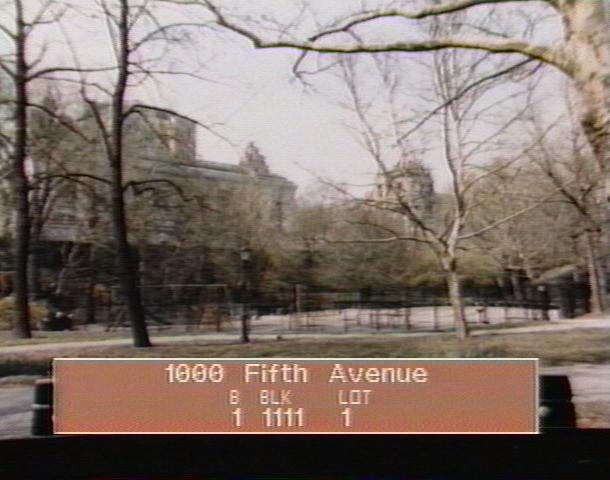
The city photographed every building for its tax records around 1940 and again in the 1980s. NYC Municipal Archives.
Written with AI from the source each entry cites, then fact-checked.
- 1851
New York State finishes an arsenal that predates the park
Built between 1847 and 1851 to store arms and ammunition for the state militia, the Arsenal is one of only two structures in Central Park older than the park itself. When the city bought it from the state in 1857 for $275,000, the munitions were removed and it became the park's administrative headquarters and a police precinct.
Source: 6sqft
- 1857
New York City buys the Arsenal from the state for $275,000
The Arsenal had been built for the state militia, but in 1857 New York City purchased it from New York State for $275,000 and made it the administrative headquarters for the newly planned Central Park. The sale came two years before the building's basement began holding a donated menagerie.
Source: Daytonian in Manhattan
- 1859
Donated animals start a menagerie at the Arsenal
In 1859 animals began arriving at the Arsenal as gifts from donors including P.T. Barnum and August Belmont, forming the menagerie that grew into the Central Park Zoo. The cages in the basement were removed in 1871 because of safety concerns and the smell.
Source: 6sqft
- 1859
Diarist George Templeton Strong calls the Arsenal hideous and hopes it burns
George Templeton Strong, the diarist, wrote in 1859 of the "hideous State Arsenal Building" and hoped an accidental fire would soon destroy it. NYC Parks says park advocates and urban observers regarded the structure as a blight on the landscape. The wish went unfulfilled, and the building went on to serve many roles over the following decades.
Source: nycgovparks.org
- 1869
The American Museum of Natural History opens in the Arsenal
From 1869 to 1877 the young American Museum of Natural History used the Arsenal's second and third floors while its building on Central Park West was being built. Paleontologist B. Waterhouse Hawkins worked in a studio here reconstructing dinosaur skeletons, and the city's weather bureau kept instruments on the roof from 1869 to 1918.
Source: 6sqft
- 1869
The Municipal Weather Bureau moves into the Arsenal's upper story
According to the Landmarks Preservation Commission, the Municipal Weather Bureau was installed in the Arsenal's upper story in 1869. The city had bought the building in 1857, and its report says the headquarters of the 11th Precinct police took the place of the stored arms. The commission lists a police precinct, a museum, the Weather Bureau and the Department of Parks among the uses that made the building's history distinguished.
“In 1869, the Municipal Weather Bureau was installed in the upper story.”
- 1870
Jacob Wrey Mould remodels the Arsenal's interior
In 1870 Jacob Wrey Mould, the architect responsible for much of the ornamental detail at Bethesda Terrace and elsewhere in Central Park, remodeled the Arsenal's interior. NYC Parks notes that various designs for remodeling the building emerged over time.
Source: nycgovparks.org
- 1871
The Arsenal's interior animal cages are removed by 1871 over danger and stench
By 1871 the cages inside the Arsenal had been removed. Donated animals had been shown in outdoor cages and in the basement, and NYC Parks says the "great insecurity and danger" of that arrangement, along with the stench, led to the change.
Source: nycgovparks.org
- 1924
A $75,000 overhaul of the near-ruined Arsenal turns up a spring and a secret passage
From 1914 to 1924 the Manhattan parks offices operated out of the Municipal Building, and the Arsenal deteriorated so far that a 1922 New York Times headline called it a near ruin. The city appropriated $75,000 for an overhaul, with most of the space set aside for Parks Department offices. Reconstruction uncovered an underground spring and a secret passage, possibly dating from the building's days as an arsenal, and the restoration was completed in 1924.
Source: nycgovparks.org
- 1934
The Arsenal is renovated as headquarters of the unified citywide Parks Department
In 1934 the Arsenal was completely renovated to serve as the first and only headquarters of a citywide, unified Parks Department. Commissioner Robert Moses, working from command posts at the Arsenal and Randall's Island, set about an unprecedented expansion of the park system and the modernization of public facilities. NYC Parks notes the building had served only off and on as borough park offices before then.
Source: nycgovparks.org
- 1936
Allen Saalburg paints Civil War-era murals in the Arsenal's renovated lobby
The Arsenal had faced demolition threats over its old-fashioned, fortress-like appearance before falling into broader use in the 1920s and undergoing renovation in the 1930s. During that period, WPA artist Allen Saalburg painted a series of floor-to-ceiling lobby murals in 1935 and 1936, mixing Civil War-era New York scenes with ornamental scrollwork.
Source: Wikipedia
- 1967
The Arsenal is designated a New York City landmark
The Landmarks Preservation Commission designated the Arsenal a New York City landmark in 1967, protecting the fortress-style brick building that predates Central Park itself, decades after it had passed from armory to menagerie to museum to Parks Department headquarters.
Source: Daytonian in Manhattan
Further reading
- Arsenal (Central Park)Wikipedia
Nearby
- Delacorte Clock1000 5th Avenue | 6 entries
- Edward J. Berwind House828 5th Avenue | 11 entries
- 834 Fifth Avenue834 5th Avenue | 10 entries
- 820 Fifth Avenue820 5th Avenue | 11 entries
- New India House3 East 64th Street | 4 entries
- Temple Emanu-El840 5th Avenue | 8 entries