Gorham Building
889 Broadway | also 15 East 19th Street | Flatiron | built 1884
Open on the map8 entries

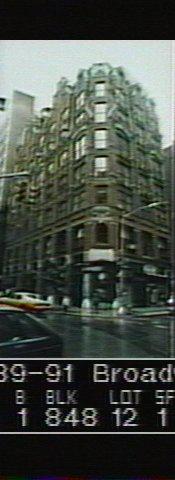
The city photographed every building for its tax records around 1940 and again in the 1980s. NYC Municipal Archives.
Written with AI from the source each entry cites, then fact-checked.
- 1845
A hardware store and a marble dealer occupy the Goelet-owned corner before 1883
Almy Goelet bought the Broadway and 19th Street site in 1845-46, when the Goelet family, known for holding on to land, was assembling property on both sides of Broadway. In the 1850s it held a hardware store and a marble dealer. The most opulent residence on this stretch was Peter Goelet's house on 19th Street, which stood until 1897.
“During the 1850s, that site contained a hardware store and a marble dealer.”
Source: Wikipedia
- 1883
Robert and Ogden Goelet build a block with bachelor flats above a silver store
Construction began in June 1883 and ended a year later on an eight-story building for the Goelet brothers. The Gorham Manufacturing Company rented the two lower floors for a store, and bachelor apartments filled the floors above. Commerce took over this stretch of Broadway so fast that, of four buildings begun here in the first half of 1883, only this one had residential floors.
“Of four buildings begun on this section of Broadway in the first half of 1883, only the Gorham included residential floors…”
- 1883
Architect Edward Hale Kendall, who designed an elevator office tower at 120 Broadway, plans the building
Edward Hale Kendall, born in Boston, came to New York in 1865. With Arthur Gilman he designed the Equitable Life Assurance Building at 120 Broadway, finished about 1870, the city's first office building with a passenger elevator. The Goelet brothers, for whom he had designed Fifth Avenue houses in 1880, hired him for the Broadway and 19th Street building. From 1884 to 1888 he headed the New York chapter of the American Institute of Architects, and in 1892 and 1893 he led the national body.
“The Equitable was the first office building in New York to have a passenger elevator.”
- 1884
Gorham opens its New York silver store, which the Times calls the most extensive silverware house in the country
Gorham's founder, Jabez Gorham of Providence, became a silversmith in 1831, and by his retirement in 1847 the firm was the first among silversmiths to turn to machinery. It incorporated in 1865 with his son John as president. At the New York store's opening in May 1884, the Times described the firm as the country's most extensive silverware house. An 1892 guidebook described its work as the finest of its line anywhere.
“…the most extensive silverware house in this country…”
- 1888
Gorham takes over the third and fourth floors for an engraving room and a salesroom
In 1888 Gorham expanded upward, removing partitions on the third floor to make an engraving room for silver-plated ware and turning the fourth into a salesroom. In 1893 the last residential use of the building ended, with exterior and interior alterations by Kendall. Gorham's operation now filled the building.
“…the third floor was turned into an engraving room for silver-plated ware, and the fourth into a salesroom…”
- 1906
Gorham follows B. Altman uptown, leaving Ladies' Mile for Fifth Avenue at 36th Street
The district stayed fashionable for shopping into the early 1900s, but the big stores then began moving north. B. Altman's left first in 1906, relocating to Fifth Avenue at 34th Street. The Gorham Company made a similar move that year, to a new building at Fifth Avenue and 36th Street. After World War I, nearly all the large retailers had gone, leaving their buildings behind.
“The Gorham Company followed the same year, moving to a new building on Fifth Avenue at 36th Street.”
- 1912
John H. Duncan converts the building to lofts in 1912, and it returns as shops and apartments in 1977
In 1912 the architect John H. Duncan turned the building into lofts and offices, taking off the corner tower and putting dormers on the roof. By 1922 the upper floors could also be used for light industry. A 1977 restoration brought back a ground-floor store with cooperative apartments above and added a rooftop penthouse. Around 1988 the dinnerware retailer Fishs Eddy took the retail space.
“…converted by John H. Duncan in 1912 into lofts and offices, removing a corner tower and adding roof dormers…”
Source: Wikipedia
- 1984
The Landmarks Commission designates the Gorham Building, a rare commercial Queen Anne design
After hearings in November 1980 and February 1981, with two witnesses and two letters in favor and no opposition, the commission designated the building on June 19, 1984. Its report calls the building an unusual surviving example in New York of the Queen Anne style, a style seldom used for commercial buildings, and notes the picturesque massing and rich ornament. It is one of Kendall's few surviving works.
“…is an unusual example remaining in New York of the Queen Anne style…”
Further reading
- 889 BroadwayWikipedia
Nearby
- Theodore Roosevelt Birthplace28 East 20th Street | 10 entries
- 144 5th Avenue3 entries
- Old Town Bar45 East 18th Street | 7 entries
- 860 Broadway4 entries
- Scribner Building155 5th Avenue | 9 entries
- 18 East 17th Street1 entry