John F. Kennedy Educational Campus
99 Terrace View Avenue | also 1 Terrace View Avenue | Inwood Hill Park
Open on the map11 entries

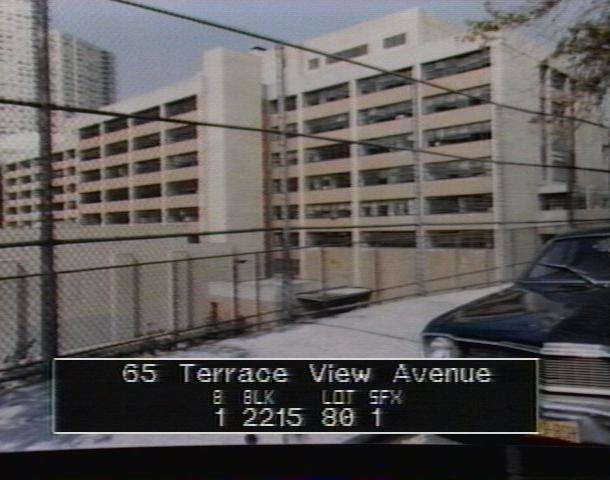
The city photographed every building for its tax records around 1940 and again in the 1980s. NYC Municipal Archives.
Written with AI from the source each entry cites, then fact-checked.
- 1914
Spuyten Duyvil Creek's old course, where the school now stands, is filled in
Before the school, this ground was part of Spuyten Duyvil Creek, the waterway that separated Manhattan from the Bronx. After the Harlem River Ship Canal was dug in 1895, the old creek route was filled in during 1914. The land was later used as Kingsbridge Yard, a freight spur of the New York Central Railroad's Spuyten Duyvil and Port Morris line. Tibbett Avenue follows the old Tibbetts Brook right-of-way, which met the creek near West 230th Street.
“…in 1914 the original creek routing was filled in. The land was later used as a freight spur called Kingsbridge Yard…”
Source: Wikipedia
- 1969
Construction begins on Kennedy High School's Marble Hill campus
The city condemns and acquires the Terrace View Avenue site in 1968, and construction begins on John F. Kennedy High School in 1969. The building rises on land once occupied by the old Spuyten Duyvil Creek, filled in decades earlier after the Harlem River Ship Canal rerouted the waterway.
Source: Wikipedia
- 1972
John F. Kennedy High School opens in the old Spuyten Duyvil creek bed
The eight-story school opened on September 11, 1972, on the Bronx-Manhattan border, built in the former creek bed of Spuyten Duyvil on land that had been a railroad freight yard. Designed for 4,000 students, it had a 22,000-volume library, several gyms and industrial arts shops, and a pedestrian bridge leads into it at the fourth floor.
Source: Wikipedia
- 1982
Kennedy and the private Fieldston School start a joint arts program called Urban Arts
A new program called Urban Arts brought students and teachers from John F. Kennedy High School and the private Fieldston School together for year-round joint arts classes and projects, the New York Times reported in April 1982. It was the idea of Sylvia Corwin, a Kennedy administrator who had heard federal funds were available and applied for them the spring before. When she called Fieldston, assistant principal Ellen Stern said yes. The schools were planning a joint arts festival at Kennedy the following month, with exhibits and performances.
Source: Internet Archive
- 1983
Sara Lawrence Lightfoot's book The Good High School features Kennedy among six schools
Harvard sociologist Sara Lawrence Lightfoot spent three years looking for good high schools. After a week at Kennedy she included it among the six in her 1983 book, The Good High School, which quotes principal Robert Mastruzzi. Mastruzzi arrived in April 1972, before construction was finished, and left in 1984 to become superintendent of the Manhattan high schools. The account comes from Sylvia Corwin, a former Kennedy assistant principal, writing in the Riverdale Press.
Source: riverdalepress.com
- 1984
Kennedy's football team wins the city title, then becomes the first public school to take the Metro Bowl
In the fall of 1984 Kennedy's football team won the city championship in the Bronx-Manhattan A division, then went on to be the first public school to capture the Metro Bowl, the yearly game pitting Catholic school champions against public school champions. The girls' volleyball team also took a city title, and the boys' track squad took the city's indoor title. The Times noted that Kennedy, with 4,800 students, was being called an athletic power, though principal Charles Saltzman said he was not interested in becoming Notre Dame.
Source: Internet Archive
- 2002
Smaller schools begin sharing Kennedy High School's campus
In September 2002, Marble Hill High School opens inside the Kennedy building, the first of several small schools to move onto the campus as the city reorganizes large high schools. The Bronx School for Law and Finance and Bronx Theatre High School follow in September 2003, and Kennedy's own enrollment shrinks as the new schools grow.
Source: Wikipedia
- 2004
A new principal's crackdown and school-spirit push turns Kennedy around, the Times reports
By early 2004, after a 2002 stabbing outside the school and the metal detectors that followed, Principal Anthony Rotunno had started to reverse Kennedy's slide. Beginning in November 2002 he cracked down on hallway wanderers and fighters, pressed students with few credits toward other placements, reopened bathrooms that had been bolted shut after arson and flooding, and brought back events such as homecoming. Mayor Bloomberg left Kennedy off his list of 12 unruly schools.
Source: Internet Archive
- 2010
The city proposes to close Kennedy High School in stages by June 2014
On December 6, 2010, the city announced a plan to phase out Kennedy by June 2014. It would stop admitting freshmen the next fall while upper-grade students graduated, and two new schools would open in its place. The school then had 1,159 students, down from about 6,000 in 1985, and applications had dropped by 1,500 since 2005. The Panel for Educational Policy was to vote the first week of February.
Source: riverdalepress.com
- 2014
Kennedy High School graduates its last class
The Kennedy Knights won 38 city championships in 40 years, but by 2010 the school's four-year graduation rate had fallen to 46 percent, and the city phased it out. Its final class graduated in June 2014, and the building now houses seven smaller schools. Alumni include city comptroller Scott Stringer and DJ Kid Capri.
Source: Wikipedia
- 2015
A gas explosion damages the former Kennedy High School building
On August 20, 2015, a gas explosion tears through the former Kennedy High School building, damaging the fourth through sixth floors and injuring three workers. The blast comes the year after Kennedy graduated its last class, with the campus by then fully passed to the smaller schools sharing its building.
Source: Wikipedia
Further reading
Nearby
- St. Stephen's United Methodist Church146 West 228th Street | 4 entries
- Robertson Field at Satow Stadium543 West 218th Street | 3 entries
- NewYork-Presbyterian Allen Hospital5141 Broadway | 2 entries
- St. John's Church3021 Kingsbridge Avenue | 4 entries
- Class of 1929 Boathouse607 West 218th Street | 1 entry
- Commisso Soccer Stadium507 West 218th Street | 3 entries