Alexander Hamilton U.S. Custom House
1 Bowling Grn | also 1 Bowling Green | Financial District | built 1907
Open on the map12 entries

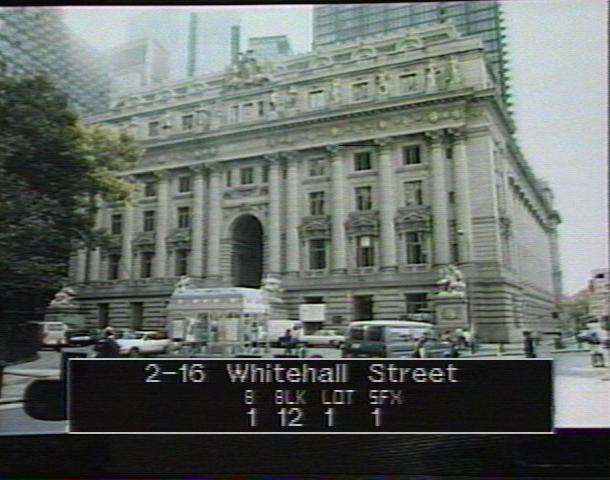
The city photographed every building for its tax records around 1940 and again in the 1980s. NYC Municipal Archives.
Written with AI from the source each entry cites, then fact-checked.
- 1790
Government House, planned as a presidential mansion, replaces Fort George on the Custom House site
The ground at Bowling Green was New York's citadel as Fort Amsterdam, which the English renamed Fort James and then Fort George after 1664. By 1790 Government House stood there, planned as the president's residence until Congress moved the federal capital to Philadelphia that year. It served as the governor's mansion until the state capital moved to Albany in 1797, and it was demolished in 1815 and replaced by rowhouses. The Custom House later rose on the same ground.
Source: Forgotten New York
- 1899
Cass Gilbert wins the competition to design a new custom house
In May 1899 the federal government invites twenty firms to compete to design a new custom house at Bowling Green. By September the field is down to two finalists, Carrere and Hastings and Cass Gilbert, who had recently moved from Minnesota to New York. The supervising architect, James Knox Taylor, picks Gilbert, a choice that draws criticism from some opponents.
Source: Wikipedia
- 1902
A ticker-tape parade precedes the laying of the Custom House cornerstone
On October 7, 1902, Treasury Secretary Leslie M. Shaw attended the ceremony laying the cornerstone of the new Custom House. A ticker-tape parade went down Broadway first. The stone, filled with souvenirs and artifacts of the day, was set at the northeast corner of the site.
“The cornerstone of the building was laid on October 7, 1902, in a ceremony attended by Treasury secretary Leslie M. Shaw.”
Source: Wikipedia
- 1907
The Customs Service moves into the new Custom House on Bowling Green
The U.S. Customs Service moves its offices into the building on November 4, 1907, after about five years of construction. The site had been dug out to a depth of 25 feet, removing some 2.2 million cubic feet of earth. With a projected final cost of $4.5 million, it is the most expensive public building in the city apart from the Tweed Courthouse.
Source: Wikipedia
- 1918
Cass Gilbert is ordered to replace German insignia on the Germania statue with Belgian ones
After the United States entered World War I, individuals and patriotic societies objected to a figure of Germany among the Custom House's cornice sculptures. Federal officials judged it not feasible to remove the five-ton Germania statue, so in September 1918 architect Cass Gilbert was directed to replace the German insignia on it with Belgian ones. The figure is the work of sculptor Albert Jaegers.
“…in September 1918, Gilbert was directed to remove the German insignia on the entablature's Germania statue and replace them with Belgian insignia…”
Source: Wikipedia
- 1937
Reginald Marsh paints rotunda murals for a federal relief program
In 1937 the painter Reginald Marsh is commissioned to decorate the rotunda ceiling, which had been left as plain white plaster. The work is part of the Treasury Relief Art Project, with funds and help from the Works Progress Administration. The larger panels show shipping in the port, and the smaller ones depict explorers. The murals are finished by February 1938.
Source: Wikipedia
- 1965
The city designates the Custom House a landmark even though federal officials question its authority
On October 14, 1965, the Landmarks Preservation Commission designated the Custom House as landmark LP-0020. After a hearing at which five people spoke in favor, a letter from the federal General Services Administration questioned whether a city could regulate federal property. The commission replied that it wished to honor a building New Yorkers were proud of, and warned that the building might someday be in jeopardy.
“At some time in the future this building may be in jeopardy. Our designation will be especially helpful in alerting New York City's elected representatives in Washington…”
- 1983
After a decade of padlocked gates, the government invites tenants into the Custom House
In November 1983 the New York Times found the Custom House silent: no one had worked there for a decade and no visitor had been inside for more than four years, since the last art show in summer 1979. The General Services Administration sought proposals to reuse 77,000 square feet including the rotunda, whose two clocks were frozen at 1:55 and 2:35. Senator Daniel Patrick Moynihan said $29 million was appropriated, and the Landmarks Conservancy built a 15-foot model of the building as an exhibit.
Source: Internet Archive
- 1984
The federal government picks a Holocaust museum over an arts center for the Custom House
On October 17, 1984, the General Services Administration announced that the New York City Holocaust Memorial Commission would turn part of the Custom House into a museum, after a six-month contest with a consortium of arts groups that wanted a cultural center. Regional administrator William Diamond said the commission offered the strongest deal, including $5 million toward restoration. Consortium chairman Gilbert Tauber called the choice a mistake, saying the building's opulence would blunt the museum's message.
Source: Internet Archive
- 1989
Ghostbusters II films at the Custom House, which stands in for a Manhattan art museum
The Custom House's exterior and lobby appear in the 1989 supernatural comedy Ghostbusters II, where the building plays the fictional Manhattan Museum of Art. Other productions shot there include Inside Man in 2006, How to Lose a Guy in 10 Days in 2003, and Black Swan, and it has appeared in Citibank and BMW commercials.
“Its exterior and lobby were used as a filming location in the 1989 American supernatural comedy film Ghostbusters II…”
Source: Wikipedia
- 1994
The Heye Center museum opens its galleries in the Custom House
The George Gustav Heye Center, a branch of the National Museum of the American Indian, formally opens its galleries around the rotunda on October 30, 1994. Most of the space had been closed for about twenty years after the Customs Service left. Congress had renamed the building for Alexander Hamilton in 1990, and the U.S. Bankruptcy Court takes two upper floors.
Source: Wikipedia
- 2012
The National Archives' New York branch announces its move into the Custom House
In September 2012 the National Archives and Records Administration said it would move its New York facility from 201 Varick Street to the Custom House in late October. It would occupy the third and fourth floors, above the National Museum of the American Indian. Its holdings include Susan B. Anthony's 1873 record of conviction for voting and records of immigration through Ellis Island.
Source: Internet Archive
Further reading
- Alexander Hamilton U.S. Custom HouseWikipedia
Nearby
- Battery Park Control House10 Battery Park | 5 entries
- 2 Broadway9 entries
- 6 Stone Street5 entries
- 1 Broadway14 entries
- 25 Bridge Street6 entries
- 17 State Street8 entries