17 State Street
also 2 Pearl Street | Financial District | built 1987
Open on the map8 entries

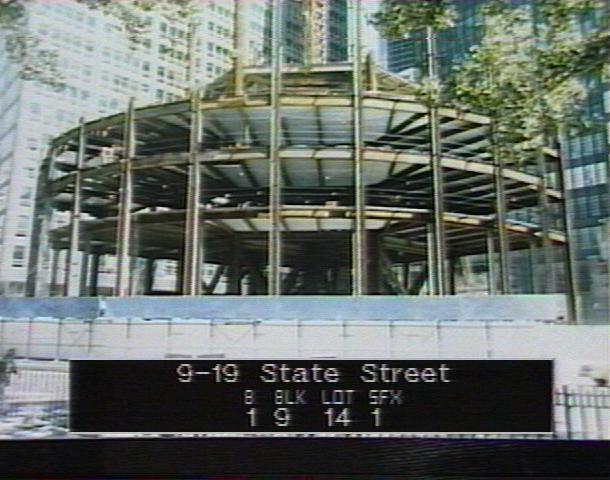
The city photographed every building for its tax records around 1940 and again in the 1980s. NYC Municipal Archives.
Written with AI from the source each entry cites, then fact-checked.
- 1819
Herman Melville is born on the site, at the old 6 Pearl Street address
Novelist Herman Melville was born in 1819 in a house at 6 Pearl Street, a plot that now sits behind 17 State Street's tower. A bronze bust of Melville was later displayed in the small plaza behind the building, fittingly close to where the Seamen's Church Institute once stood.
Source: Forgotten New York
- 1968
The Seamen's Church Institute moves into a 23-story building at 15 State Street
In 1968 the Seamen's Church Institute of New York and New Jersey relocated to a 23-story building at 15 State Street that offered 295 rooms for seafarers, according to the institute's archival finding aid. This tower is the one that 17 State Street later replaced.
Source: qcarchives.libraryhost.com
- 1986
A Board of Standards and Appeals permit makes a public exhibit space a condition of the tower
The developer asked for a special permit in 1986 to modify the height and setback rules. The Board of Standards and Appeals made a 1,600-square-foot public exhibit space a condition of that permit, without granting a zoning bonus for it. The Municipal Art Society's public-space profile says the space held the South Street Seaport Museum's "New York Unearthed" archaeological exhibit.
Source: apops.mas.org
- 1986
Construction halts after diggers find colonial-era artifacts
Demolition of the site's previous tower began in September 1985, and excavation for a new speculative office building by the William Kaufman Organization and JMB Realty started in February 1986. Work stopped that April after archaeologists raised concerns about artifacts tied to the 18th-century family of Jewish settler Abraham Isaacs, who had lived on the site.
Source: Wikipedia
- 1988
The finished tower opens with no tenants and rents about 50 percent above comparable buildings
Completed in early 1988, 17 State Street was a speculative project with no anchor tenant and opened with no tenants at all. Offices were being offered at an average of $50 per square foot, roughly half again as much as comparable buildings. Downtown demand was falling, and by December 1988 only four floors were occupied.
Source: Wikipedia
- 1988
A curved glass tower replaces the short-lived Seamen's Church Institute building
Architect Roy Gee of Emery Roth & Sons designed the 42-story, 542-foot tower with a quarter-round facade of curved glass facing Battery Park, completed in 1988. It replaced the 23-story Seamen's Church Institute headquarters, which had stood for only about sixteen years before demolition.
Source: Wikipedia
- 1990
"New York Unearthed" opens as a street-level archaeology exhibit
The South Street Seaport Museum ran a ground-floor exhibition space called New York Unearthed at 17 State Street from 1990 to 2005, displaying artifacts recovered from archaeological digs around Lower Manhattan.
Source: Wikipedia
- 1994
TIAA sets up a website for 17 State Street when few office buildings had one
In October 1994 the building's owner, TIAA, set up a website with videos and photographs of 17 State Street to attract tenants. Relatively few office buildings had websites at that point. Within a year, firms in places as distant as Geneva and Hong Kong had shown interest.
Source: Wikipedia
Further reading
- 17 State StreetWikipedia
- 6 facts about Herman Melville, born 200 years ago today in ManhattanThe Bowery Boys
Nearby
- St. Elizabeth Ann Seton Shrine7 State Street | 12 entries
- SeaGlass Carousel10 Battery Park | 1 entry
- Alexander Hamilton U.S. Custom House1 Bowling Grn | 12 entries
- Battery Park Control House10 Battery Park | 5 entries
- 25 Bridge Street6 entries
- The Battery South Kiosk10 Battery Park | 1 entry