One Police Plaza
1 Police Plaza | also 109 Park Row | Civic Center | built 1973
Open on the map14 entries

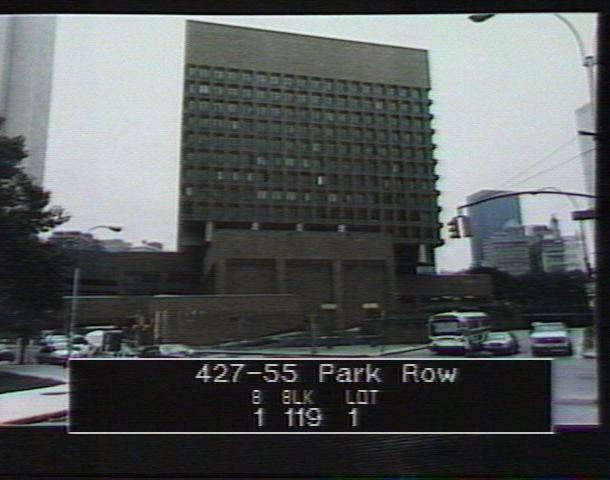
The city photographed every building for its tax records around 1940 and again in the 1980s. NYC Municipal Archives.
Written with AI from the source each entry cites, then fact-checked.
- 1968
Gruzen & Partners break ground for the new police headquarters a decade after first being offered the job
The architects Gruzen & Partners were first offered the headquarters commission in 1958, and ground was broken about ten years later. This was the third and final site proposed for moving the department out of its Beaux-Arts building on Centre Street in Little Italy, which it had occupied since 1909. Several streets, including Duane and New Chambers, were closed to create the site, and Park Row was lowered to curve under the Brooklyn Bridge anchorage.
Source: nycurbanism.com
- 1971
Park Row is rerouted beneath the new plaza and an intersection disappears
Between 1971 and 1973 the city built a pedestrian plaza as part of One Police Plaza. Park Row was rerouted to run underneath it, and the street no longer crosses New Chambers Street or Duane Street there. Until then Park Row had run in a relatively straight line, apart from a curve around the Brooklyn Bridge's ramps.
“Between 1971 and 1973, a pedestrian plaza was built as part of 1 Police Plaza, after which Park Row was rerouted underneath the plaza…”
Source: Wikipedia
- 1973
One Police Plaza is dedicated as the NYPD's new headquarters, replacing 240 Centre Street
One Police Plaza was dedicated on October 16, 1973, as headquarters of the New York City Police Department. It replaced the previous headquarters at 240 Centre Street, about a mile to the north. The building was designed by Gruzen and Partners. The second floor houses the Real Time Crime Center, a data network that detectives use to assist officers in the field, and the police commissioner's office is on the 13th floor.
Source: Wikipedia
- 1973
Critics praise the red-brick headquarters and a plaza that was the city's largest when it opened
The headquarters is a red brick cube whose corners cantilever over a horizontal base, and below it are a garage for 650 cars, holding cells and a shooting range. Critic Paul Goldberger said its plazas tied the building into the surrounding neighborhood, and Ada Louise Huxtable called the plaza the city's finest. Designed by M. Paul Friedberg and paved in the same red brick, it was larger than any other public plaza in the city when it opened.
Source: nycurbanism.com
- 1973
Remnants of an 18th-century prison and an 1890 building survive on the plaza
When the plaza was built, a single wall with a barred window and a plaque was preserved at its edge as a remnant of an 18th-century Revolutionary War prison. Several Doric columns that came from the Rhinelander Building, built in 1890, also remain on the site.
Source: nycurbanism.com
- 1974
Tony Rosenthal's 35-foot "5 in 1" sculpture is installed on the plaza
Rosenthal's painted CorTen steel sculpture, commissioned by the city in 1971 for $80,000 and made in 1973 and 1974, stands 35 feet tall and weighs 75,000 pounds. Its five interlocking discs stand for the five boroughs. When installed in 1974 it was the largest metal public sculpture in New York City.
Source: Wikipedia
- 1989
Painter Valerie Jaudon's Reunion paving and fountain wall are added to the plaza
In 1989 the painter Valerie Jaudon contributed Reunion, a paving scheme and fountain wall surrounded by honey locust trees, to the plaza outside police headquarters. It joined Tony Rosenthal's sculpture 5 in 1 as one of the plaza's two public art installations. The plaza was paved in the same red brick as the headquarters building.
Source: nycurbanism.com
- 2000
Bill Bratton plans a TV series called Puzzle Palace, a nickname for One Police Plaza
Puzzle Palace was a nickname first used for the Pentagon, and it is also known to NYPD insiders as a name for One Police Plaza. On May 1, 2000, the Daily News reported that former commissioner Bill Bratton was planning a TV series based on his memoir Turnaround, tentatively titled Puzzle Palace, to be pitched to networks that August. Speaking of his former office on the top floor, Bratton said "It's where all the puzzles are never solved."
Source: barrypopik.com
- 2001
Park Row is closed to public traffic, with the NYPD citing the threat of a truck bomb
Park Row, long a main artery between the Financial District and Chinatown, has been closed to public traffic since 2001, which the NYPD says protects its headquarters from a truck bomb. Chinatown residents and the Civic Center Residents Coalition fought the security perimeter for years. The street reopened to foot traffic and MTA buses in 2005, limited to 200 buses a day through checkpoints, and a greenway opened in June 2018.
“Park Row, historically a major artery linking the Financial District to Chinatown and the Bowery, has been closed to public traffic since 2001.”
Source: Wikipedia
- 2005
Park Row reopens to pedestrians and a limited number of buses
Park Row, closed to public traffic since 2001 as a security measure, reopened to foot traffic and MTA buses in 2005. Only 200 buses a day were allowed through, and they had to pass security checkpoints. Chinatown residents had been frustrated by the closure, and in 2007 the NYPD said it would not move its headquarters despite their complaints.
“Park Row reopened for foot traffic and MTA buses in 2005, although only 200 buses per day were allowed on the street…”
Source: Wikipedia
- 2008
Downtown residents rally against the headquarters expansion
On August 27, 2008, Lower Manhattan residents rallied near One Police Plaza to protest a planned addition to the headquarters. Tenants of three neighboring co-ops sued to force the NYPD to carry out environmental and land-use reviews. The 22,000-square-foot expansion was nonetheless completed in 2011.
Source: Wikipedia
- 2009
Police reporters learn that their press room, "the shack," must move out for renovation
The press room on the building's second floor is called "the shack," and in 2009 the police department announced renovations that would force the reporters out. The nickname, officially the Headquarters Press Building, dates to at least 1943, when it described a three-story building at 4 Centre Market Place opposite the old headquarters, built in 1940 for $25,000 raised by a Daily News reporter. Newspapers have kept shacks near police headquarters since 1863.
Source: barrypopik.com
- 2009
Commissioner Kelly backs down on evicting reporters from The Shack
In 2009 Police Commissioner Ray Kelly ordered the press out of One Police Plaza by July 31, and Mayor Bloomberg publicly backed him. After the Daily News and the Post protested, Kelly backtracked by the end of the week and said the media could stay, though on unclear terms. Reporters have worked on the second floor since the building opened in 1973.
Source: nypdconfidential.com
- 2018
A greenway for cyclists and pedestrians opens on Park Row beside headquarters
In June 2018 two lanes of Park Row beside One Police Plaza were converted into a cycling and pedestrian greenway. The NYPD took part in the effort while keeping the street closed to ordinary traffic as a precaution against a truck bomb, a restriction in place since 2001.
Source: Wikipedia
Further reading
- 1 Police PlazaWikipedia
Nearby
- Murry Bergtraum High School411 Pearl Street | 7 entries
- Metropolitan Correctional Center150 Park Row | 15 entries
- Church of St. Andrew20 Cardinal Hayes Place | 8 entries
- 375 Pearl Street (Verizon Building)375 Pearl Street | 9 entries
- Municipal Building (David N. Dinkins Municipal Building)1 Centre Street | 6 entries
- Thurgood Marshall United States Courthouse40 Foley Square | 12 entries