Thurgood Marshall United States Courthouse
40 Foley Square | also 24 Cardinal Hayes Place, 40 Centre Street, 39 Pearl Street | Civic Center | built 1933
Open on the map12 entries

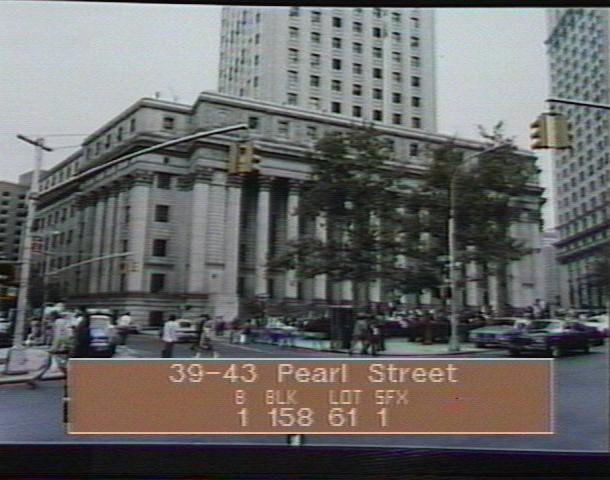
The city photographed every building for its tax records around 1940 and again in the 1980s. NYC Municipal Archives.
Written with AI from the source each entry cites, then fact-checked.
- 1933
Treasury awards the $5,996,000 contract to build the Foley Square courthouse in granite
On January 19, 1933, the contract for the federal courthouse in New York went to James Stewart & Co. for $5,996,000. Granite was named as the material, though the kind of granite was not yet settled. The contractor was allowed 720 days for the work on what was described as a 31-story building.
Source: Internet Archive
- 1934
Lewis Mumford savages the courthouse in The New Yorker months after Gilbert's death
Cass Gilbert died in May 1934 while the building was going up. That October, Lewis Mumford used his New Yorker column to call the courthouse the supreme example of pretension, mediocrity and fake grandeur, and he singled out the awkward pairing of tower and base. He added that Gilbert would probably be remembered as one of the worst monumental architects the country had produced.
Source: Internet Archive
- 1936
Cass Gilbert's federal courthouse opens on Foley Square
Designed by Cass Gilbert with his son Cass Gilbert Jr., the Classical Revival courthouse was built from 1932 and opened on January 15, 1936. A six-story base supports a 31-story tower clad in Minnesota granite, with 35 courtrooms inside. It became a city landmark in 1975 and was later renamed for Thurgood Marshall, who sat on the Second Circuit court here from 1961 to 1965.
Source: Wikipedia
- 1936
Clerks wheel the last filings out of the old post office courthouse and into Foley Square
On January 11, 1936, a deputy clerk accepted the final document filed in the federal district court one minute before noon, in the old post office building. Dozens of handcarts rumbled through its corridors as federal offices moved to the new building on Foley Square, where the clerk's office was due to open soon after.
Source: Internet Archive
- 1938
The Dies Committee hears testimony about Nazis and a transit union leader in the new courthouse
In 1938 the House Committee on Un-American Activities, chaired by Martin Dies, held hearings in the courthouse on Nazi activity and on labor unions. Testimony named Michael J. Quill, who sat on the city council and had founded the Transport Workers Union, as a Communist Party member. Quill denied it.
Source: Internet Archive
- 1949
Alger Hiss goes on trial at the courthouse as his lawyer stares down Whittaker Chambers
Eleven leaders of the Communist Party were tried under the Smith Act before Judge Harold Medina in the Foley Square courthouse. Proceedings began in November 1948, and the trial concluded on October 14, 1949, with guilty verdicts, which made it the longest federal trial to that date. Medina sent five defendants to jail for outbursts and held defense lawyers in contempt. Ten defendants received five-year sentences.
Source: Internet Archive
- 1949
A burst water main floods the courthouse and a judge holds a conference on the front steps
Eleven leaders of the Communist Party were tried under the Smith Act before Judge Harold Medina in the Foley Square courthouse. Proceedings began in November 1948, and the verdicts came on October 14, 1949, which made it the longest federal trial to that date. Medina sent five defendants to jail for outbursts and held defense lawyers in contempt. Ten defendants received five-year sentences.
Source: Wikipedia
- 1951
A federal jury convicts Julius and Ethel Rosenberg of atomic espionage
The trial of Julius and Ethel Rosenberg on charges of conspiracy to commit espionage opened in the Southern District of New York on March 6, 1951, with Irving Saypol and Roy Cohn prosecuting. The key witness was Ethel's brother, David Greenglass. The jury found both guilty on March 29, and on April 5 Judge Irving Kaufman sentenced them to death.
Source: Wikipedia
- 1975
The city designates the Foley Square courthouse a landmark
New York's Landmarks Preservation Commission designates the Foley Square courthouse a city landmark on March 25, 1975. Cass Gilbert and his son, Cass Gilbert Jr., had designed the 1936 Classical Revival tower with a granite facade and a gold-leafed pyramidal roof rising above its 30th floor.
Source: Wikipedia
- 1977
A burst water main floods the courthouse and judges hold hearings on the front steps
A 20-inch main broke near Pearl Street and Park Row shortly after 1:30 a.m. on March 29, 1977, flooding the basement and cutting phones and elevators. Judge John Cannella held a pretrial conference on the steps, other judges used law offices, and the Second Circuit crossed the square to the Customs Court. Two judges found their cars underwater in the garage.
Source: Internet Archive
- 2003
The courthouse is renamed for Justice Thurgood Marshall
Congress votes in 2001 to add Thurgood Marshall's name to the Foley Square courthouse, and the building is formally rededicated on April 15, 2003. Marshall, who later became the first Black justice on the U.S. Supreme Court, had served as a judge on the Second Circuit Court of Appeals inside this courthouse from 1961 to 1965.
Source: Wikipedia
- 2013
A years-long renovation adds a green roof to the courthouse
Starting in November 2006, an extensive renovation forces the Second Circuit Court of Appeals to relocate temporarily out of its Foley Square home. Completed in early 2013, the project modernizes the building's mechanical systems and adds a 21,000-square-foot green roof with a rainwater tank meant to cut the courthouse's water use by a quarter.
Source: Wikipedia
Further reading
Nearby
- Church of St. Andrew20 Cardinal Hayes Place | 8 entries
- Metropolitan Correctional Center150 Park Row | 15 entries
- New York County Courthouse60 Centre Street | 12 entries
- Daniel Patrick Moynihan U.S. Courthouse500 Pearl Street | 6 entries
- Municipal Building1 Centre Street | 11 entries
- One Police Plaza1 Police Plaza | 14 entries