Church of St. Andrew
20 Cardinal Hayes Place | Civic Center | built 1937
Open on the map8 entries

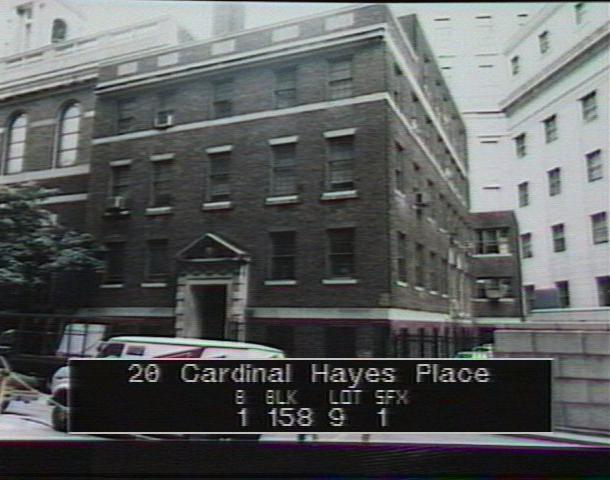
The city photographed every building for its tax records around 1940 and again in the 1980s. NYC Municipal Archives.
Written with AI from the source each entry cites, then fact-checked.
- 1842
A new Catholic parish moves into a former Universalist church on Duane Street
In 1842 the newly organized parish of St. Andrew settled into a church at the corner of Duane Street and City Hall Place, now Cardinal Hayes Place, near today's church. Built in 1808 as a Congregational church, the building passed to Methodists and then Universalists, and for some years it stored wine. The parish first worshipped in nearby Carroll Hall before taking over the old church.
Source: Daytonian in Manhattan
- 1875
The roof of St. Andrew's caves in on a packed congregation when a neighboring wall falls
On the stormy night of February 25, 1875, a standing-room crowd was hearing a guest priest preach on death when wind toppled the fire-damaged wall of the neighboring crockery dealer's building onto the church. The roof fell in over some 250 people in the east gallery, and a panicked rush for doors that opened inward left at least five people dead and dozens hurt. The disaster helped start a movement to make doors in public buildings open outward.
Source: Daytonian in Manhattan
- 1887
A court officer's funeral packs the church and closes streets, mixing politicians with the poor of Mulberry Bend
On December 13, 1887, the funeral of Jeremiah "Jere" Hartigan, an Irish-born court officer and former tavern keeper, was held at St. Andrew's. The crowd overflowed the steps and sidewalk, streets had to be closed, and mourners lined Duane Street nearly to Chatham. The Times noted well-dressed politicians standing shoulder to shoulder with the ragged poor of Mulberry Bend. As he lay dying, Hartigan had asked his sister to look after a poor family nearby.
Source: Daytonian in Manhattan
- 1900
A steeplejack dangles 150 feet up to replace the church's cross as crowds watch
On July 10, 1900, the old wooden cross on the steeple came down and a galvanized-tin one more than seven feet tall went up. A large crowd watched steeplejack George V. Wing, called the Wizard of the Steeple and brought in from Zanesville, Ohio, dangling from a boatswain's chair 150 feet up. Wing told reporters he would be looking for whiskey bottles, which he said builders often left behind in church steeples.
Source: Daytonian in Manhattan
- 1901
Park Row newspaper workers win a late-night service, earning St. Andrew's the name Printers' Church
In 1901 newspaper workers on nearby Park Row, whose night shifts kept them from Sunday services, petitioned Archbishop Corrigan for services they could attend after work. He approved them that May, and the church soon became known as the Printers' Church. At the Easter service in 1907, begun at 2:30 a.m., the church was crowded, and Father Evers read the night workers a cable from the Pope.
Source: Daytonian in Manhattan
- 1927
The pastor offers to give up his church so Cardinal Hayes's birthplace can become a shrine
In 1927 the city chose a courthouse site that took in the old tenement that was the birthplace of Cardinal Patrick Joseph Hayes, born in 1867. St. Andrew's pastor, Father Cashin, proposed trading the church, which stood across the street, for lots at 15 through 19 City Hall Place and 25 Duane Street so the birthplace could be kept as a shrine. He admitted he would rather have restored the old church, but feared it would look out of place among the new municipal buildings. A truce was reached on July 12, 1932.
Source: Daytonian in Manhattan
- 1939
The old church is torn down and the new St. Andrew's is dedicated on Cardinal Hayes Place
In January 1938 a wrecking crew took over the old Duane Street church, which the Times called the birthplace of the night workers' Mass. Its replacement, planned at $300,000 by Maginnis & Walsh of Boston with New York architect Robert J. Reiley, rose on the church's new site at No. 20 Cardinal Hayes Place. It was dedicated on November 30, 1939.
Source: Daytonian in Manhattan
- 1939
Maginnis & Walsh and Robert J. Reiley's Georgian Revival church replaces the old St. Andrew's
The present church was built in 1939 as a joint project of the Boston firm Maginnis & Walsh and New York architect Robert J. Reiley, in the Georgian Revival style. It is the only New York City church that Maginnis & Walsh designed. A Latin inscription over the entrance praises those who walk in the law of the Lord. The church stands near the Five Points slum and near the place where Cardinal Hayes was born.
“St. Andrew is the only New York City church to be designed by Maginnis & Walsh.”
Source: Wikipedia
Further reading
- St. Andrew Church (New York City)Wikipedia
Nearby
- Thurgood Marshall United States Courthouse40 Foley Square | 12 entries
- Metropolitan Correctional Center150 Park Row | 15 entries
- Municipal Building1 Centre Street | 11 entries
- New York County Courthouse60 Centre Street | 12 entries
- Daniel Patrick Moynihan U.S. Courthouse500 Pearl Street | 6 entries
- Municipal Building (David N. Dinkins Municipal Building)1 Centre Street | 6 entries