Metropolitan Correctional Center
150 Park Row | also 128 Park Row | Civic Center | built 1974
Open on the map15 entries

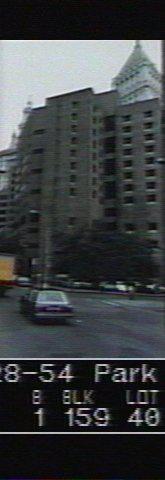
The city photographed every building for its tax records around 1940 and again in the 1980s. NYC Municipal Archives.
Written with AI from the source each entry cites, then fact-checked.
- 1975
The Metropolitan Correctional Center opens as the Bureau of Prisons' first high-rise facility
Opened in 1975, the Metropolitan Correctional Center was the first high-rise building the Federal Bureau of Prisons used. It acted as an extension of the courthouse at Foley Square, to which it was joined by a footbridge. Prisoners lived in ten self-contained housing units, which meant little movement within the building. Most of those held there had cases pending in the federal court for the Southern District of New York.
Source: Wikipedia
- 1975
Gruzen & Partners design a 12-story jail meant to blend in with office towers
The architecture firm Gruzen & Partners designed the 12-story building at a cost of $23 million. Its brutalist exterior of striated precast concrete has horizontal rows of windows, and the designers left out guard towers, barbed wire and chain-link fences so it would sit comfortably among the offices around it. Tunnels join it to the federal courthouse, and the west wing houses the U.S. Attorney's Office. It was built for about 480 inmates.
Source: nycurbanism.com
- 1986
Hells Angels member Chuck Zito spends fourteen months in the jail before taking a plea deal
Chuck Zito, a member of the Hells Angels, was held at the Metropolitan Correctional Center for fourteen months. In late 1986 he took a plea bargain with federal prosecutors and admitted one felony count of conspiracy involving drugs. He received a ten-year sentence.
Source: Wikipedia
- 2009
Bernie Madoff is sent to the jail after pleading guilty
After pleading guilty on March 12, 2009, Bernie Madoff was remanded to the Metropolitan Correctional Center by Judge Denny Chin, who found him a flight risk given his age, wealth and the prospect of life in prison. Since December 2008 he had been confined to his Upper East Side penthouse on $10 million bail. An appeals court refused his request for house arrest on March 20, and his sentencing was set for June 29.
Source: Wikipedia
- 2017
El Chapo is held in the jail's maximum-security wing after extradition from Mexico
Joaquin 'El Chapo' Guzman was extradited to the United States on January 19, 2017, and held in the maximum-security wing of the jail. The next day he pleaded not guilty to a 17-count indictment in federal court in New York. Judge Brian Cogan set the trial, and jury selection began on November 5, 2018. Guzman was found guilty on all counts on February 12, 2019, and sentenced on July 17 to life in prison plus 30 years.
Source: Wikipedia
- 2017
The jail holds 796 inmates in a building designed for 449
In 2017 the jail held 796 men and women, far above its design capacity of 449, and it was chronically understaffed. Each housing unit takes up two stories, and prisoners on the 10-South wing were kept in single cells for 23 hours a day under constant camera watch. Overcrowding had also been widely reported in 2002.
“In 2017, it had 796 inmates, both male and female, which is far more than its design capacity of 449.”
Source: Wikipedia
- 2019
Paul Manafort is moved to the jail from a Pennsylvania prison, then sent back two months later
Paul Manafort, who had been held at the federal prison in Loretto, Pennsylvania, was moved to the Metropolitan Correctional Center in June 2019. In August 2019 he was sent back to Loretto. On May 13, 2020, he was released to home confinement because of COVID-19 concerns.
Source: Wikipedia
- 2019
Jeffrey Epstein is jailed after his arrest and placed in the special housing unit
Jeffrey Epstein was arrested on July 6, 2019, on federal charges of sex trafficking and was held at the jail. The next day he was assigned a cell in the special housing unit, where inmates stay locked in about 23 hours a day, because of media coverage of his case and other inmates' awareness of his notoriety. On July 18 a court refused to set bail and ordered him held pending trial.
Source: oig.justice.gov
- 2019
Officers find Epstein with a cloth around his neck and put him on suicide watch
At 1:27 a.m. on July 23, 2019, correctional officers responded to Jeffrey Epstein's cell and found him with an orange cloth around his neck. His cellmate told them Epstein had tried to hang himself. Medical staff saw friction marks and reddening on his neck and knee and placed him on suicide watch, a status that was lifted the next day.
Source: oig.justice.gov
- 2019
The jail's video recording system fails less than two weeks before Epstein's death and stays broken
A malfunction of the jail's digital video recorder system on July 29, 2019, meant that only about half the cameras were being recorded, although live feeds kept running. Staff discovered the failure on August 8, but it was not repaired until after Epstein died. For August 9 and 10, only one camera covering the special housing unit's common area left recorded footage, and it did not show his cell door.
Source: oig.justice.gov
- 2019
A grand jury indicts two jail employees for falsifying records about checks on Epstein's unit
On November 19, 2019, a federal grand jury charged correctional officer Tova Noel and material handler Michael Thomas with conspiracy and falsifying records. The indictment said Noel skipped the required inmate counts on August 9 and both skipped counts and 30-minute rounds on August 10, then submitted paperwork saying otherwise. As a result the records suggested regular monitoring, although no one had checked on Epstein between about 10:40 p.m. and 6:30 a.m.
Source: oig.justice.gov
- 2019
Jeffrey Epstein dies after being found unresponsive in his cell while awaiting trial
Jeffrey Epstein was arrested on July 6, 2019, and held at the jail on sex trafficking charges. He was found injured in his cell on July 23, and he was placed on suicide watch for six days. On August 10 he was found unresponsive at 6:30 a.m. and pronounced dead at 6:39 a.m. at a nearby hospital. The medical examiner ruled his death a suicide. Guards had skipped required checks, and two were later charged with falsifying records.
Source: Wikipedia
- 2021
Charges against the two Epstein-unit employees are dismissed after deferred prosecution agreements
Federal prosecutors reached deferred prosecution agreements with Tova Noel and Michael Thomas on May 25, 2021. In them the two admitted falsely certifying that they had done inmate counts and rounds, and each agreed to 100 hours of community service. After they met the terms, the court dismissed all pending charges on December 13, 2021.
Source: oig.justice.gov
- 2021
The Bureau of Prisons announces the jail will close temporarily because of its condition
On August 26, 2021, the Bureau of Prisons announced it would temporarily close the center because of its deteriorating condition. The 233 prisoners then held there were moved to other prisons. The jail had long been crowded: in 2017 it held 796 people against a design capacity of 449. Well-known inmates over the years included John Gotti, Bernie Madoff, Ramzi Yousef, Viktor Bout and Joaquin Guzman.
Source: Wikipedia
- 2023
The Justice Department's inspector general blames staffing shortages and broken cameras for the jail's failures
A June 2023 report by the Justice Department's inspector general reviewed how the jail handled Epstein and found numerous failures, including skipped counts and rounds and falsified records. It tied them to long-standing problems of staffing shortages, managing inmates at suicide risk and unreliable security cameras. It found no evidence contradicting the FBI's conclusion that nothing criminal caused his death.
Source: oig.justice.gov
Further reading
Nearby
- Thurgood Marshall United States Courthouse40 Foley Square | 12 entries
- Daniel Patrick Moynihan U.S. Courthouse500 Pearl Street | 6 entries
- Church of St. Andrew20 Cardinal Hayes Place | 8 entries
- One Police Plaza1 Police Plaza | 14 entries
- New York County Courthouse60 Centre Street | 12 entries
- Chatham Towers170 Park Row | 5 entries