228 West 13th Street
West Village | built 1899
Open on the map4 entries

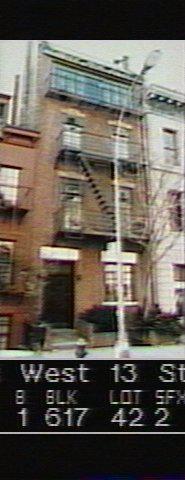
The city photographed every building for its tax records around 1940 and again in the 1980s. NYC Municipal Archives.
Written with AI from the source each entry cites, then fact-checked.
- 1847
Attorney Robert Jacques lives in the brick house then numbered 160 West 13th Street
By 1847 the lawyer Robert Jacques and his family were living in the brick house, then numbered 160 West 13th Street and renumbered 228 in 1868. A sale notice appeared in April 1855, and when it was advertised for rent in March 1870, at $1,300 a year, the notice promised all the modern improvements. The tenants who followed, among them a milliner, a carpenter and a clerk, each stayed only for a one-year lease.
Source: Daytonian in Manhattan
- 1900
Martin Metzener's house is advertised for auction six months after he buys it for $4,500
Martin A. Metzener bought the three-story brick house in November 1899 for $4,500. On May 15, 1900, auctioneer Peter F. Meyer ran a notice in the New York Times announcing the sale of the house and lot at auction. It was the start of a run of quick ownership changes that lasted into 1906.
Source: Daytonian in Manhattan
- 1906
The city cites the house for lacking a fire escape, marking it as a tenement
After J. J. Bush, who owned the house in 1905, sued the city for $65 over damage from a burst water main, he sold it to Alta H. Denam. On February 7, 1906, she received a violation for having no fire escape, which shows the city now classed the house as a tenement. She quickly sold it to Karl Shafer, who resold it that May.
Source: Daytonian in Manhattan
- 1926
The third floor is raised and a glass-faced artist's studio is added on top
In 1926, as Greenwich Village became Manhattan's artist colony, the owner raised the third floor to full height and added a fourth-floor studio faced in glass to catch northern light. The Early American style door with iron strap hinges probably dates from the same work. Casement windows and modernist fire escapes followed around mid-century, and the building holds nine apartments today.
Source: Daytonian in Manhattan
Further reading
- The Altered Robert Jacques House - 228 West 13th StreetDaytonian in Manhattan
- Then & Now photos: 228 West 13th StreetVillage Preservation: Greenwich Village Then & Now
Nearby
- Samuel Phillips House226 West 13th Street | 5 entries
- Panhard & Levassor Building230 West 13th Street | 5 entries
- 108 Greenwich Avenue2 entries
- 104 Greenwich Avenue1 entry
- 106 Greenwich Avenue5 entries
- Hiram and Linus Little House102 Greenwich Avenue | 5 entries