Andrew Freedman Home
1125 Grand Conc | also 1125 Grand Concourse | Concourse | built 1922
Open on the map9 entries

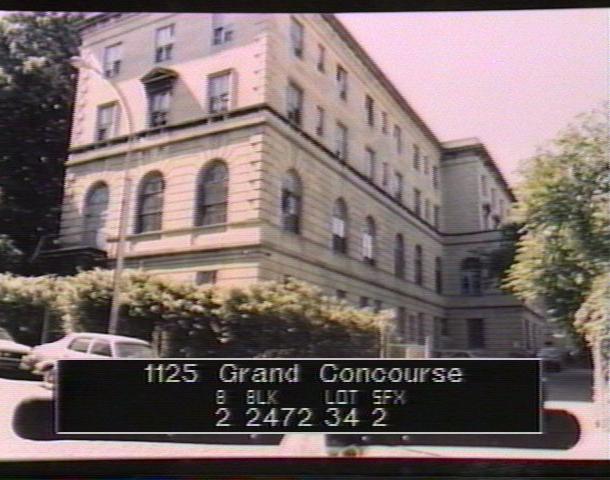
The city photographed every building for its tax records around 1940 and again in the 1980s. NYC Municipal Archives.
Written with AI from the source each entry cites, then fact-checked.
- 1915
Andrew Freedman's will leaves most of his fortune to a home for the once-rich
Several weeks after the death of the capitalist Andrew Freedman, his will was made public. Besides gifts to relatives and friends, including a pair of white pearl shirt buttons for Tammany boss Richard Croker, the bulk of the estate, about $5 million at first, went to found a free home for elderly people who had once been comfortable but had fallen into poverty, with married couples allowed to live together.
- 1917
The Freedman trustees buy a Grand Concourse block for the home
After a special act of the State Legislature incorporated the institution in 1916, the Andrew Freedman Home bought a whole block running from the Grand Concourse down to Walton Avenue, between East 166th and McClellan Streets, in 1917. World War I held up construction, which did not start until 1922. The board was led by lawyer Samuel Untermyer, Freedman's friend, partner and executor, who decided the home would admit mainly couples aged sixty to eighty.
- 1922
Freedlander and Jacobs model the home on Rome's Palazzo Farnese
Joseph H. Freedlander and Harry Allan Jacobs, both Beaux-Arts trained, designed the original section, built 1922-24. Their main model was the Palazzo Farnese in Rome, borrowed for the three-story massing, the thirteen-bay front and the alternating triangular and curved window pediments, while the entrance lamps follow one on the Palazzo Strozzi. Behind the Renaissance dress is a modern fireproof steel frame with concrete floors.
- 1924
The Andrew Freedman Home is dedicated on the Grand Concourse
The Italian Renaissance central pavilion was dedicated on May 25, 1924, with an announcement that two wings would follow. Speaking at the opening, Freedman's business associate DeLancey Nicoll recalled urging him toward unusual charities; Freedman had answered that the sick and the poor already had plenty of helpers, while nobody offered shelter to people who had lost their fortunes.
- 1924
Residents live as club "members" under house rules against tipping
The home was furnished by the decorating firm L. Alavoine & Co. with a Georgian living room, an oak-paneled library, rooms for cards and billiards, and a dining room decorated with chinoiserie. Residents were never called inmates, only "members," as in a club. In return for free room and board they could not tip or scold the staff, had to eat meals in the dining room, and could take up to four weeks of vacation a year.
“Among the rules were those that forbade tipping or reprimanding the employees, required all meals be taken in the dining room…”
- 1974
The landmarks commission approves the home, but the Board of Estimate denies it
The Landmarks Preservation Commission first took up the home in 1973, when three representatives of the institution spoke against designation. The commission approved it on November 26, 1974, but the Board of Estimate denied the designation. The case was reopened only after the Mid-Bronx Senior Citizens Council bought the building, with new hearings in 1984.
- 1983
Rising costs close the Andrew Freedman Home in 1983
Rising upkeep costs forced the Andrew Freedman Home to close in 1983. The building went to the Mid-Bronx Senior Citizens Council, a nonprofit that sponsors housing for older Bronx residents, whose director promised that Freedman's legacy would live on, now for residents from many walks of life. The building stood empty for a time but was again serving elderly residents by the time of its landmark designation report.
“The Andrew Freedman Home continued to serve its original function until 1983, when the increasing cost of maintaining the facility forced the home to close.”
- 2012
"This Side of Paradise" turns the old home into an art space
On April 4, 2012, the arts group No Longer Empty launched "This Side of Paradise," a show of photography, video and installations about the home's past and themes of immigration and memory, with work by photographer Sylvia Plachy and graffiti artist Daze. Director Walter Puryear then started an artist residency whose participants have included DJ Kool Herc, trading monthly community workshops for studio space.
Source: Wikipedia
- 2017
"State Property" examines prison labor in a three-venue show
In fall 2017 the Andrew Freedman Home joined BronxArtSpace and Swing Space for STATE PROPERTY, a multidisciplinary exhibition about American consumption of goods made by prison labor. Participants included Incarcerated Nation, Solitary Watch, Noté Peter George, Hank Willis Thomas and Julia Justo, among dozens of artists and organizations.
Source: Wikipedia
Further reading
- Andrew Freedman HomeWikipedia
Nearby
- Andrew Freedman Home1125 Grand Concourse | 1 entry
- The David Farragut1074 Walton Avenue | 2 entries
- Bronx Housing Court1118 Grand Conc | 2 entries
- Bronx Society for the Prevention of Cruelty to Children Building1130 Grand Conc | 3 entries
- 1100 Grand Concourse (The John Ericsson)1099 Carroll Place | 3 entries
- 1055 Grand Conc2 entries