Disco Fever
1218 Jerome Avenue | also 5 East 167th Street, 1 East 167th Street, 9 East 167th Street | Concourse | built 1937
Open on the map4 entries

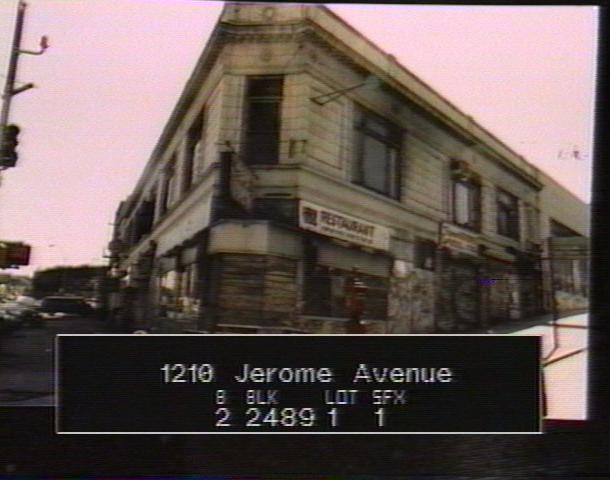
The city photographed every building for its tax records around 1940 and again in the 1980s. NYC Municipal Archives.
Written with AI from the source each entry cites, then fact-checked.
- 1976
Allie Abbatiello turns a neighborhood bar into the Disco Fever nightclub
Albert "Allie" Abbatiello, who already ran the Golden Hour and Pepper-n-Salt clubs in the Bronx, reworked an old bar here as his third nightclub, first aimed at an older crowd. His wife suggested the name after seeing a television ad. The room held 350, but in its early months a good night drew only about 200 people.
“It opened in 1976, but did not get popular quickly. The place could hold 350, but on a good night only about 200 would come through.”
Source: Wikipedia
- 1977
Grandmaster Flash plays Disco Fever's first Tuesday hip hop night for $50
Bartender Sal Abbatiello noticed night manager George "Sweet G" Godfrey working the crowd on the microphone and asked him for more acts like that; Godfrey took him to see Grandmaster Flash in a local park. At the first Tuesday show Flash earned $50 and his two MCs $25 each. With a $1 cover and a $1 drink minimum, the line ran out the door and the club took in $1,000.
Source: Wikipedia
- 1983
People magazine calls the Fever the rap capital of the Solar System
By then the club booked hip hop every night, and Grandmaster Flash had named it in "The Message" (1982). Writing in People in 1983, Bill Adler gave it its cosmic title. The Fever also served as a proving ground: Kurtis Blow came to hear what the street liked and signed his first deal with Sal Abbatiello's Fever Records, and Russell Simmons got his brother Joseph a turn on stage, which became Run-D.M.C.'s first paying gig.
“…in 1983 Bill Adler wrote in People magazine that it was "the rap capital of the Solar System…”
Source: Wikipedia
- 1985
Filming Krush Groove exposes Disco Fever's missing cabaret license
The 1985 film Krush Groove, with Run-D.M.C., the Beastie Boys, LL Cool J, Sheila E. and others, was shot at Disco Fever, and Sal Abbatiello played himself. While securing film permits, the producers found the club had never held a cabaret license. The community board turned Abbatiello down; he called it a technicality, pointing to his youth association and the club's fundraising for the United Negro College Fund, and he closed the club, which had run from 1976 to 1986.
“…the film producers discovered that Disco Fever had been operating from the beginning without the required cabaret license.”
Source: Wikipedia
Further reading
- Disco FeverWikipedia
Nearby
- Church of the Sacred Heart75 West 168th Street | 2 entries
- Andrew Freedman Home1125 Grand Conc | 9 entries
- Andrew Freedman Home1125 Grand Concourse | 1 entry
- 188 East 167th Street3 entries
- Noonan Plaza Apartments105 West 168th Street | 9 entries
- 1166 Grand Conc2 entries