1261 Madison Avenue
also 47 East 90th Street | Carnegie Hill | built 1901
Open on the map4 entries

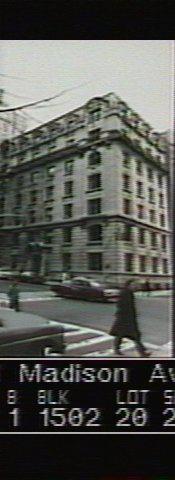
The city photographed every building for its tax records around 1940 and again in the 1980s. NYC Municipal Archives.
Written with AI from the source each entry cites, then fact-checked.
- 1900
Developer Gilbert Brown builds an apartment house for 14 families with a telephone in every flat
After Andrew Carnegie began his mansion in 1899, Gilbert Brown bought the corner lot at Madison Avenue and 90th Street and hired Buchman & Fox. Construction began in 1900 for 14 families, two apartments per floor. Brown advertised a telephone in each apartment, two elevators (one for servants and deliveries), steel safes, two baths, two maids' rooms and two refrigerators. East Side buildings like this went by their street address, not a name.
Source: Daytonian in Manhattan
- 1901
Buchman & Fox complete a seven-story Beaux-Arts apartment house with a broken-pediment entrance
The limestone building rises seven stories including a tiled mansard roof, on a heavily rusticated two-story base. Its Madison Avenue entrance sits under a broken pediment whose volutes frame the street number 1261, with a marble medallion above. The outer bays project slightly, with arched fifth-floor windows, and a wrought-iron balcony runs above the cornice. The commission calls it a restrained example of the style.
- 1950
The 16 resident families buy the building and turn it into a cooperative
George Kean bought the building from Bing & Bing in 1923. Robert W. Dowling's City Investing Company bought it in 1946, when Dowling also held the remaining buildings on the east side of Madison Avenue up to 91st Street. In 1950 Dowling sold it to the 1261 Madison Avenue Corporation, a cooperative formed by the 16 families who lived there.
Source: Wikipedia
- 1974
The Landmarks Commission designates the building in July 1974 after a hearing with one objector
The commission heard the case on June 25, 1974. Eight witnesses spoke in favor of designation and one spoke against. Its report calls the building a fine example of French Beaux-Arts style, an interesting example of a building type that became fashionable in the early 20th century, and a source of distinction for its block and the Carnegie Hill area.
“Eight witnesses spoke in favor of designation. There was one speaker in opposition to designation.”
Further reading
- 1261 Madison AvenueWikipedia
Nearby
- Spence School22 East 91st Street | 6 entries
- St. Thomas More Church59 East 89th Street | 8 entries
- John Henry Hammond House9 East 91st Street | 15 entries
- Cooper Hewitt, Smithsonian Design Museum (Carnegie Mansion)2 East 91st Street | 13 entries
- Nightingale-Bamford School20 East 92nd Street | 5 entries
- James A. Burden House7 East 91st Street | 8 entries