John Henry Hammond House
9 East 91st Street | Carnegie Hill | built 1903
Open on the map15 entries

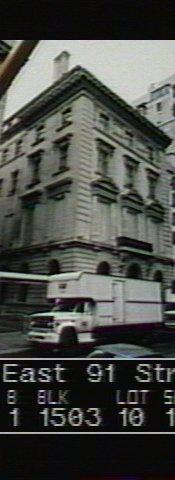
The city photographed every building for its tax records around 1940 and again in the 1980s. NYC Municipal Archives.
Written with AI from the source each entry cites, then fact-checked.
- 1899
John Hammond bristles at his father-in-law's offer of a house, saying he will not be a kept man
When W. & J. Sloane furniture heir William D. Sloane approved his daughter Emily's engagement to John Henry Hammond, he said he would give the couple a new home. Hammond's pride was stung, and he declared he would not be a kept man. He took the gift anyway. Sloane bought the lot at 9 East 91st Street from Andrew Carnegie and hired Carrère & Hastings to design the house.
Source: Daytonian in Manhattan
- 1903
Carrère & Hastings finish a palazzo-style mansion with a ballroom and a squash court
Finished in 1903, the house was modeled on Italian palazzi and furnished with Louis XVI-style pieces from the Sloane firm. It had two elevators, a 50-by-28-foot ballroom, an Elizabethan-style library, and a second-floor suite that held 300 guests at Mrs. Hammond's musicales. The five children used the fifth-floor squash court more for roller skating, and the basement kitchen was so far from the dining room that one daughter recalled her father never had a hot meal.
Source: Daytonian in Manhattan
- 1918
Young John Hammond hears jazz from the servants' bedrooms before Benny Goodman plays the house
John Henry Hammond Jr., born in 1910, grew up in the house and knew jazz by about age eight, partly because it drifted from the servants' bedrooms. The house regularly hosted concerts for 300 guests, and jazz musicians visited, among them Benny Goodman, who later became the husband of Alice, John Jr.'s sister. John Jr. and his sister Emily also played concerts for guests.
Source: Wikipedia
- 1946
Eye surgeon Ramón Castroviejo buys the mansion and runs an eye hospital on its top floors
The Hammonds sold the house in May 1946 to the ophthalmologist Ramón Castroviejo, who lived and kept his office there. His eye hospital filled the top two floors, where he sometimes operated on Cuban citizens who were otherwise barred from entering the United States. He also threw large parties for guests including the actress Hermione Gingold and the soprano Victoria de los Ángeles.
“He operated an eye hospital on the top two floors, where he sometimes performed eye surgery on Cuban citizens…”
Source: Wikipedia
- 1974
The Landmarks Commission designates the house in July 1974 over the owner's opposition
The commission heard the case on June 25, 1974, after an earlier hearing in 1970. Seven witnesses backed designation and two spoke against it, including the owner's representative. The report calls the house a High Renaissance design inspired by Roman palazzi, and notes that Emily Hammond, an heiress to both the Sloane and Vanderbilt fortunes, gave much of her time to philanthropy, including restoring the Theodore Roosevelt House on East 20th Street.
“Seven witnesses spoke in favor of designation. There were two speakers in opposition to designation including the representative of the owner.”
- 1975
The Soviet Union buys the mansion for $1.6 million but cannot open its consulate there
The Soviets bought the house in 1975, a year after the two countries agreed to open consulates. William Gleckman modernized the wiring, added air-conditioning and a theater, and gated the courtyard. The consulate could not open until a matching American consulate in Kiev did. After the Soviet move into Afghanistan in December 1979, President Carter froze the program, and the house sat shuttered behind metal shutters for about 13 years.
Source: Daytonian in Manhattan
- 1975
Soviet talks to buy the mansion surprise the nuns next door
In July 1975 the Soviet government confirmed it was negotiating to buy the mansion, which Dr. Ramon Castroviejo had vacated in April, and to open a consulate there. Some of the Sacred Heart nuns next door were caught off guard. One spokeswoman reacted with an emphatic blessing on everyone, then said she welcomed the Russians because the street would be more secure.
Source: Internet Archive
- 1976
A Soviet consul-designate falls for the house and it is fitted with a theater and a metal gate
Architect William Gleckman remodeled the house for the Soviets, adding new electrical service, a theater, air-conditioning and a huge metal gate across the courtyard. He recalled that the consul-designate, Mr. Myshkov, loved classical buildings and loved this one, since it reminded him of imperial architecture in Russia. The work was finished about a year after the purchase.
Source: Internet Archive
- 1980
Neighbors on East 91st Street say goodbye to the Soviet consular staff
As the Soviet consular aides left in January 1980, neighbors told The New York Times they were sorry to see them go. The Soviets had bought the mansion in 1975 as their first consulate in the city in over three decades, and had won special permission to add a high wrought-iron fence and closed-circuit cameras watching the street.
Source: Internet Archive
- 1982
The NYPD finds that a fictitious Inspector Whitmore had tricked it into guarding the empty consulate
After 17 Soviet diplomats were expelled, police guarded the house around the clock until October 1980. That December the guard was restored after the 23rd Precinct got a call from a supposed Inspector Whitmore. In May 1982 a Soviet van was robbed nearby and the intelligence division said it knew of no police booth there. Officials then found that Whitmore did not exist, canceled the guard and took the booth apart.
Source: Wikipedia
- 1990
The Times's Streetscapes column calls the shuttered palazzo Manhattan's chief mystery house
By 1990 the mansion had stood vacant for years, dark and moody behind heavy metal shutters, like a mothballed ocean liner. Neighbors at the Convent of the Sacred Heart complained that the Soviets never plowed their snow, though they had been good neighbors while in residence. A Soviet spokesman said only that something would eventually happen to the building.
Source: Internet Archive
- 1992
Russia's consul general finds a pond in the basement after twelve years of neglect
When Russian diplomats returned to the house in 1992, consul general Ivan Kuznetsov was astonished by what a dozen years of abandonment had done. Roof leaks had left a pond in the basement, floorboards squeaked, and the plumbing, heating and elevators were dead. Paint peeled from the 18-foot walls, and the second-floor public rooms were in ruins.
Source: Internet Archive
- 1994
Random House publisher Harold Evans rallies donors to restore the decayed mansion for the Russian consulate
When Russian consul general Ivan Kuznetsov first reopened the house in 1992, he found it in a bad state, with water in the walls and failed plumbing. Sixteen Moscow artisans worked in shifts of nine to ten months, sleeping on the top floor. Random House's Harold Evans, who made the job a pet project, persuaded American firms to donate time and materials, and the designers Stanley Barrows, Mario Buatta and Albert Hadley took part.
Source: Daytonian in Manhattan
- 1994
Moscow workmen restore the mansion to Sinatra and trail a designer with an office chair
During the restoration, Russian workmen labored from 8 a.m. to 6 p.m. under foreman Vladimir Yakimchuk, played Frank Sinatra, and painted Russian winter scenes in a bedroom where John Henry Hammond once practiced his golf swing. Designer Stanley Barrows, 80, spoke through a translator and once made them redo the ballroom gilding, while the men followed him with an office chair so he could rest.
Source: Internet Archive
- 2022
Red paint is splashed across the consulate's facade hours before Putin's annexation speech
At about 1:30 a.m. on September 30, 2022, police were called to the Russian consulate on East 91st Street, where streaks of red paint covered the ground-floor windows and a set of double doors. No words were visible. The vandalism came hours before Vladimir Putin spoke about annexing four regions of Ukraine, and the consulate canceled the day's appointments.
Source: Internet Archive
Further reading
- John Henry Hammond HouseWikipedia
Nearby
- Nightingale-Bamford School20 East 92nd Street | 5 entries
- James A. Burden House7 East 91st Street | 8 entries
- Otto Kahn House1100 5th Avenue | 12 entries
- Spence School22 East 91st Street | 6 entries
- Cooper Hewitt, Smithsonian Design Museum (Carnegie Mansion)2 East 91st Street | 13 entries
- The Jewish Museum (Warburg Mansion)1109 5th Avenue | 11 entries