St. George's Episcopal Church
135-33 39th Avenue | also 135-32 38th Avenue | Willets Point | built 1907
Open on the map9 entries

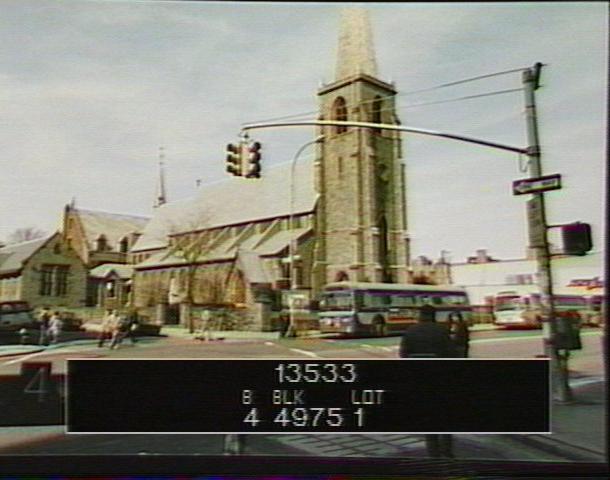
The city photographed every building for its tax records around 1940 and again in the 1980s. NYC Municipal Archives.
Written with AI from the source each entry cites, then fact-checked.
- 1746
Capt. Hugh Wentworth gives land for Flushing's first Anglican church and graveyard
Around 1746 Capt. Hugh Wentworth, a West India trade merchant, donated a half-acre of his Flushing farm for an Anglican church and burial ground beside the road to Jamaica, today's Main Street. The small frame church built there, an earlier building on this site, was soon named St. George's. Before it, Rev. William Urquhart had held Church of England services in Flushing's Guard House from 1704.
“Capt. Hugh Wentworth, a merchant in the West India trade, donated a half-acre tract from his farm in Flushing for the construction of an Anglican church…”
- 1761
Under Samuel Seabury, St. George's is incorporated by a royal charter from George III
In 1761, while Samuel Seabury led it, the church was formally incorporated under a Royal Charter from King George III. Seabury would go on to serve as the Episcopal Church's first American bishop. In 1797 Trinity Church in Manhattan gave the churches of Flushing, Newtown and Jamaica $1,250 apiece so that each could become a separate parish with its own minister.
“In 1761, under the leadership of Samuel Seabury, who later became the first bishop of the Episcopal Church in America, the church was officially incorporated under a Royal Charter…”
- 1765
Declaration signer Francis Lewis begins 25 years as a warden of St. George's
Francis Lewis, who signed the Declaration of Independence, served as a warden of St. George's from 1765 to 1790, and his son, Francis Lewis Jr., held the same post from 1791 to 1794. Once the Revolution was over, the parish prayer book's petition for the king was covered with one for the president.
“Francis Lewis, a signer of the Declaration of Independence, was a Warden at St. George's Church, 1765–1790…”
Source: Wikipedia
- 1847
Rev. John Carpenter Smith begins a fifty-year tenure as rector
In 1847 the vestry named Rev. John Carpenter Smith (1817-1901), formerly minister of Trinity Church in the Rockaways, as rector, ending a string of short stays by young clergy. Over fifty years he grew the parish from about 140 communicants to 770 and opened chapels in Bayside, Whitestone, College Point and Flushing's Murray Hill section; Bayside and Whitestone later became parishes of their own.
- 1854
Wills & Dudley's Gothic Revival church is consecrated on Main Street
The congregation hired Wills & Dudley, leaders of the ecclesiological Gothic Revival, and chose their design with a tower and spire centered on the front. The cornerstone was set on May 18, 1853, and consecration followed on June 1, 1854, with a final cost of $32,222.80, nearly double the first estimate. The old 1820s frame church was moved to 38th Street and later used as a Sunday school.
“The cornerstone for the new church was laid on May 18, 1853 and the church was completed a year late at a cost of $32,222.80…”
- 1894
J. King James's new chancel is consecrated, with a window by Heaton, Butler & Bayne
Demolition for a larger chancel began on May 24, 1894, and building started on June 21, with architect J. King James preparing the drawings and supervising the work himself. Built of granite and brownstone in the Gothic Revival style to match the 1850s church, the chancel was consecrated on December 9. Its large traceried rear window is by the English stained-glass firm Heaton, Butler & Bayne.
- 1907
Charles C. Haight's Gothic parish house rises on 39th Avenue
In June 1906 the vestry put off a planned auditorium but went ahead with a parish house on 39th Avenue, then Church Street, by Charles C. Haight, architect of the Trinity Church Corporation. Built in 1907-08 of the same granite as the church, it had club rooms for the Boys' Club and a shower on its lower level, and three rooms and a kitchen upstairs, the largest a 20-by-30-foot guild room.
“Erected in 1907-08, the Old Parish House is constructed of the sam! granite as the church…”
- 1996
The bishop blocks the parish's choice of Rev. Franco Kwan as rector
St. George's hired Rev. Dr. Franco Kwan in 1988 to reach Flushing's growing Asian community and serve as vicar to its Chinese-speaking members. In October 1996 the vestry tried to make him permanent rector, but Bishop Orris G. Walker Jr. of the Episcopal Diocese of Long Island rejected him. Three diocesan clergy and twenty parishioners filed a canon-law complaint against Walker; a panel of bishops ruled for the bishop.
“Fr. Kwan's appointment, however, was rejected by the Rt. Rev. Orris G. Walker, Jr., Bishop of the Episcopal Diocese of Long Island.”
Source: Wikipedia
- 2010
A microburst topples the steeple onto two city buses on Main Street
During the microburst that tore across Brooklyn and Queens on September 16, 2010, the church's 45-foot wooden steeple fell onto two city buses that were parked along Main Street. No one knows whether winds of over 100 miles per hour or a reported lightning strike brought it down. The steeple was rebuilt in 2013.
“…destroyed the church's 45-foot wooden steeple which crashed down on top of two New York City buses parked on Main Street…”
Source: Wikipedia
Further reading
- St. George's Church (Queens)Wikipedia
Nearby
- Flushing Quaker Meeting House137-16 Northern Boulevard | 7 entries
- Flushing Armory137-58 Northern Boulevard | 2 entries
- Flushing Town Hall137-35 Northern Boulevard | 7 entries
- Mann house, Free Synagogue of Flushing136-23 Sanford Avenue | 4 entries
- Flushing Post Office41-65 Main Street | 2 entries
- Bowne House37-01 Bowne Street | 5 entries